
Sun Country Airlines’ First Quarter: Steady Earnings Stewardship Ahead of Merger Closure
Sun Country reported solid Q1 results with positive net income and a liquidity position that supports operational stability as it readies for an imminent merger with Allegiant.
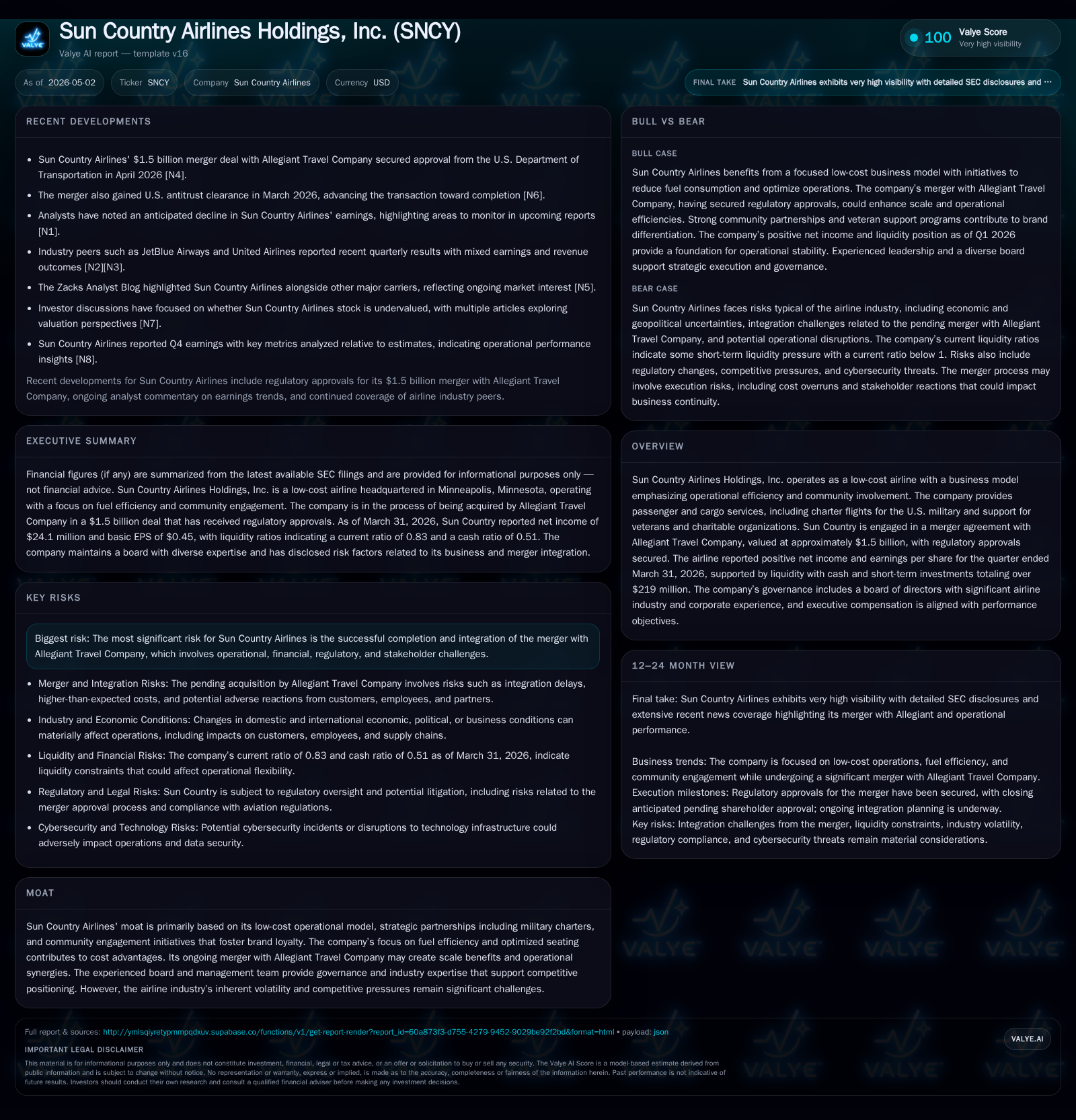
The airline posted $52.8 million in net income for the first quarter ended March 31, 2026, supported by cash and equivalents of approximately $154 million and manageable net debt nearing $156 million as of quarter-end [F1][S2]. Sun Country’s business model centers on low-cost operations complemented by diversified revenue from passenger flights, cargo, and military charters [S1]. The ongoing merger with Allegiant has cleared key regulatory hurdles and promises scale synergies but raises integration risks [S3][N4]. While Sun Country holds competitive strengths in fuel efficiency and community engagement, the airline's liquidity ratio under 1.0 signals some near-term financial caution [F1]. Monitoring merger execution milestones will be crucial to assessing the company’s next chapter [S3].
Latest Quarterly Operating Performance: A Profitable Start to 2026
Sun Country Airlines reported a $52.8 million net income for the quarter ended March 31, 2026, marking a continuation of profitability into the new year amidst ongoing sector challenges such as fluctuating fuel costs and demand variability [F1][S2]. The airline's liquidity reflects cash and equivalents totaling approximately $153.7 million against total debt near $309.6 million, leaving net debt around $155.9 million as of quarter-end [F1].
Operating income remains supportive of earnings trends seen through fiscal year-end December 31, 2025, where operating income was reported at over $100 million [F1]. The Q1 results signal disciplined earnings stewardship ahead of integration complexities anticipated with the pending Allegiant merger.
Business Model Overview: Low-Cost Focus and Tactical Diversification
Sun Country Airlines’ business model is rooted in low-cost carrier principles that stress lean operations enhanced by tactical diversification. The airline generates revenue primarily through passenger services on scheduled leisure routes focused on secondary airports—a niche that facilitates lower fees and less congested terminals compared to legacy carriers [S1].
Beyond passenger capacity sales, ancillary revenues form an important part of the mix: cargo transportation services augment revenue streams by utilizing spare aircraft capacity efficiently, while military charter contracts provide stable cash flow anchored in government demand cycles [S1]. This charter segment also reinforces relations with veteran and charitable organizations enhancing public goodwill—the latter acting as a non-price switching cost that builds brand loyalty in communities served.
Fuel efficiency initiatives and optimized seating density contribute materially to Sun Country’s cost control advantage. With fleet modernization aligning with operational needs, management targets sustainable unit costs below industry averages—aligning both pricing power durability and margin resilience ahead of competitive pressures.
Competitive Positioning within U.S. Regional and Low-Cost Airlines
Sun Country occupies a strategic weight within U.S. leisure-oriented low-cost carriers (LCCs), largely competing alongside firms like Allegiant (pre-merger), JetBlue Airways, and Southwest Airlines although focusing more explicitly on niche routes linking smaller secondary markets to select leisure destinations [S1][N2][N3].
Its competitive moat derives from its efficient cost base driven by fuel optimization technology adoption and dense seating configurations that maximize available revenue per flight leg.
Complementing this is its community-based branding strategy centered on veterans' support programs and other local partnerships which foster repeat customer loyalty uncommon among comparable low-cost peers.
However, competition remains intense as larger LCCs expand their networks aggressively; differentiation hinges increasingly on seamless scheduling, ancillary product offerings (e.g., baggage fees, onboard sales), and digital distribution capabilities—areas undergoing constant evolution under management oversight.
Growth Drivers: Merger Synergies, Network Expansion, and Ancillary Revenues
The announcement on January 11, 2026 of a planned merger between Sun Country and Allegiant Travel Company—the deal valued at approximately $1.5 billion—marks a pivotal growth vector for Sun Country [S3][N4]. Regulatory approval milestones were achieved early in Q2 2026 including the U.S. Department of Transportation granting interim exemptions facilitating merger progression [N4][S3].
This transaction expects to unlock economies of scale across combined fleets totaling roughly double Sun Country’s standalone capacity by harmonizing overlapping functions such as marketing, fleet maintenance procurement, scheduling systems, and leveraging joint purchasing power for fuel hedges.
Integration efforts target operational synergies translating into cost savings that may improve combined adjusted earnings margins if deployment timelines are met timely.
In parallel to merger-enabled scale growth, Sun Country sustains internal paths through network expansion targeting promising leisure destinations underserved by legacy carriers while also enhancing ancillary services including digital booking platforms and loyalty programs—all aimed at extracting higher yield per passenger without sacrificing core low-fare appeal.
Risks and Headwinds: Merger Execution, Industry Volatility, and Liquidity Concerns
While the executed regulatory approvals clear key procedural hurdles for the merger closure anticipated imminently in mid-2026,[S3] risks associated with integration execution remain substantial, spanning culture assimilation challenges between two distinct corporate entities to more practical issues like aligning IT systems or fleet standardization timelines.
Industry-wide risks persist due to cyclicality inherent in air travel demand sensitivity to geopolitical events, macroeconomic shifts impacting discretionary consumer travel spending, and volatile jet fuel prices which can rapidly erode narrow low-cost margins despite hedging strategies.
On liquidity front lines reflected in Q1 financials, working capital dynamics indicate current assets of approximately $355 million against current liabilities near $430 million, resulting in a current ratio of 0.83 as of March 31, 2026 [F1].
Lastly remaining risk considerations call attention to absence of material changes from previously disclosed risk factors according to quarterly filings indicating stable but unmitigated exposure ambiance otherwise observed since the FY2025 Annual Report disclosure timeframe [S2].
Near-Term Catalysts and Monitoring Milestones
The principal near-term catalyst remains the successful closing of the Allegiant-Sun Country merger now looming after all regulatory conditions were satisfied including Hart-Scott-Rodino clearance termination in early March followed by DOT interim exemption granted mid-April 2026 [S3][N4].
Subsequent phases warrant careful observation such as initial post-merger synergy realization reports expected during the first full quarter after consolidation; these will reflect how well cost-reduction initiatives integrate fleet management or administrative overheads.
Additional milestone focal points include announcements regarding expanded network reach possibly leveraging Allegiant’s existing markets synergistically paired with Sun Country’s roster plus updates concerning digital platforms or loyalty program enhancements which may increasingly underpin revenue diversification thus cushioning cyclical passenger fluctuations.
Finally market feedback loops via forthcoming quarterly earnings guidance revisions or volume-pricing trend disclosures by management represent critical barometers offering real-time navigation cues about merged entity operational health trajectory going forward [N5][S3].
Financial Snapshot: Balance Sheet Strength Amid Integration
Latest financial snapshot
| Metric | Value | Period |
|---|---|---|
| Cash & equivalents | $154mm | |
| 2026-03-31 | ||
| Total debt | $310mm | |
| 2026-03-31 | ||
| Net debt | $156mm | |
| 2026-03-31 | ||
| Current assets | $355mm | |
| 2026-03-31 | ||
| Current liabilities | $430mm | |
| 2026-03-31 | ||
| Current ratio | 0.83x | |
| 2026-03-31 |
Source: SEC companyfacts cache [F1].
| Metric | Value (USD) |
|---|---|
| Cash & Equivalents | 153,729,000 |
| Total Debt | 309,635,000 |
| Net Debt | 155,906,000 |
| Current Assets | 355,436,000 |
| Current Liabilities | 429,793,000 |
| Current Ratio | 0.83 |
This snapshot as of March 31, 2026 underscores a cash position supportive of ongoing operations alongside moderate net leverage reflecting industry norms albeit tempered by working capital tension indicated by sub-1 current ratio foundationally relevant during integration phases[F1][S2].
Disclaimer: This analysis is based solely on publicly available information up to May 2026 including recent SEC filings; it does not constitute investment advice or recommendations.
Disclaimer: This is research-only, informational analysis and not investment advice. It may include AI-generated interpretation and general industry context. Always verify important details using primary sources.

Comments