
GrafTech’s Q1 2026 Loss Highlights Cyclical Pressure in Graphite Electrode Markets
GrafTech International reports a net loss amid weak electrode pricing and EAF steel demand, underscoring sector volatility and its vertical integration strengths.
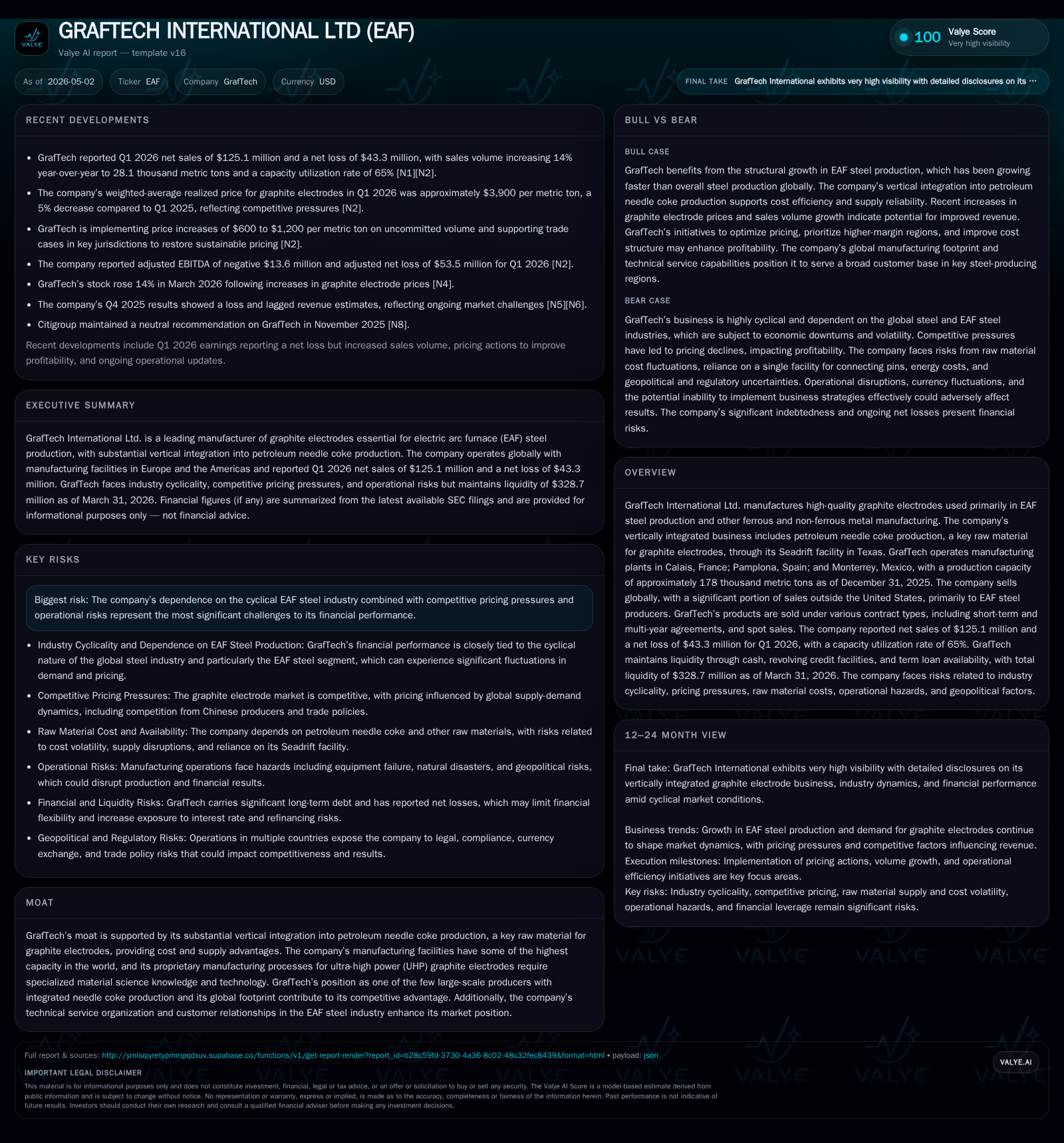
In its first quarter of 2026, GrafTech International Ltd. faced a net loss of $43.3 million despite revenue topping estimates, reflecting ongoing softness in graphite electrode prices and subdued EAF steel production demand. The company’s unique vertical integration into needle coke production remains a strategic moat, granting material cost and supply advantages amid competitive pressures. With global capacity utilization constrained by soft market conditions, GrafTech’s growth prospects hinge on the structural expansion of electric arc furnace steelmaking and the company’s ability to manage cyclicality through pricing discipline and operational efficiency.
Recent Operating Update: Q1 2026 Results Reflect Market Challenges
GrafTech International Ltd.'s latest quarterly filing as of May 1, 2026, reveals continuing headwinds in its core graphite electrode business. The company reported net sales of $125.1 million but incurred a net loss of $43.3 million for the three-month period ended March 31, 2026 [S2][N2]. This outcome signals persistent softness in graphite electrode pricing driven by subdued demand from the electric arc furnace (EAF) steel sector combined with excess industry capacity globally.
Spot prices for graphite electrodes have been under pressure since their peak in 2018 when tight needle coke supply coincided with robust growth in EAF steel production. However, beginning in 2023 and persisting through 2025 into early 2026, the commercial environment has softened with spot prices declining to about $4,100 per metric ton on a weighted-average basis by the end of last year [S1]. GrafTech's filings emphasize that depressed spot prices have adversely impacted results throughout this period [S1][S2].
Capacity utilization at GrafTech’s three primary manufacturing sites—Calais (France), Pamplona (Spain), and Monterrey (Mexico)—has softened accordingly but benefits remain from integrated upstream petroleum needle coke production at their Seadrift facility in Texas. This vertical integration strategy is pivotal as it provides cost and supply chain advantages against competitors reliant on external needle coke purchases [S1][S2].
Recent event filings reinforce that these dynamics remain front and center for management as the company grapples with cyclical weakness while pursuing operational efficiency improvements [S3].
Business Model: Vertically Integrated Supplier to Growing EAF Steel Industry
GrafTech’s business model is anchored on manufacturing high-quality ultra-high power (UHP) graphite electrodes — a critical consumable input for EAF steelmakers worldwide [S1]. Electrodes act as electric conductors generating heat needed to melt scrap metal or alternative iron feedstocks such as direct reduced iron (DRI). Though electrodes represent less than 2% of total steel production cost at an EAF site, their reliability and performance are essential to furnace productivity.
Revenue is driven by sales volume (tons of electrodes sold), weighted-average realized prices per metric ton, product mix between standard high-power versus UHP electrodes, and contract types ranging from short-term spot sales to multi-year agreements [S1][S2]. Operating margins hinge on raw material costs—primarily petroleum needle coke—and manufacturing efficiencies.
Where GrafTech distinguishes itself is via substantial vertical integration encompassing needle coke production—a scarce raw material derived from petroleum refining residue—at its Seadrift plant [S1]. This not only insulates supply but also contains costs amid volatile commodity cycles. Proprietary materials science expertise governing UHP electrode manufacturing processes further supports differentiation in durability and electrical conductivity metrics compared to commoditized alternatives.
Customer concentration lies heavily within the global mini-mill segment of the steel industry using EAF technology. Demand correlates closely to steel scrap availability economics and replacement of basic oxygen furnace (BOF) capacity with EAF plants internationally—a structural trend given EAF’s lower emissions profile.
Industry Structure and Competitive Position
The global graphite electrode market is oligopolistic with few large-scale producers owing to high capital intensity, complex technology requirements for UHP products, and limited suitable geographic locations for raw materials sourcing [S1]. GrafTech ranks among the largest vertically integrated manufacturers globally.
Its competitors include major players operating both integrated and non-integrated models; however, GrafTech’s unique upstream control over needle coke sets it apart in managing raw material cost volatility—a critical factor given needle coke can comprise a substantial portion of finished electrode cost.
Manufacturing facilities at Calais, Pamplona, and Monterrey boast some of the highest capacities worldwide (~178 thousand MT combined as of December 31, 2025) alongside advanced continuous-process capabilities enabling improved product quality consistency [S1][S2]. A former U.S. plant at St. Marys was idled in 2024 reflecting rationalization amid oversupply conditions.
Globally diversified operations support access to major markets across Europe, North America, Latin America, and Asia-Pacific. Customer relationships are longstanding with leading mini-mills requiring stable supply chains backed by technical service support—including furnace optimization consulting—which contributes to switching costs favoring incumbent suppliers like GrafTech.
Growth Drivers
Industry fundamentals suggest several long-term growth catalysts:
Structural Shift Toward EAF Steelmaking: With environmental pressures tightening on carbon emissions from traditional BOF methods using blast furnaces fueled by coking coal, steelmakers are accelerating adoption of electric arc furnaces powered largely by recycled scrap or DRI inputs. GrafTech estimates uranium UHP graphite electrode demand could grow approximately at a compound annual growth rate (CAGR) near 3% through 2030 outside China markets considering announced greenfield expansions plus productivity improvements at existing sites [S1].
Increasing Use of Alternative Iron Sources: Growth in scrap shortages or price volatility incentivizes substitution toward DRI or hot briquetted iron (HBI), which also rely heavily on EAF technology involving UHP electrodes for smelting.
Innovation in Electrode Quality & Durability: Advances enabling longer electrode life per production cycle improve user furnace uptime and reduce consumption rates potentially enhancing customer value propositions.
Contractual Mix Optimizations: Shifting toward longer-term contracts may stabilize revenue streams amidst cyclical fluctuations.
However, growth realization depends on global economic conditions influencing steel demand across automotive, construction machinery, appliance sectors that ultimately govern downstream consumption trends.
Risks and Watchpoints
GrafTech faces noteworthy risks including:
Industry Cyclicality: Demand for graphite electrodes directly tracks highly cyclical steel production cycles prone to macroeconomic shocks such as recessions or trade disruptions causing sharp volume declines impacting sales realization.
Price Volatility: Graphite electrode prices have historically swung widely based on supply-demand imbalances compounded by petroleum needle coke cost dynamics since that chemical feedstock dominates raw material costs.
Competition & Market Share Risks: Emergence of lower-cost producers or technology substitutes could erode pricing power or share particularly if needle coke supplies tighten for integrated producers.
Operational Risks: Manufacturing reliability challenges or regulatory issues related to environmental compliance or labor disputes could disrupt output or inflate costs.
Supply Chain Dependencies: While vertical integration mitigates some procurement risks for needle coke inputs internally at Seadrift facility there remains exposure to feedstock quality variations or logistics interruptions especially for export markets.
What To Watch Next
Key indicators offering insight into near-term trajectory:
Capacity Utilization Rates: Trends will reveal whether demand softening continues or firms begin recovering supporting margin improvements.
Graphite Electrode Spot & Contract Prices: Tracking spread changes vis-à-vis petroleum needle coke will signal competitive positioning strength.
Backlog & Order Book Composition: Changes between spot versus multi-year contracts indicate customer confidence levels.
Customer End-Market Demand Trends: Updates from major mini-mills regarding scrap availability or incremental furnace buildouts provide volume cues.
Management commentary from forthcoming quarterly disclosures may highlight any initiatives around cost structure optimization or new product launch progress enhancing competitive barriers further.
Financial Profile Contextualized Against Operations
Latest financial snapshot
| Metric | Value | Period |
|---|---|---|
| Total debt | $1125mm | |
| 2025-12-31 | ||
| Net debt | $1004mm | |
| 2025-12-31 | ||
| Current assets | $485mm | |
| 2025-12-31 | ||
| Current liabilities | $128mm | |
| 2025-12-31 | ||
| Current ratio | 3.78x | |
| 2025-12-31 |
Source: SEC companyfacts cache [F1].
As of year-end December 31, 2025 data supported by companyfacts snapshot indicate: total debt stands near $1.125 billion while cash balances were approximately $121 million as of mid-2024 resulting in estimated net debt just over $1 billion.[F1] Despite holding leverage typical for capital intensive industrials focused on commodity-related materials production, GrafTech maintains liquidity flexibility with a strong current ratio near 3.8 reflecting solid short-term asset coverage relative to liabilities.[F1]
Operating income was negative in recent periods reflecting market pressures causing earnings deterioration.[F1] Continued losses underscore sensitivity to cyclicality despite operating scale advantages but emphasize need for efficient working capital management alongside sustained progress integrating vertical capabilities fully.[F1]
Overall financial metrics corroborate caution around liquidity resilience amidst ongoing pricing pressure but do not currently suggest acute distress given ample current asset buffers.[F1]
This analysis synthesizes publicly available SEC filings as primary sources augmented with recent earnings transcripts. It interprets operating context without providing investment recommendations or price forecasts.
Disclaimer: This is research-only, informational analysis and not investment advice. It may include AI-generated interpretation and general industry context. Always verify important details using primary sources.

Comments