
Camden Property Trust Elevates Portfolio Quality with Strategic Dispositions and Acquisitions in Q1 2026
Q1 operating results highlight disciplined capital deployment and robust leasing dynamics supporting Camden’s multifamily platform.
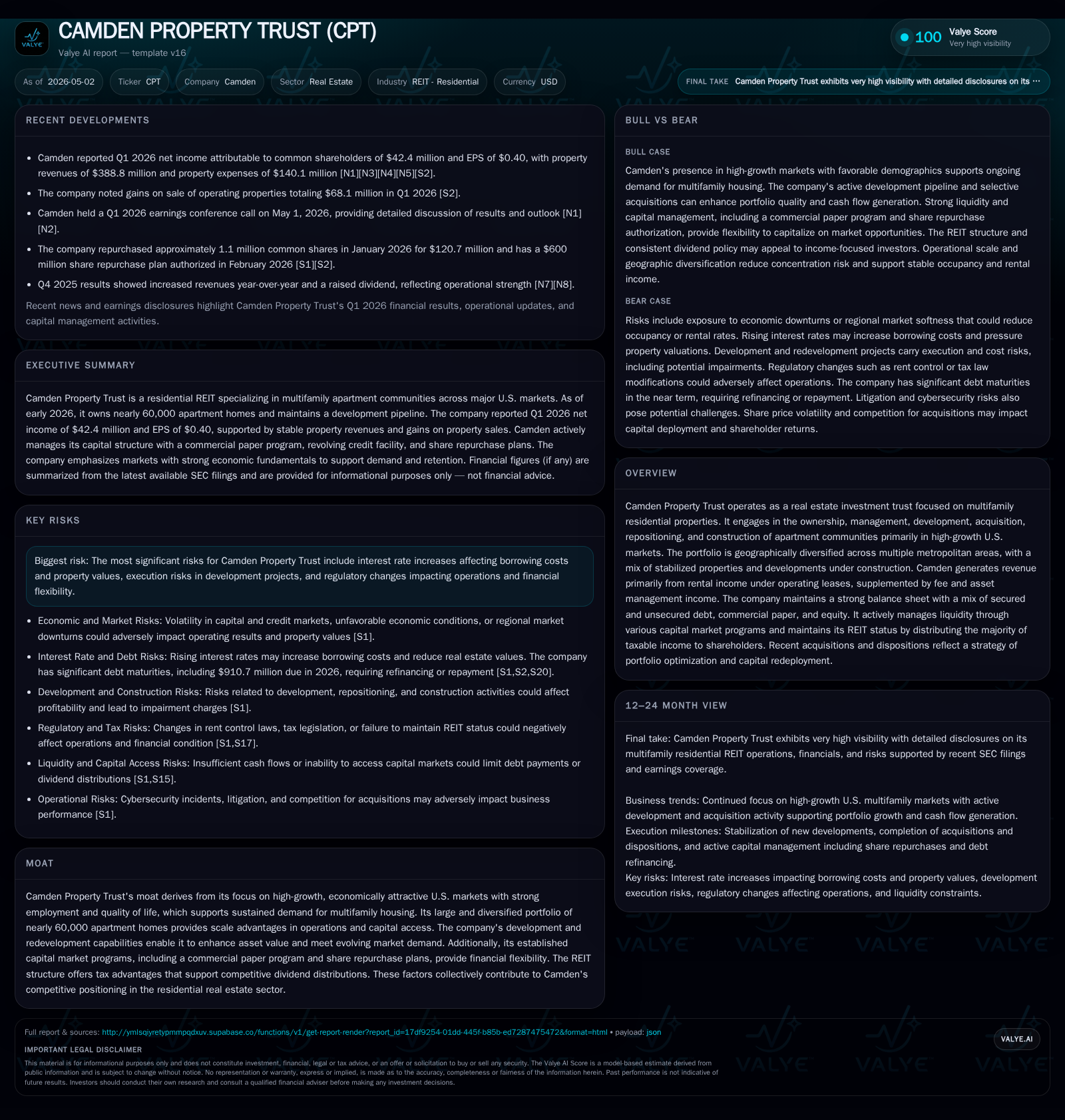
Camden Property Trust’s latest quarterly filing reveals a purposeful strategy balancing asset rotation with new acquisitions, enhancing its high-growth U.S. multifamily portfolio. The company sold a Texas property at a substantial gain to fund two recent acquisitions in Atlanta and Orlando, maintaining focus on promising markets. Camden sustains its credit discipline with ample liquidity supported by an amended revolving credit facility and a commercial paper program. Performance share awards granted underpin management's alignment with long-term value creation. Despite near-term macro risks, Camden’s scale, market selection, and development capabilities position it well for steady organic growth.
Recent Quarterly Operating Update
Camden Property Trust’s Q1 2026 filing [S2] reveals disciplined capital activity reflective of its strategic focus on portfolio optimization in high-growth U.S. markets. Notably, Camden sold one operating property in Irving, Texas for approximately $77 million during the quarter, recognizing a gain around $67.9 million [S18]. Restricted cash includes $76.4 million held with a qualified intermediary earmarked for a Section 1031 exchange, directly funding property acquisitions completed in April: specifically, two multifamily communities totaling roughly 557 apartment homes located in Atlanta, Georgia, and Orlando, Florida for $171.3 million [S18]. No operating property acquisitions occurred within the first quarter itself [S13].
The company continues to generate the majority of its revenue through real estate lease contracts presented as property revenues [S2]. Its accounting practice treats combined lease and non-lease components as a single unit where applicable to simplify recognition and excludes certain lessor costs paid directly by residents [S2]. This stable leasing revenue foundation is supplemented by fee income related to asset management activities.
Performance share awards comprising approximately 50,927 units were granted to executives in February 2026 under the 2018 Share Plan; these vest after a three-year period tied to Core FFO per share and net debt to adjusted EBITDAre metrics [S2][S14]. Dividends accrue additional equivalent rights on these units that align management incentives closely with shareholder returns.
Business Model
Camden operates as a real estate investment trust (REIT) focusing on multifamily residential properties across vibrant U.S. metros characterized by strong employment growth and quality living conditions [S1]. Its business model centers on four principal activities: ownership, management, development/redevelopment, acquisition/disposition of apartment communities.
Revenue generation is predominantly rental income from residents under operating leases supplemented by contractual ancillary services such as parking or pet rent [S2]. The company's recent practical expedients elect not to separately account for lease versus non-lease components when conditions permit [S2]. Maintaining rental income stability involves preserving high occupancy levels supported by demographic trends toward renting over home ownership.
Beyond stabilized properties generating recurring cash flow, Camden actively pursues development projects — investing significant capital into construction—as well as repositioning existing assets to enhance value and market competitiveness [S1][S25]. This dynamic allows Camden to capture upside from improving markets and evolving tenant demand.
Capital recycling through dispositions funds accretive acquisitions or redeployment into higher-return projects.
Industry Structure and Competitive Position
The multifamily residential sector remains attractive due to persistent housing demand created by demographic shifts such as urbanization and affordability challenges limiting home ownership. Camden’s competitive moat arises from its geographic diversification across multiple high-growth markets amassing nearly 60,000 apartment homes—a scale that enables operational efficiencies and access to capital markets on favorable terms.
Its ability to develop or reposition properties distinguishes it from pure-operating landlords by allowing proactive response to tenant preferences and supply-demand imbalances. Additionally, its established capital programs—including commercial paper issuance and large-scale share repurchase plans—render financial agility uncommon among mid-tier peers.
Camden competes alongside other publicly traded apartment REITs but retains advantages through selective market exposure focused on expanding job hubs and quality-of-life destinations critical for sustained demand.
Growth Drivers
- Market Demographics: Favorable rental housing demand driven by younger populations delaying homeownership and migration into metro areas positions Camden well for stable occupancy and rent growth [S1].
- Development Pipeline: Capital expenditure plans approaching $176.6 million tied to developments under construction indicate planned organic property additions enhancing portfolio cash flow potential [S14].
- Capital Recycling: Ongoing rotation of assets—selling mature properties at gains while acquiring newer or more strategically located communities—supports improved yield profiles [S18].
- Financial Flexibility: The amended revolving credit facility extending maturity to 2030 plus access to commercial paper enhances liquidity sources enabling opportunistic investments responsive to market conditions [S6].
- Operational Scale: Nearly 60,000 units provide economies of scale for centralized leasing systems, vendor relationships, and technology deployment ensuring cost-efficient operations.
Risks and Watchpoints
Key risks include:
- Interest Rate Sensitivity: Floating rate debt exposures ($900 million+) subject Camden’s borrowing costs to upward pressure amid rising benchmark rates notwithstanding swaps that moderate exposure [S4][S16].
- Development Execution: Successful completion within budget/timeline uncertainties could affect profitability given sizeable ongoing project investments [$176 million+ under development] [S14][S25].
- Regulatory Environment: Rent control laws or unfavorable regulations could impair rent-setting flexibility impacting revenues [S1].
- Legal Contingencies: Antitrust litigation associated with use of revenue management software entails potential settlement payments classified outside core FFO; while currently manageable without major liquidity impact, outcomes remain uncertain [S28][S20].
- Capital Markets Conditions: Volatility could constrain access or increase cost of funds limiting growth initiatives.
What To Watch Next
Analysts should monitor:
- Leasing velocity data and same-store revenue trends as leading indicators of organic demand strength.
- Progression on developments including start/completion dates and capitalized costs providing visibility into pipeline maturation.
- Subsequent acquisition activities signaling sustained capital deployment appetite post recent transactions.
- Debt maturities schedule adherence alongside any refinancing or incremental borrowing announcements.
- Legal proceedings updates specifically related to the antitrust class action settlement process influencing contingent liabilities.
- Amendments or utilizations under share repurchase programs reflecting confidence in valuation or capital return priorities.
- Adoption timing of ASU 2024-03 affecting expense disclosures as noted for year-end reports [S9].
Financial Profile (Latest Quarter Highlights)
Latest financial snapshot
| Metric | Value | Period |
|---|---|---|
| Cash & equivalents | $41mm | |
| 2026-03-31 | ||
| Total debt | $4.3bn | |
| 2026-03-31 | ||
| Net debt | $4.2bn | |
| 2026-03-31 |
Source: SEC companyfacts cache [F1].
| Metric | Value | Period Ending |
|---|---|---|
| Cash & Equivalents | $40.7 million | March 31, 2026 |
| Total Debt | $4.25 billion | March 31, 2026 |
| Net Debt (Debt - Cash) | ~$4.21 billion | March 31, 2026 |
Camden manages approximately $4.25 billion in total indebtedness primarily through senior unsecured notes bearing an average interest rate near 4.1% factoring settled derivatives effects [S16][F1]. Approximately $900 million constitutes floating rate debt partially mitigated via interest rate swaps reducing exposure volatility but demanding vigilant interest cost oversight [S4][S16].
The commercial paper program supplements short-term financing needs up to $600 million at about 3.85% average interest rates currently deployed around $358 million [S4][S19].
In capital allocation moves consistent with shareholder value preservation priorities, Camden launched a new $600 million share repurchase authorization early in February replacing an older plan while actively buying back shares during Q1 averaging prices around $102-$110 per share across ~3 million shares repurchased year-to-date under these programs offsetting dilution effects from outstanding equity incentives [S5][S22]. Dividends continue aligning with REIT distribution requirements whilst preserving investment capacity for development initiatives and acquisition growth.
Conclusion
Camden Property Trust demonstrates steady execution that balances cautious yet assertive capital deployment fostering portfolio enhancement amidst evolving macro environments. Its emphasis on top-tier U.S. markets combined with scale-driven operational leverage offers resilience against cyclicality typical within real estate sectors. While interest rate sensitivity and legal contingencies pose notable risks requiring continued management attention, Camden’s diversified asset base together with proactive pipeline development provides credible pathways for sustainable growth supported by substantial financial flexibility.
This analysis synthesizes publicly available information without offering investment advice or recommendations. It reflects data current as of the cited filings released through May 1, 2026.
Disclaimer: This is research-only, informational analysis and not investment advice. It may include AI-generated interpretation and general industry context. Always verify important details using primary sources.

Comments