
Dream Finders Homes Faces Interest Rate Risks While Leveraging Regional Scale and Financial Services Integration
The latest quarter affirms Dream Finders Homes’ diversified regional presence and integrated financial services as pillars amid evolving capital markets and housing demand conditions.
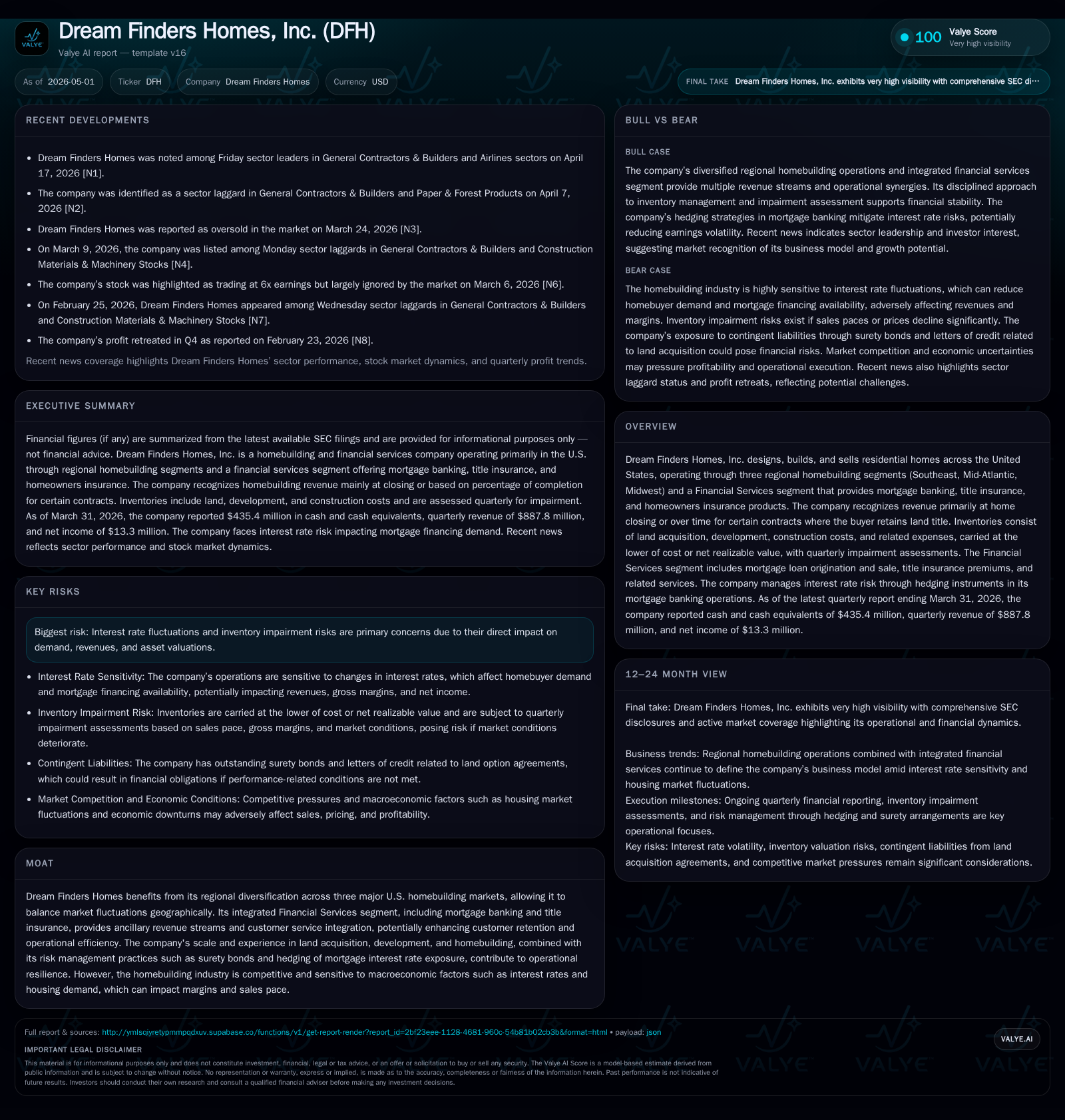
In its Q1 2026 report, Dream Finders Homes demonstrated stable operational performance underpinned by its three-region homebuilding strategy and complementary financial services operations. The company recognizes revenue primarily at home closings, with additional income streams from mortgage banking and title insurance. Regional diversification across Southeast, Mid-Atlantic, and Midwest markets buffers geographic demand fluctuations, while its financial services segment enhances customer retention and margin diversification. Key challenges remain with rising interest rates impacting buyer financing capacity and potential inventory impairments. The company’s capital structure remains healthy, supported by a substantial revolving credit facility and manageable debt levels. Monitoring mortgage interest rate trends, inventory valuations, and sales absorption rates will be critical near-term drivers.
Recent Operating Update
In the first quarter ended March 31, 2026, Dream Finders Homes continued its core homebuilding operations across three geographic segments: Southeast, Mid-Atlantic, and Midwest markets. The latest Form 10-Q filing reveals consistent revenue recognition predominantly upon closing of homes where the company retains title to the lots sold. For some contracts where title remains with buyers or third-party investors during construction, revenue is recognized on a percentage-of-completion basis measured quarterly by elapsed construction days relative to total estimated build time [S2][S1].
Importantly, the Financial Services segment—which encompasses mortgage banking through Jet HomeLoans LP along with title insurance underwriting—remains a strategic complement to home sales. This segment contributes recurring revenues from mortgage loan origination fees, sales gains on loans sold into secondary markets, closing service fees, and title insurance premiums. The recent acquisition of Alliant National Title Insurance Company expanded the company’s title underwriting capabilities effective April 2025 [S3][S1].
From a liquidity standpoint as of March 31, 2026, Dream Finders held approximately $435 million in cash and equivalents [F1], providing ample funding for working capital needs amid ongoing inventory investments. While no explicit updated debt levels are cited in the recent filings beyond December 31, 2021 data indicating minimal reported debt balance relative to cash holdings [F1], earlier disclosures detail a $1.5 billion revolving credit facility maturing in 2028 that supports land acquisition and development activities [S4][S5].
Business Model
Dream Finders Homes generates revenue primarily from building and selling residential homes across diverse U.S. regions. Its business model hinges on several key components:
Homebuilding Sales: Revenue is largely recognized at closing when title transfers for homes built on land owned by the company. Equally material are contracts where buyers retain lot title during construction; here revenue is accrued based on percent completion—this dual approach aligns revenue recognition with project delivery risk.
Land Inventory Management: Critical cost inputs involve acquiring raw land lots followed by phased development—this inventory is carried at lower of cost or net realizable value with frequent impairment reviews due to market sensitivity.
Financial Services: Through Jet HomeLoans (mortgage origination/sale) and DF Title / Alliant Title (title insurance), Dream Finders captures ancillary revenue streams that benefit from vertical integration—offering bundled solutions that potentially improve customer retention while mitigating sales cycle friction.
Integration & Risk Management: The company employs surety bonds as security for land option agreements plus interest rate swaps/hedges to limit volatility from mortgage lending exposure associated with fluctuating interest rates affecting buyer affordability [S17][S8].
This multi-pronged model benefits from diversification across three distinct U.S. regions—each exhibiting unique demographic trends and real estate cycles—which dampens exposure to localized downturns or regulatory shifts.
Industry Structure & Competitive Position
The U.S. homebuilding sector is intensely competitive yet regionally fragmented due to varying regulations, labor availability, land costs, zoning laws, and local economic conditions.
Nonetheless, macroeconomic sensitivities impose constraints—especially rising interest rates that reduce buyer pool affordability or increase capital costs—placing pressure on pricing power despite otherwise favorable demographic demand tailwinds.
Growth Drivers
Several catalysts underpin growth prospects:
Expanding Geographic Footprint: Acquisitions (e.g., Crescent Homes) allow entry into new markets with established franchise value while organic expansions deepen penetration within existing regions.
Financial Services Cross-Selling: Leveraging mortgage origination coupled with title insurance encourages repeat customer usage enhancing margins beyond pure home sale profits.
Robust Land Acquisition Pipeline: Disciplined purchase of land banks combined with lot option agreements ensures long-term supply continuity able to respond quickly when demand rebounds.
Operational Efficiency & Risk Mitigation: Use of surety bonds limits upfront cash requirements on certain deals; active hedging programs moderate earnings volatility tied to rising interest rates impacting mortgage lending profitability.
These drivers are quantitatively tracked via KPIs including backlog volume/valuations by region, capture rate of financial services offerings within homebuyer cohorts, same-home average sales prices adjusted for mix shifts which reflect incremental product premium capture potential.
Risks / Watchpoints / Growth Constraints
Key risks need vigilant monitoring:
Interest Rate Sensitivity: Increasing mortgage rates directly reduce new homebuyer affordability which can delay sales velocity or depress pricing power leading to elevated carrying costs on inventory [S26][S8].
Inventory Impairments: Land values are susceptible to cyclical corrections necessitating quarterly fair value assessments; overaccumulation or misjudgment in development timelines can crystallize losses [S14][S21].
Litigation Exposure: Active legal proceedings related to past acquisitions e.g., Crescent Homes breach of contract claims may distract management teams or impose contingency costs albeit not currently viewed as materially adverse [S16][S26].
Regulatory Compliance Risks: Operating branches in multiple states alongside in-house financial services requires adherence to diverse licensing regimes—failure could impair operations or result in penalties.
Maintaining adherence to debt covenants under its credit agreement also constrains leveraged expansion while share repurchase programs signal capital discipline but must balance reinvestment needs appropriately.
What to Watch Next
To assess forward momentum:
Quarterly updates on homes closed vs backlog levels within each regional reporting unit—key signals of market absorption pace.
Mortgage origination volumes at Jet HomeLoans indicative of consumer financing environment strength plus effectiveness of hedging instruments offsetting interest rate swings.
Inventory carrying value changes signaling signs of stress or recovery within land development pipeline.
Legal proceeding developments regarding acquisition-related disputes that might affect consolidated results unexpectedly.
Guidance revisions explicitly tied to macroeconomic changes including Fed rate outlook adjustments impacting residential real estate demand.
Financial Profile Contextualization
While detailed financial tables are not included here per policy constraints, the company’s liquidity posture appears solid as reflected by recent cash balances exceeding $435 million [F1] against relatively modest documented long-term debt positions reported up through end of 2021 filings. Earlier disclosures describe senior unsecured notes issuance ($295 million series) alongside a $1.5 billion credit facility supporting working capital needs and land purchases [S4][S5].
Revenue scale topped roughly $4.3 billion per calendar year ending December 2025 supported by segment diversification between core homebuilding revenues concentrated around closings or construction progress milestones plus meaningful contributions from mortgage banking fees and title insurance premiums driving margin expansion opportunities [F1][S1][S12].
Management exhibits focus on capital return initiatives via share buybacks capped at $100 million authorization levels balanced carefully against reinvestment priorities including acquisitions that expand operational footprint [S6][S10].
This analysis is based exclusively on publicly available filings as of May 2026 without any confidential insight or undisclosed information. It does not constitute investment advice but aims to provide an informed operational perspective grounded in disclosed facts relevant for industry participants evaluating Dream Finders Homes’ positioning within U.S. residential construction markets.
Disclaimer: This is research-only, informational analysis and not investment advice. It may include AI-generated interpretation and general industry context. Always verify important details using primary sources.

Comments