
Verizon’s Strategic Execution and Network Leadership Sustain Competitive Edge
Verizon’s latest quarterly report reveals subscriber growth acceleration and robust capital deployment reinforcing its leading network position amid intense telecom competition.
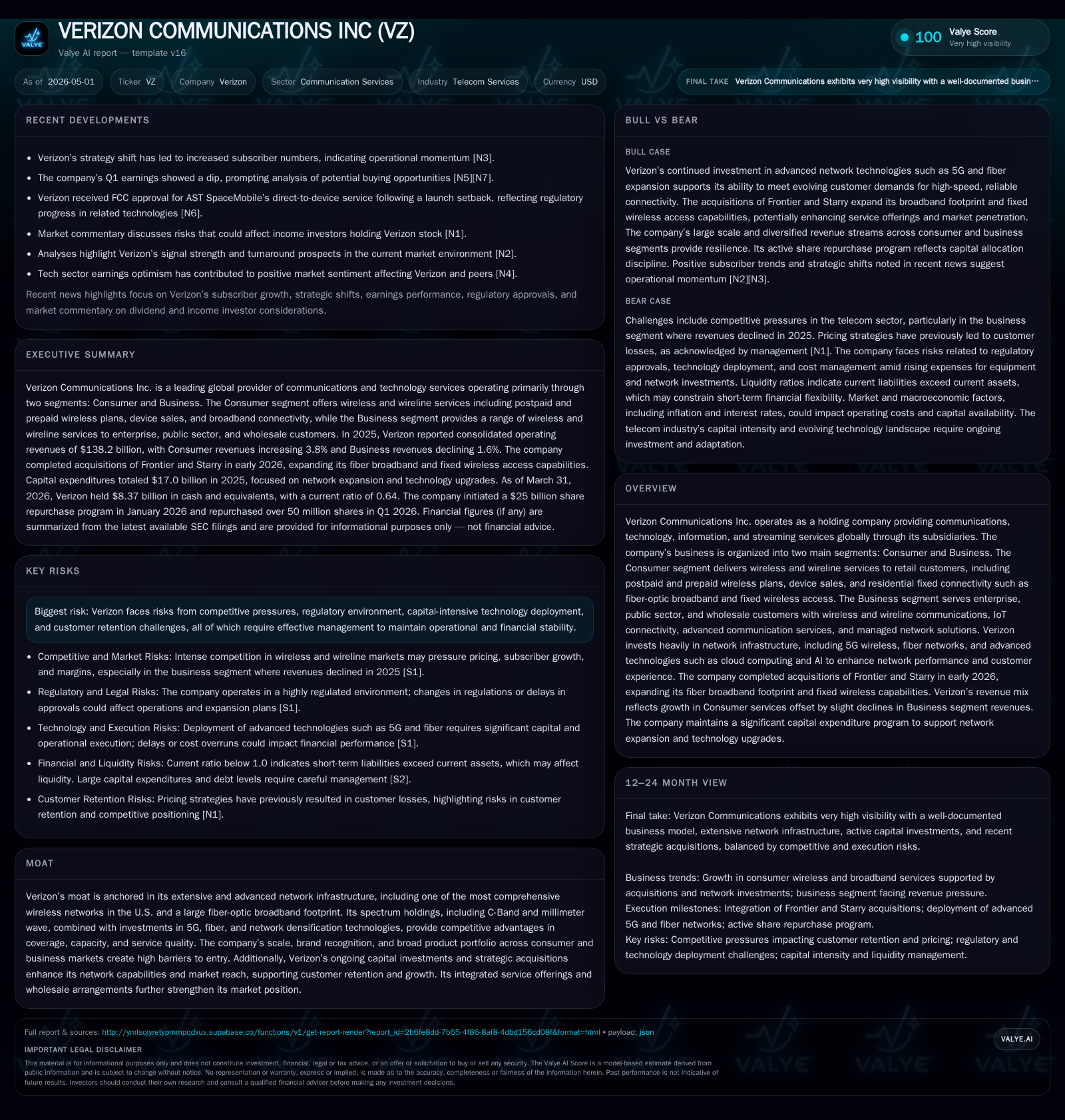
In Q1 2026, Verizon demonstrated steady postpaid wireless subscriber gains and broadband expansion while initiating a $25 billion share repurchase program signaling financial confidence. The company’s dual Consumer and Business segments leverage advanced 5G and fiber-optic infrastructure to sustain competitive advantages in coverage, capacity, and service quality. Key growth drivers include network densification, fiber rollout, and enterprise IoT adoption, supported by disciplined capital allocation balancing heavy capex with share buybacks despite elevated net debt. Regulatory challenges, market saturation in wireless, and capital intensity remain constraints to monitor closely.
First-Quarter 2026 Operating Highlights
Verizon’s Q1 2026 reported steady momentum in its core consumer wireless base with net additions of approximately 280,000 retail postpaid subscribers representing sustained demand for premium connectivity despite industry-wide saturation risks [S2]. Fixed broadband saw continued subscriber expansions primarily driven by fiber optic penetration which reached new highs across Verizon’s footprint. Notably, fixed wireless access (FWA) broadband connections surged by over 450,000 year-over-year [S2], underscoring the strategic importance of 5G-enabled home internet alternatives.
Simultaneously, Verizon launched a major share repurchase initiative authorized to buy up to $25 billion in stock beginning January 30, 2026. By March end, through accelerated share repurchase (ASR) agreements alone it reacquired over 50 million shares at an average price near $49.25 per share [S2]. This aggressive buyback program points to management’s confidence in cash flow generation even as capital spending remains elevated.
This quarter also incorporated the Frontier Communications acquisition completed in January 2026 which expands Verizon’s fiber footprint notably in underpenetrated regions—the full operational impacts will evolve through the year but bolster broadband leadership [S3]. The firm revised segment reporting to better reflect mobility and broadband revenue streams aligned with emerging product mixes [S19].
Business Model and Product Portfolio Overview
Verizon operates through two primary reporting segments: Consumer and Business [S1]. The Consumer segment generates revenue chiefly from wireless service plans (postpaid being the largest component), device sales including smartphones and accessories, wireline services such as Fios fiber broadband internet and video offerings. Wireline residential broadband includes both fiber and legacy copper networks mainly within 31 U.S. states plus Washington D.C.
The Business segment addresses enterprise clients with a portfolio consisting of wireless mobility services tailored for corporate accounts, managed network solutions including software-defined networking (SDN), cybersecurity services, Internet of Things (IoT) connectivity platforms targeting smart cities & industrial applications, fixed wireless access solutions for business premises, as well as wholesale carrier services [S1]. This diverse ecosystem enhances customer retention through integrated contracts and specialized offerings with higher margin characteristics relative to consumer wireless service.
Revenue mechanics depend on subscription volumes (subscriber counts) for recurring service revenue combined with equipment sales which contribute significant but lower-margin cash inflows. Pricing power resides primarily with differentiated network quality especially on the consumer wireless front where Verizon holds one of the most extensive U.S. cellular footprints supported by premium spectrum allocations.
Competitive Landscape and Verizon’s Moat
Verizon is positioned as one of the top three national U.S. telecom operators competing directly with AT&T and T-Mobile. Its moat is built on an asset-intensive base:
- Extensive C-Band mid-band spectrum complemented by millimeter-wave (mmWave) bands provides capacity for high-speed low-latency 5G services.
- A vast fiber-optic network backbone deployed across multiple states enabling superior wireline speeds compared to coaxial or DSL competitors.
- Economies of scale enable efficient capital deployment for network densification—especially critical as data consumption rises sharply.
- Strong brand recognition coupled with broad service bundling across consumer and business units creates switching cost barriers.
- Strategic wholesale agreements allow monetization of excess capacity enhancing return on infrastructure investment.
This infrastructure advantage supports robust pricing power enabling revenue sustainability amid aggressive pricing competition prevalent in prepaid wireless segments handled by MVNOs or discount carriers.
Drivers Supporting Subscriber and Revenue Growth
Key demand drivers frame around the ongoing expansion of:
- 5G Network Densification: Continuous investment in cell site upgrades leveraging C-Band spectrum boosts both coverage quality and data throughput driving ARPU uplift among smartphone users.
- Fiber Broadband Penetration: Accelerated rollout tied to Frontier integration enhances fixed internet subscriber growth supporting non-wireless revenue diversification [S2].
- Premium Plan Adoption: Increasing prevalence of unlimited data plans bundled with device financing increases average revenue per user (ARPU).
- Business IoT Adoption & Managed Services: Enterprise customers increasingly rely on connected devices requiring secure scalable networks—a growing source of stickier revenue streams for Verizon.
- Fixed Wireless Access (FWA): The surge in customers adopting FWA complements fiber build-out by providing an alternative broadband technology that can scale rapidly without trenching costs.
These drivers are underpinned by measurable KPIs such as subscriber additions (280k net retail postpaid adds Q1), broadband connection growth (+460k total broadband adds), ARPU metrics from premium mobility plans reported separately post-representation changes [S2,S19,N3].
Capital Strategy: Network Investments and Share Repurchases
Verizon’s capital strategy exemplifies balancing aggressive infrastructure investments with shareholder returns. The company forecasts approximately $16–16.5 billion in capital expenditures for full-year 2026 targeting:
- Completion of C-Band spectrum deployment,
- Expanding fiber network coverage,
- Investments in AI-driven network optimization to reduce operating costs,
- Enhancements supporting new enterprise communication technologies [S6].
Concurrently, Verizon accelerated its share repurchase program authorizing up to $25 billion in stock buybacks commencing January 2026—executed partly through ASR mechanisms purchasing ~50 million shares worth roughly $2.5 billion upfront payment [S2].
Effective mitigation relies on operational excellence alongside proactive regulatory engagement.
Upcoming Catalysts and Monitoring Points
Key indicators investors should track include:
- Quarterly subscriber trends focusing on retail postpaid net adds and churn rate trajectories post-promotion cycles.
- Fiber rollout progress measured via geographic penetration milestones particularly integrating Frontier assets.
- Developments in FCC rulings related to spectrum auctions or direct-to-device communications potentially altering competitive dynamics [N4].
- Execution pace of share repurchases under the authorized plan indicating management's confidence midpoint assessment post-Q2 earnings.
- Capital expenditure outlays relative to forecast tracking efficiency gains or inflationary pressures on network build costs.
Cash and equivalents totaled about $8.4 billion, while current assets and liabilities were $44.7 billion and $69.9 billion respectively, resulting in a current ratio of 0.64 as of the quarter-end [F1]. This ratio reflects tight working capital management consistent with the capital-intensive nature of Verizon’s operations.
Latest financial snapshot
| Metric | Value | Period |
|---|---|---|
| Cash & equivalents | $8.4bn | |
| 2026-03-31 | ||
| Total debt | $144.2bn | |
| 2026-03-31 | ||
| Net debt | $135.9bn | |
| 2026-03-31 | ||
| Current assets | $44.7bn | |
| 2026-03-31 | ||
| Current liabilities | $69.9bn | |
| 2026-03-31 | ||
| Current ratio | 0.64x | |
| 2026-03-31 |
Source: SEC companyfacts cache [F1].
A concise snapshot from the quarter ending March 31, 2026 shows:
Disclaimer: This is research-only, informational analysis and not investment advice. It may include AI-generated interpretation and general industry context. Always verify important details using primary sources.

Comments