
Celularity's Placental Cell Platform Challenges Longevity Medicine Landscape
Celularity leverages unique placental biology and an integrated manufacturing platform amid financial headwinds and pipeline advancement efforts.
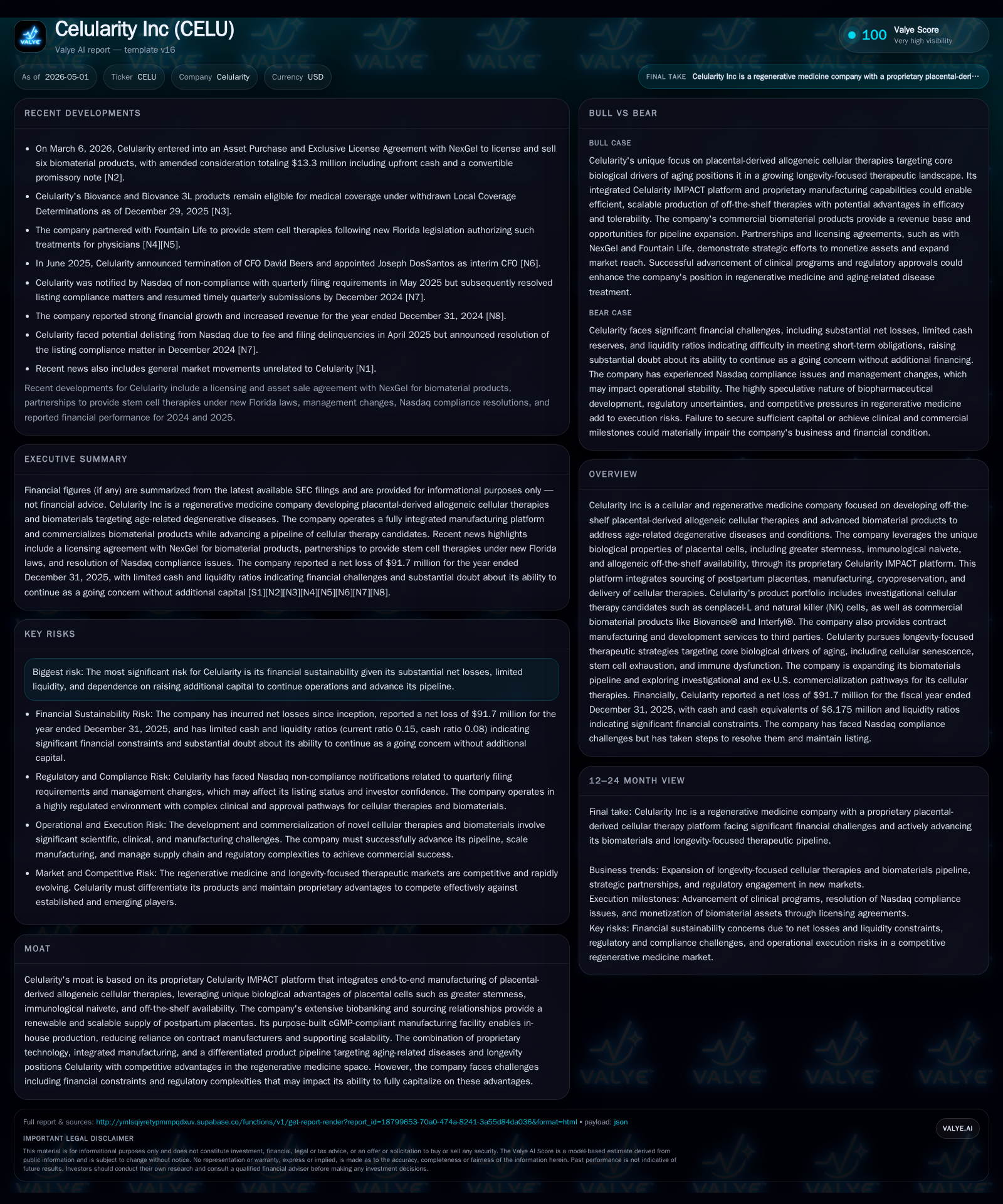
Celularity Inc’s recent disclosures detail operational restructuring to conserve cash amidst constrained liquidity, while underscoring its proprietary Celularity IMPACT platform for placental-derived allogeneic cellular therapies. The company's innovative business model focuses on leveraging postpartum placentas for off-the-shelf regenerative treatments targeting age-related diseases, supported by a manufacturing facility facilitating scalability. Despite promising pipeline candidates and diversified biomaterial offerings, Celularity faces significant risks from its persistent net losses, weak current ratio, and dependence on raising additional capital. Ongoing clinical development progress and regulatory milestones will be pivotal to validating the commercial viability of its platform. Capital raises and execution on its core therapeutic focus remain critical watchpoints.
Latest Operating Developments: Restructuring and Capital Challenges
Celularity’s April 2026 Form 8-K filing ([S3]) reveals key amendments to agreements that impose new restrictions on payments or value transfers to current or former officers and directors as part of broader efforts to conserve cash and stabilize operations. The amendment also outlines mutual limitations on public disclosures relevant to these arrangements, indicating a heightened focus on managing financial discipline and transparency amid funding constraints.
Concurrently, leadership shifts have been announced with the departure of Senior VP R. Haines effective May 8, 2026, and immediate resignation of Stephen Brigido as President of Degenerative Diseases ([S14]). Management communicates these changes as steps to realign organizational structure with its strategic emphasis on the core cellular therapy platform.
The company reported ongoing net losses totaling $91.7 million for FY 2025 with continuing doubts about its ability to operate as a going concern without fresh capital infusion ([S1], [S6]). To address this reality, earlier cost-cutting measures included reductions in headcount and executive compensation during Q1 2026 ([S1]).
This near-term operating picture underscores urgency in balancing innovation ambitions against liquidity preservation imperatives.
Innovative Business Model: Placental-Derived Allogeneic Therapies
Celularity’s business strategy capitalizes on the unique biological advantages of placental-derived cells collected postpartum—characterized by enhanced stemness properties and immunological naivete—that allow for allogeneic "off-the-shelf" cellular therapies (, [S1]).
At the heart lies the proprietary Celularity IMPACT platform integrating sourcing from donor placentas with sophisticated manufacturing capabilities including cryopreservation logistics. This vertically integrated approach supports scale efficiencies and supply chain reliability uncommon in regenerative medicine firms relying heavily on external contractors.
Revenue mechanics are multifaceted: one-time collection fees, long-term biobanking storage charges from contracted parents (18–25 years typical duration), ongoing biomaterial product sales (e.g., Biovance®, Interfyl®), alongside advancing investigational cell therapies like cenplacel-L (targeting inflammatory disorders) and gene-edited natural killer (NK) cells aimed at oncology indications ([S1],,[S8]).
Contract manufacturing services also supplement revenues by leveraging excess capacity.
Despite no therapeutics having yet achieved regulatory approval for commercial sale, Celularity pursues accelerated development paths identifying indications where placental biology confers potential efficacy advantages coupled with clearer regulatory pathways ([S13]).
Strategic Competitive Moat through Proprietary IMPACT Platform
The company’s competitive moat is rooted in its integrated supply chain—from biobanking networks harvesting post-delivery placentas through end-to-end manufacturing within its dedicated Florham Park facility compliant with cGMP standards (, [S8], [S13]). This setup markedly reduces reliance on contract manufacturing organizations typical of peer biopharma developers operating asset-light models.
Its extensive donor sourcing network provides renewable cell populations supporting pipeline breadth targeted at aging-related diseases — a complex constellation involving inflammatory cascades like “inflammaging,” cellular senescence mechanisms linked to tissue dysfunctions, cancer risk modulation via senescent cell clearance strategies, and immune system rejuvenation ([S1]).
Proprietary manufacturing know-how enables rapid scaling potential while preserving product quality—a critical differentiator in biologics where batch variability can materially impact clinical success.
The regulatory rigor required for biologic cellular therapies imposes high barriers to entry that Celularity attempts to navigate strategically by focusing on select unmet needs where accelerated FDA pathways may exist for novel regenerative modalities ([S5]). However, evolving international regulatory environments require tailored commercialization approaches; less regulated foreign markets may yield early revenues but entail amplified enforcement risks ([S5]).
Regulatory Environment and Market Positioning
Celularity operates within a complex global regulatory landscape shaped by stringent U.S. Food and Drug Administration (FDA) requirements for biologics alongside more variable international regimes ([S5]). For cell therapies classified under Section 361 HCT/Ps or requiring Biologics License Applications (BLA), rigorous demonstration of safety, efficacy, consistent manufacturing controls per cGMP standards are prerequisites.
Regulatory timelines potentially compress under expedited designations but still pose uncertainty due to novel product classes leveraging gene editing technologies with limited historical benchmarks ([S1],[S13]). In parallel, managed care dynamics within the U.S., especially under sustained impacts from the Affordable Care Act (ACA), exert downward pressures on pricing structures and reimbursement levels which could hamper revenue realizations if products reach market ([S1]).
Coverage determinations by third-party payors remain crucial hurdles given nascent clinical data for investigational candidates. Additionally, interactions between healthcare providers receiving stock-based compensation potentially raise scrutiny under fraud-and-abuse statutes adding compliance complexity ([S27]).
Growth Potential: Pipeline, Biomaterials, and Contract Manufacturing
Celularity’s growth vectors encompass advancing clinical trials in key therapeutic candidates such as cenplacel-L—an allogeneic mesenchymal-like stromal cell therapy—with prospects addressing inflammatory vascular disorders—and NK cell platforms designed as off-the-shelf cancer immunotherapies utilizing gene editing to reduce graft-versus-host disease risk (, [S13]).
Complementing therapeutics are commercial biomaterial products—Biovance® (decellularized human amniotic membrane) and Interfyl® (human connective tissue matrix)—which contribute current revenues from established markets like wound care and orthopedics while supporting broader product development pipelines targeting ophthalmology through recent licensing partnerships (e.g., NexGel agreement) ([S8], [S18]).
Contract development and manufacturing services offer additional revenue diversification leveraging internal capacity advantages relative to larger CMOs struggling with operational scale inefficiencies observed across emerging regenerative medicine firms. Near-term catalysts include pivotal trial initiations or readouts tied to regulatory filings (IND submissions) that would de-risk scientific hypotheses underlying placenta-derived cell therapeutics.
Risks and Constraints: Financial Sustainability and Clinical Pathways
While Celularity’s platform technology offers distinctive scientific promise aligned with burgeoning longevity medicine trends targeting inflammaging and senescence clearance mechanisms (,[S1]), it grapples with acute financial stress marked by sustained high burn rates unaccompanied by commercialized therapeutics. Year-end 2025 financial metrics highlight cash & equivalents at approximately $6.2 million juxtaposed against $80.8 million in current liabilities yielding a precariously low current ratio of ~0.15; total debt stands near $33.8 million implying net debt close to $27.6 million after accounting for cash reserves ([F1],[S6]). This stark imbalance underpins recurring 'going concern' warnings articulated in SEC filings reflecting existential operational risks absent substantial fundraising success.
Furthermore,Persistent net losses — exemplified by a negative net income exceeding $91 million in 2025 — reflect ongoing heavy investment in R&D alongside limited revenue realization beyond biomaterials and biobanking segments ([F1],[S6],[S26]). Management must navigate complex regulatory approval pathways with inherently uncertain timelines amplified by the novelty of therapeutic modalities such as gene-edited allogeneic NK cells; any delay or failure could impair future earnings prospects materially. Additional concerns include potential impacts from regulatory compliance matters—for example FDA Warning Letters concerning promotional materials—and exposure arising from litigation settlements or collections defaults noted in recent legal proceedings summaries ([S7], [S10], [S16], [S27]). Operational risks related to maintaining cGMP compliance amid scale-up pressures present further hurdles impacting clinical supply continuity.
Key Milestones and Market Signals to Monitor
Investors should closely track several upcoming milestones:
- Submission timelines for Investigational New Drug applications aiming to initiate additional clinical trials across lead pipeline assets (0% likelihood indication from disclosures) ([S1],[S13])
- Progress towards Biologics License Application interactions with regulators spotlighting potential accelerated approvals routes ([S1])
- Clinical trial readouts that demonstrate safety/efficacy signals validating placental allogeneic therapy concepts which could unlock partnership or licensing opportunities()
- Commercial adoption metrics for biomaterial products like Biovance® particularly through expanded distribution channels domestically & internationally ([S8])
- Financing activities including equity raises or debt restructurings evidenced in public disclosures necessary given limited operating runway indicated by FY25 results([F1],[S3])
- Updates on ongoing legal matters resolving residual uncertainty impacting cash flow or reputation risk([S10],[S16]) Such markers would serve both as validation points of scientific feasibility/commercial relevance as well as indicators of necessary capital access capabilities.
Current Financial Snapshot
Latest financial snapshot
| Metric | Value | Period |
|---|---|---|
| Cash & equivalents | $6mm | |
| 2025-12-31 | ||
| Total debt | $34mm | |
| 2025-12-31 | ||
| Net debt | $28mm | |
| 2025-12-31 | ||
| Current assets | $12mm | |
| 2025-12-31 | ||
| Current liabilities | $81mm | |
| 2025-12-31 | ||
| Current ratio | 0.15x | |
| 2025-12-31 |
Source: SEC companyfacts cache [F1].
| Metric | Value (USD) |
|---|---|
| Cash & Equivalents | 6,175,000 |
| Total Debt | 33,812,000 |
| Net Income | -91,716,000 |
| Current Assets | 12,319,000 |
| Current Liabilities | 80,759,000 |
| Current Ratio | 0.15 |
(Source: [F1])
This snapshot encapsulates the challenging liquidity position threatening sustained operations absent successful capital infusions or significant operational pivots. While Celularity has made purposeful structural adjustments including headcount reductions in early 2026 aimed at conserving cash resources ([S1]), the necessity of fresh financing is manifestly critical given prevailing working capital deficits.[F1][S6]
Disclaimer: This analysis is based solely on publicly available information as provided in official SEC filings dated up to April 30, 2026. It does not constitute investment advice or recommendations but seeks to inform readers through rigorous synthesis of verified data regarding Celularity Inc.'s operating context as of mid-2026.
Disclaimer: This is research-only, informational analysis and not investment advice. It may include AI-generated interpretation and general industry context. Always verify important details using primary sources.

Comments