
Estée Lauder Advances with Restructuring and Brand Strengthening in Q3 2026
The latest quarter reveals operational recalibration through restructuring initiatives alongside leveraging iconic brand assets, positioning Estée Lauder amid evolving industry dynamics.
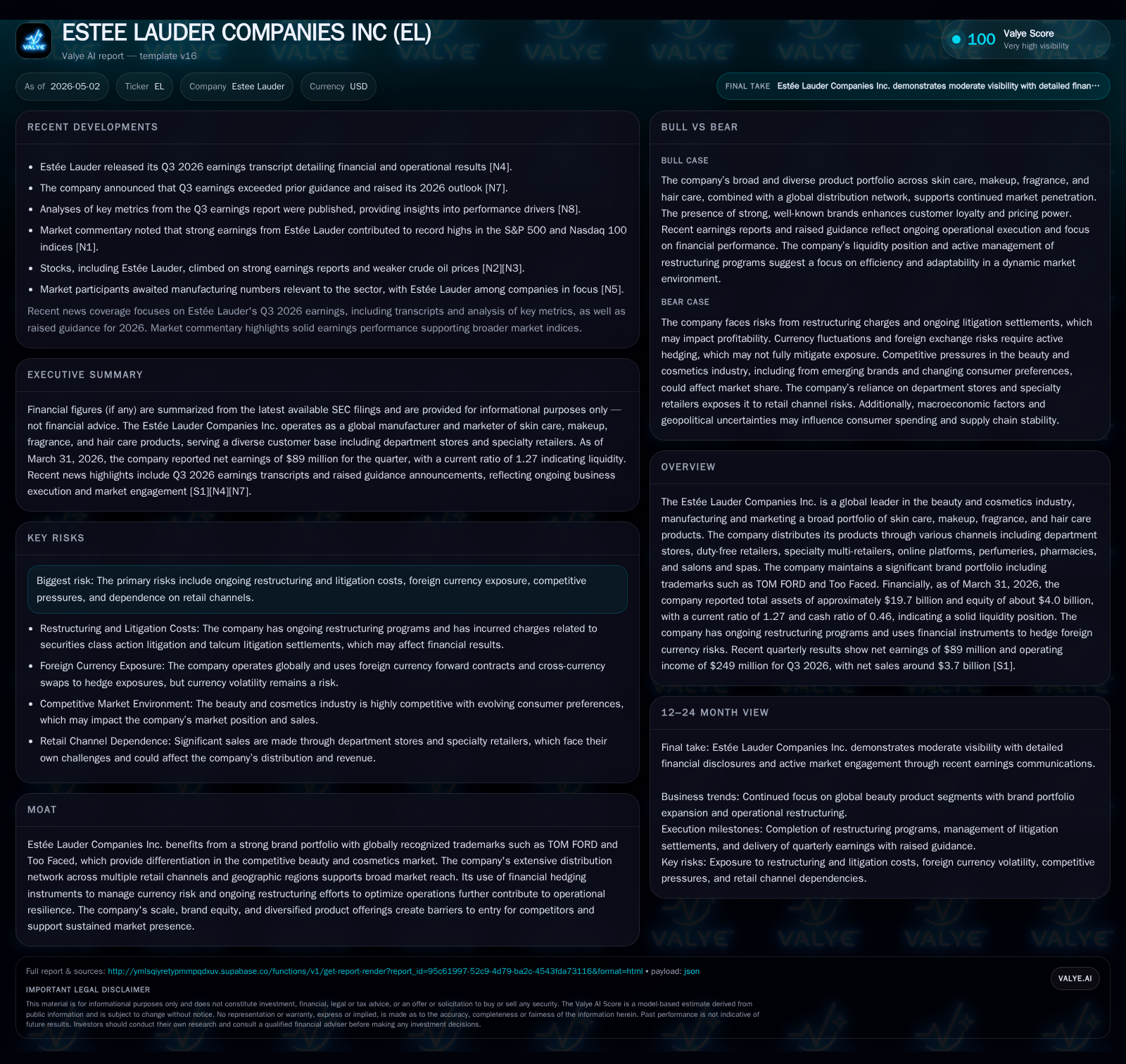
In its Q3 2026 filing, Estée Lauder Companies Inc. underscored ongoing restructuring programs aimed at operational efficiency and deployed supplier finance agreements that optimize working capital management. The company continues to capitalize on a diversified portfolio of premium brands like TOM FORD and Too Faced distributed through multi-channel networks. Industry competition remains intense, but Estée Lauder’s scale, brand equity, and geographic reach provide a moat. Growth drivers include innovation in skin care formulations and expanding digital sales penetration. Risks involve restructuring expenses, currency volatility, and channel-specific disruptions, with close attention warranted on execution progress and consumer trends.
Q3 2026 Operating Updates: Restructuring and Supplier Finance
The Estée Lauder Companies’ latest quarterly filing dated May 1, 2026 [S2] reveals continued execution of restructuring initiatives designed to streamline operations and improve cost structure. These programs encompass employee severance, contract terminations, asset impairments, and other cost-reduction measures that have seen charges escalate in the recent quarter reflecting active recalibration efforts. With accrued restructuring liabilities rising from $279 million previously to $427 million as of March 31, 2026 [S11], it is clear the company is prioritizing operational optimization.
Complementing these efforts is the deployment of supplier finance programs wherein Estée Lauder commits to settle confirmed supplier invoices within stipulated due dates—with payment terms extending up to 90 days from invoice date [S2]. Importantly, the agreements can be terminated on notice between 30-60 days or immediately upon breach, indicating a flexible working capital management tool valuable for balancing liquidity needs without compromising supplier relations. Outstanding obligations under these programs were approximately $64 million as of quarter end [S11]. Such financial arrangement nuances reflect prudent cash flow management supporting broader strategic stability.
Business Model and Brand Portfolio Overview
Estée Lauder operates as an integrated developer and marketer of luxury beauty products across skin care, makeup, fragrance, and hair care segments. Revenue generation flows from sales to a diverse set of customers including department stores (a historically dominant channel), specialty multi-retailers, online platforms capturing growing digital consumer activity, duty-free retailers targeting travel shoppers, perfumeries, pharmacies, salons, and spas. This multi-channel approach mitigates single-channel dependency risk while enabling broad market penetrance.
Central to Estée Lauder’s strategy is its strong brand portfolio featuring heavyweight trademarks like TOM FORD Beauty — well-known for its premium positioning — and Too Faced which appeals strongly to younger demographics via trend-conscious makeup innovations. The company's brand equity allows for durable premium pricing power despite competitive pressures common in cosmetics markets. Moreover, brand loyalty restricts customer switching given entrenched preferences tied to reputation and quality perception.
The operational complexity involves managing a global supply chain that supports varied product categories with differing regulatory requirements across international markets. The company's use of financial hedging instruments further smooths exposure to foreign currency volatility inherent in its global distribution footprint [S16].
Industry Context: Competitive Dynamics and Distribution Channels
Estée Lauder’s competitive set includes other multinational beauty conglomerates like L'Oréal and Coty, which incessantly innovate while contending with shifting consumer preferences toward sustainability or niche product formulations. Within this landscape, pricing power varies: premium segment players tend to sustain margin resilience aided by brand cachet whereas mass-market competitors face pronounced price sensitivity.
Distribution channels remain structurally diverse but evolving rapidly due to increased e-commerce adoption accelerated by pandemic-related behavioral shifts. While department stores once dominated prestige beauty sales globally, their foot traffic has declined necessitating more resources toward online direct-to-consumer strategies—an area where Estée Lauder has invested significantly. Duty-free retail also offers a strategic avenue by targeting tourists and travelers with preferential tax conditions.
Supply-side factors such as capacity constraints in manufacturing or ingredient availability can intermittently pressure delivery timelines or costs but Estée Lauder’s scale affords some protection over smaller rivals. Regulatory compliance across regions adds complexity but creates barriers limiting entrance or rapid scale-up by new entrants.
Customer loyalty driven by perceived efficacy or aesthetic appeal introduces switching costs that help defend market share once consumers adopt favored brands.
Key Growth Drivers: Product Innovation and Market Expansion
Innovation stands at the core of Estée Lauder’s growth trajectory particularly in skin care technologies encompassing advanced actives or delivery systems that address evolving dermatological trends. The company also focuses on fragrance reformulations responsive to consumer demand for cleaner ingredients or novel scent profiles.
Digital commerce penetration has been intensifying with tailored marketing campaigns leveraging social media influencers enhancing direct engagement and supporting higher margin sales through owned platforms [N6]. Geographic expansion into emerging markets where rising disposable income boosts beauty consumption remains a strategic priority along with expansion in duty-free outlets capitalizing on international travel rebounds.
Recent earnings commentary [N4] highlights strengthened full-year guidance reflecting successful product launches paired with underlying demand momentum despite macroeconomic uncertainties. Key performance indicators such as same-store sales growth in flagship locations or improvement in online conversion rates serve as tangible markers validating these drivers.
Risks and Constraints: Restructuring Costs, Currency Exposure, and Channel Risks
Although restructuring aims at long-term benefits, near-term costs curtail operating margins—as visible through an increase in accrued restructuring charges impacting quarterly P&L [S11]. Litigation expenses related to legacy talcum powder cases remain an episodic margin drag, underscoring legal risk management necessity.
Foreign exchange volatility is another prominent risk stemming from extensive international operations. Despite employing derivatives including forwards and cross-currency swaps designated for cash flow hedging [S16], residual translational losses persist—as evidenced by translation adjustments detracting from comprehensive income this quarter [S20]. These currency swings can unevenly affect reported revenues depending on geographic revenue mixes.
Dependency on traditional retail channels poses risks amid fluctuating foot traffic patterns or evolving consumer shopping behaviors post-pandemic. Channel disruptions from retailer bankruptcies or shifts toward private label alternatives could constrain growth if not offset by digital expansion success.
Catalysts to Watch: Guidance, Execution on Restructuring, and Consumer Trends
Market participants should monitor progress against stated restructuring cost reduction targets through subsequent quarters to assess operating leverage improvements hinted at in Q3 disclosures [S2]. Additionally, Estée Lauder’s fiscal year guidance updates issued around the earnings release [S3] serve as benchmarks for management’s confidence in demand continuity amid external challenges.
Consumer inclination towards sustainable formulation credentials or uniquely crafted beauty experiences presents potential catalyst scenarios influencing product development cycles. Keeping tabs on new launches reception across major markets alongside e-commerce KPI trajectories will provide early signals on momentum sustainability [N8].
Upcoming investor communications including quarterly earnings calls near July 2026 are expected to offer incremental insight into macro sensitivity assumptions embedded within forward-looking outlooks.
Latest Financial Snapshot
Latest financial snapshot
| Metric | Value | Period |
|---|---|---|
| Total debt | $6.8bn | |
| 2026-03-31 | ||
| Net debt | $4.6bn | |
| 2026-03-31 | ||
| Current assets | $7.5bn | |
| 2026-03-31 | ||
| Current liabilities | $5.9bn | |
| 2026-03-31 | ||
| Current ratio | 1.27x | |
| 2026-03-31 |
Source: SEC companyfacts cache [F1].
| Metric | Value |
|---|---|
| Current Ratio | 1.27 |
| Cash & Equivalents | $3.13 billion |
| Total Debt | $6.81 billion |
| Net Debt | $4.63 billion |
| Net Earnings (Q3) | $89 million |
As of March 31, 2026 [F1][S2], Estée Lauder maintains a comfortable liquidity position reflected by its current ratio exceeding unity at 1.27 alongside over $3 billion in readily available cash balances supporting ongoing operations and capital allocation flexibility. Total debt held stands at approximately $6.81 billion with net debt around $4.63 billion after subtracting cash reserves—parameters indicative of moderate leverage aligned with industry norms for large-cap consumer discretionary firms.
Net earnings rebounded positively this quarter posting $89 million versus prior period comparisons demonstrating incremental profitability gains amid restructuring headwinds [S20]. These financial metrics complement operational narratives outlining transformation execution balanced with steady top-line defense anchored by brand strength.
This analysis synthesizes public SEC filings dated May 1, 2026 [S2][S3], supported by validated financial data snapshots [F1] alongside sector-native insights; it does not offer investment advice but aims to elucidate corporate strategy within evolving market contexts.
Disclaimer: This is research-only, informational analysis and not investment advice. It may include AI-generated interpretation and general industry context. Always verify important details using primary sources.

Comments