
Senstar Technologies Advances U.S. Production Amid Evolving Trade Pressures
Senstar proactively addresses tariff risks and supply chain challenges by expanding domestic U.S. manufacturing while leveraging proprietary security technologies to sustain growth.
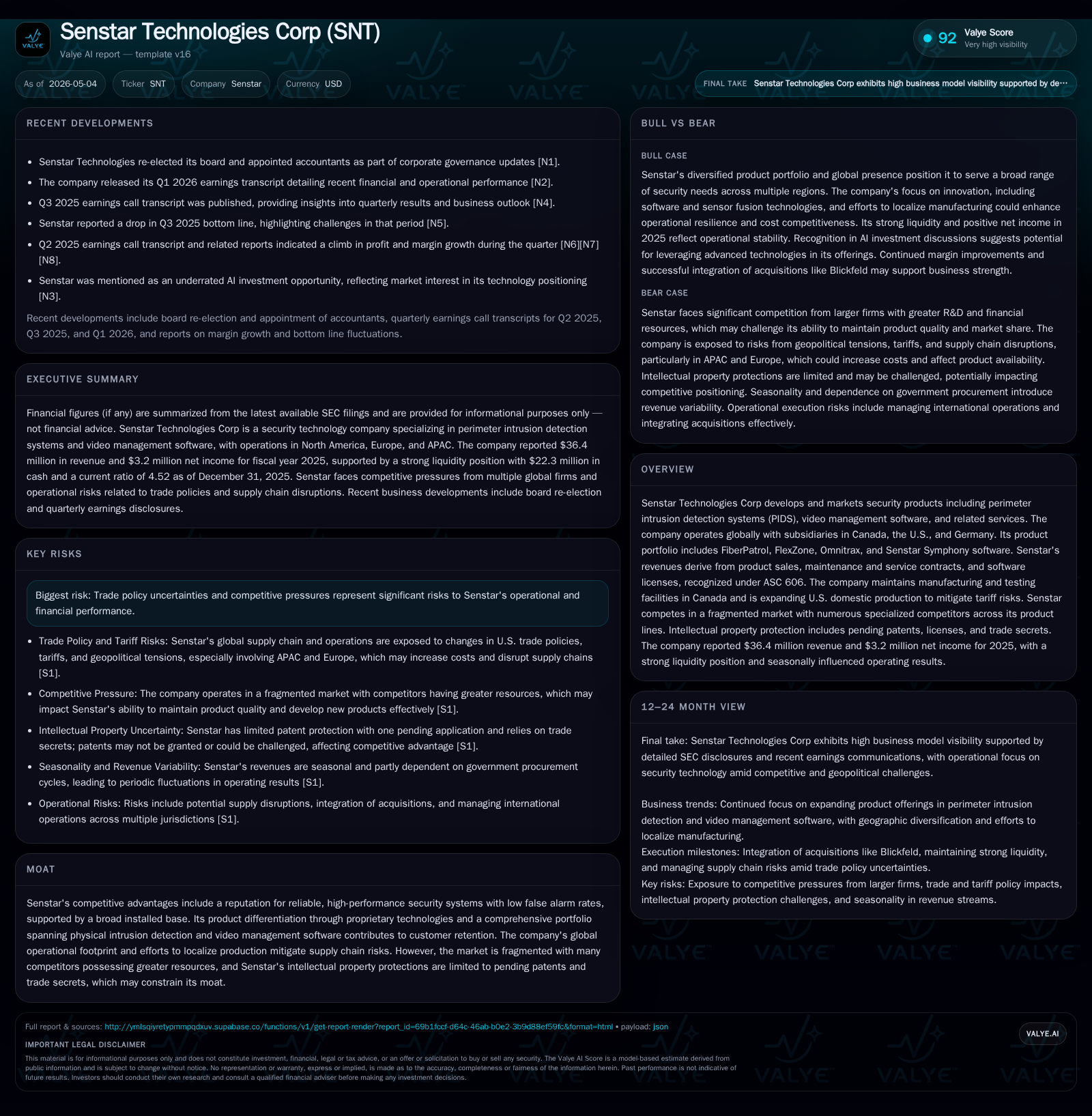
In its latest quarterly disclosures, Senstar Technologies highlighted efforts to mitigate tariff-related cost pressures and supply chain uncertainties through expansion of U.S.-based production for key products like FiberPatrol and FlexZone. The company's business model centers on perimeter intrusion detection systems and video management software, with revenues generated from product sales, maintenance contracts, and software licenses under ASC 606. Operating in a fragmented market with numerous specialized competitors, Senstar differentiates via proprietary technology and a proven track record for reliability, aiming to capture growth amid evolving trade dynamics. Key risks include tariff volatility and supply disruptions, while growth is driven by manufacturing localization and product innovation along with infrastructural security demand.
Latest Quarterly Developments Highlight Operational Challenges and Strategic Responses
Senstar Technologies' most recent filing dated May 4, 2026 ([S2]) underscores active measures to counter rising trade and tariff pressures impacting its global supply chain. The company explicitly disclosed initiation of U.S.-based production for pivotal products such as FiberPatrol (fiber optic perimeter intrusion detection) and FlexZone (active infrared sensors), reflecting a strategic pivot aimed at insulating the business from ongoing U.S. protectionist policies. These moves intend to curtail the pricing volatility induced by tariffs imposed on imports from China, Europe, Canada, and Asia-Pacific regions—a source of significant cost uncertainty noted in both the quarterly ([S3]) and annual ([S1]) filings.
This operational adjustment emerges within a context of observed seasonal revenue skewing toward the fourth quarter due to customers’ budget-driven buying patterns, combined with weather-driven delays in project deployments early in the year. Such seasonality amplifies near-term execution risk tied to contract timing but remains an acknowledged industry norm.
Revenue Streams and Product Portfolio: Evaluating Senstar's Core Business Model
Senstar’s business model is anchored in perimeter intrusion detection systems (PIDS)—including fiber optic sensors (FiberPatrol), infrared detection (FlexZone), fence-mounted systems (Omnitrax)—and video management software like Senstar Symphony ([S1]). These products cater primarily to government entities, critical infrastructure operators, industrial sites, and commercial clients who demand reliable security solutions with minimal false alarms.
Revenue generation follows a combined structure: product hardware sales contribute upfront margins; maintenance/service contracts provide recurring revenue streams; while software licensing introduces scalable fee components under ASC 606 standards ([S1]). This mix strengthens customer stickiness via extended contracts supporting installed base longevity [F1]. The company currently manufactures largely out of Canada but is ramping up U.S. capability to offset tariff-exposed components sourced globally ([S26]).
Market Dynamics: Competitive Positioning in a Fragmented Perimeter Security Sector
The perimeter security market remains highly fragmented with numerous regional and specialized players such as Southwest Microwave, AVA (Future Fibre Technologies), Fibersensys (Optex), Gallagher Group among others ([S17],). Competitive differentiation hinges largely on technological performance—particularly detection accuracy combined with low nuisance alarms—and robust customer support.
Senstar’s moat rests upon proprietary technology including certain pending patents and guarded trade secrets; however, these IP protections are not absolute barriers given industry fragmentation (). The purchasing cycle in security tech is deliberately slow due to organizational budget constraints and procurement policies typical for public sector entities. Such factors temper pricing power despite product quality advantages.
Switching costs are moderate but augmented by long-term service contracts that embed customers within Senstar’s ecosystem post-installation. Pricing competition exerts consistent pressure especially from better-capitalized rivals offering broader integrated security platforms.
Growth Catalysts: Technology Differentiation and Market Expansion
Senstar’s growth trajectory is supported by several tangible factors: A deliberate increase in domestic U.S. production aims to stabilize costs amidst geopolitical tensions ([S1],[N1]). The recent acquisition of Blickfeld GmbH brings advanced 3D LiDAR sensing capabilities ([S18])—a natural extension into volumetric traffic monitoring and industrial safety verticals that exhibit higher growth potential compared to traditional perimeter markets.
Furthermore, incremental improvements in software offerings such as Senstar Symphony embed intelligent video analytics enhancing value proposition for end-users who increasingly demand integrated cybersecurity physically securing infrastructure assets ([N1],[S13]). Regulatory trends mandating enhanced infrastructure protection may unlock incremental demand across multiple jurisdictions.
Risks to Monitor: Trade Policy Uncertainty and Supply Chain Volatility
Trade policy remains the principal external risk vector for Senstar per its latest disclosures ([S1],). Escalating or shifting tariffs between the U.S., Canada (notably revisions to USMCA), EU post-Brexit realignments, and intensifying U.S.-China conflicts threaten supply chain continuity. Such disruptions introduce raw material cost inflation—steel, aluminum—as well as lead time extensions challenging contractual delivery commitments.
Currency fluctuations compound volatility given revenues are mainly USD/EUR-denominated while expenses partially occur in CAD/EUR currencies ([S1]). Operational flexibility depends on supplier diversification but certain strategic component sourcing remains concentrated increasing vulnerability to single points of failure.
Geopolitical tensions also translate into unpredictable regulatory regimes potentially affecting sales channels or certification pathways in EMEA/APAC regions.
Forward-Looking Indicators: Guidance, Milestones, and Demand Signals
Investors should closely monitor Senstar’s progress in scaling its U.S. manufacturing footprint—specifically completion timelines for FiberPatrol/FlexZone production capacity expansions—to assess tariff exposure mitigation effectiveness ([S2],[S3]). Contract awards typically crystallize late calendar year due to procurement cycles; early signals around backlog growth or multi-year contract renewals could validate forecast assumptions ([N1]).
The rate of service contract renewals will also serve as a barometer for customer retention reflecting product satisfaction underpinned by competitive positioning.
Additionally, launch cadence for innovations derived from R&D initiatives—budgeted at approximately $4.2 million annually—should be tracked as they relate directly to market differentiation efforts ([S13],[S6]).
Financial Overview Reflecting Liquidity and Profitability Trends
Latest financial snapshot
| Metric | Value | Period |
|---|---|---|
| Cash & equivalents | $22mm | |
| 2025-12-31 | ||
| Current assets | $41mm | |
| 2025-12-31 | ||
| Current liabilities | $9mm | |
| 2025-12-31 | ||
| Current ratio | 4.52x | |
| 2025-12-31 |
Source: SEC companyfacts cache [F1].
Senstar closed fiscal year 2025 with total revenue of approximately $36.4 million generating net income of $3.2 million evidencing structural profitability at current scale ([F1]). A strong liquidity profile features $22.3 million in cash & equivalents alongside a healthy current ratio of 4.52 providing ample balance sheet flexibility amid macroeconomic headwinds ([F1]).
Operating expenses remain elevated due to investments in research & development ($3.35 million net) alongside growing selling & marketing initiatives particularly aligned with new markets accessed through Blickfeld acquisition completed February 2026 using cash reserves ([F1],[S13]).
The company maintains manageable capital expenditures (~$0.5 million estimated for 2026) supporting asset base expansions including new manufacturing capacity projects ([S6],[S26]).
Disclaimer: This is research-only, informational analysis and not investment advice. It may include AI-generated interpretation and general industry context. Always verify important details using primary sources.

Comments