
C.H. Robinson's 2026 Q1 Update: Leveraging Lean AI Amid Market Headwinds
C.H. Robinson’s latest quarter reinforces its strategic edge in AI-driven multimodal logistics despite macro uncertainties.
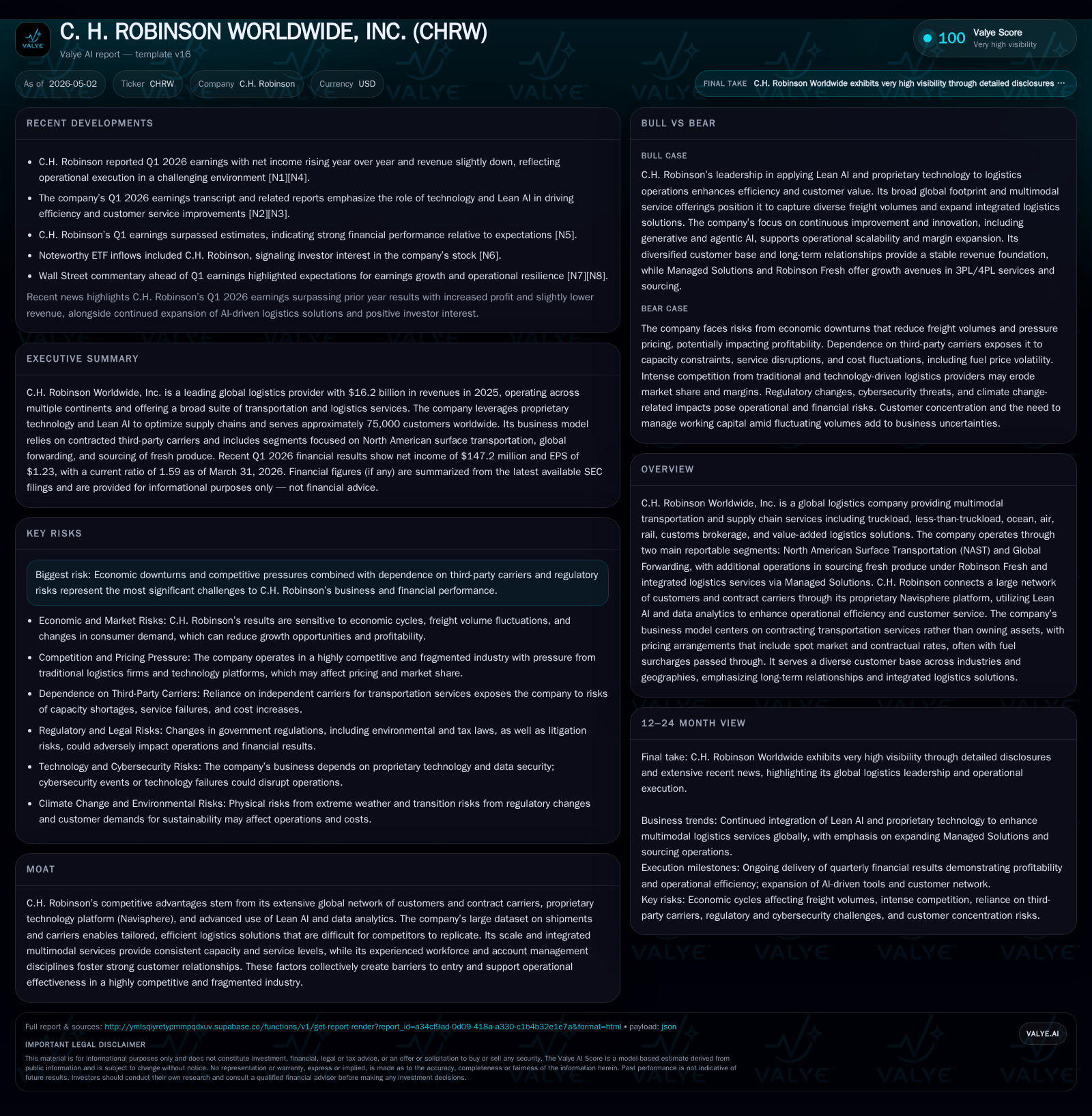
In its 2026 first quarter filing, C.H. Robinson Worldwide, Inc. reported stable operational execution powered by its proprietary Lean AI and Navisphere platform. The company continues to navigate a challenging transport market marked by fluctuating volumes and pricing pressures, relying on its asset-light model and deep carrier network. Its growth prospects hinge on scaling Managed Solutions and expanding integrated multimodal offerings, supported by its vast shipment data and technology investments. Risks remain in economic cyclicality, carrier capacity constraints, and regulatory exposures.
Recent Operating Update
C.H. Robinson’s Q1 2026 filing (Form 10-Q dated May 1) underscores steady operational performance amidst a mixed global logistics environment [S2]. The company reported persistent softening in freight volumes and trucking capacity supply constraints triggered by broader economic volatility. Despite these headwinds, the firm bolstered adjusted gross profit margins driven by its dynamic pricing powered by Lean AI and targeted service mix shifts favoring higher-value multimodal forwarding operations.
Management emphasized that customer demand remains robust for integrated supply chain solutions delivered through its Managed Solutions segment launched in late 2024. This business leverages the company’s proprietary transportation management system (TMS) technology along with consulting services to provide seamless 3PL/4PL functionalities—addressing an expanding market gap for end-to-end logistics partnership beyond traditional freight brokerage models [S2], [S20].
Contract carrier engagement was steady with over 450,000 providers active globally via the Navisphere platform. The company's ability to finely match shipments to carrier profiles using extensive historical data continues to optimize load fill rates and reduce transit disruptions.
Business Model
At the core of C.H. Robinson’s model is an asset-light approach primarily focused on transportation brokerage rather than owning fleets or warehouses directly. Revenue is generated by charging customers fees related to freight movement while paying contracted carriers a negotiated amount—capturing value as the spread between these rates.
The company’s platform orchestrates multimodal shipments spanning truckload (dry van, temperature-controlled, flatbed), less-than-truckload (LTL), ocean freight as an NVOCC, air freight as a certified IAC operator, rail intermodal transport coordination, customs brokerage, warehousing services, plus sourcing fresh produce under Robinson Fresh [S11], [S19].
Importantly, C.H. Robinson combines human expertise with advanced technology—Lean AI—to enhance decision-making speed and accuracy across procurement and delivery logistics workflows. This synergy boosts pricing agility in volatile markets while automating mundane tasks for staff—enabling scalable margin improvements without proportionate cost increases.
Pricing contracts vary: spot market transactions capture real-time rate fluctuations; longer-term contractual rates offer stability but carry exposure if market prices rise unexpectedly versus fixed customer rates.
Industry Structure and Competitive Position
Global logistics is intensely fragmented with myriad providers ranging from asset-heavy carriers to emerging digital freight matching startups offering online marketplaces. C.H. Robinson's moat rests on several pillars:
- Scale & Network: Managing approximately 37 million shipments annually for ~75,000 unique customers worldwide creates substantial network effects enhancing service reliability.
- Technology & Data: Ownership of one of the largest datasets on routes, carriers’ performance scores, load histories etc., enables superior load matching algorithms not easily replicated.
- Integrated Service Suite: Offering end-to-end transport modes plus customs compliance alongside value-added services like supply chain design gives clients a one-stop solution.
- Experienced Workforce & Relationship Depth: Strong account management teams embed deeply within customer operations fostering high retention.
This blend positions CHRW distinctively against fragmented competitors such as regional brokers or commodity-focused logistics tech platforms which lack comparable data scale or multi-modal coverage [S14].
Growth Drivers
Several levers underpin future growth:
- Managed Solutions Expansion: The move into fully managed TMS-based 3PL/4PL services taps demand from shippers seeking digital transformation coupled with hands-on supply chain consulting—a step beyond pure brokerage into higher-margin territory.
- AI and Automation Enhancements: Continuously advancing generative AI and agentic AI applications accelerate quoting precision, route optimization, capacity forecasting and customer service responsiveness.
- Broadened Customer Penetration: Leveraging proprietary insights across industries enables cross-selling additional services (e.g., customs brokerage alongside transport) and deeper integration into clients’ supply chains.
- Targeted Acquisitions: Pursuing complementary businesses to extend geographical reach or add niche capabilities enhances scale economies without diluting core competency focus.
These drivers align well with industry trends favoring technologically enabled full-spectrum logistic partners that can help mitigate supply chain volatility risks for large enterprises.
Risks / Watchpoints / Growth Constraints
While well positioned internally, C.H. Robinson faces several external challenges:
- Economic Cyclicality: Freight volumes correlate closely with global economic health; recessions materially depress demand impacting revenue volume overall.
- Carrier Capacity & Cost Pressures: Labor shortages within truck driving workforce coupled with tightened regulatory regimes elevate carrier costs which may compress gross profit spreads where fixed-price contracts exist.
- Fuel Price Volatility: Fuel costs traditionally flow through pricing mechanisms but timing mismatches can pressure adjusted gross profit margins temporarily.
- Dependence on Third Parties: Reliance on independent carriers for execution exposes CHRW to service failures or disruptions beyond direct control requiring robust contingency planning.
- Regulatory & Geopolitical Events: Customs regulations changes or geopolitical tensions can disrupt international forwarding activities especially in sensitive trade corridors.
- Working Capital Intensity: Given extended accounts receivables cycles contrasted with contract carrier payment timings, working capital requirements are elevated impacting cash flow flexibility.
Monitoring these factors carefully is crucial as they can influence short- to medium-term operational performance materially despite underlying strategic strengths.
What to Watch Next
Key upcoming milestones include:
- Execution progress in Managed Solutions scaling measured by new client bookings or volume migration from transactional brokerage models.
- Further innovations announced in AI-driven operational enhancements impacting cycle times or margin expansion.
- Quarterly freight volume trends especially in North American truckload segments providing leading indicators of end-market demand shifts.
- Pricing environment evolution versus contracted rates signaling margin sustainability amid inflationary pressures.
- Integration outcomes for any acquisitions completed adding niche capabilities or geographic coverage.
- Regulatory updates pertinent to US export/import rules or domestic transportation mandates influencing compliance costs.
These markers will clarify trajectory towards long-term growth targets communicated last year [N8], [S27].
Financial Profile Briefly Contextualized
Latest financial snapshot
| Metric | Value | Period |
|---|---|---|
| Cash & equivalents | $160mm | |
| 2026-03-31 | ||
| Total debt | $1343mm | |
| 2026-03-31 | ||
| Net debt | $1183mm | |
| 2026-03-31 | ||
| Current assets | $3.0bn | |
| 2026-03-31 | ||
| Current liabilities | $1896mm | |
| 2026-03-31 | ||
| Current ratio | 1.59x | |
| 2026-03-31 |
Source: SEC companyfacts cache [F1].
At Q1-end March 31 2026, CHRW maintained a $160 million cash position against $1.34 billion total debt yielding a current ratio of approximately 1.59—demonstrating solid short-term liquidity despite working capital intensity inherent in its operating model ([F1]). Operating income from the prior full year closed near $795 million corroborating strong profitability benchmarks amidst evolving macro conditions ([F1]).
The company's business model's inherently high days sales outstanding relative to days payable highlights elevated trade receivables financing needs but is constrained within manageable levels aligned with sector peers ([S26]). The balance sheet appears positioned to support ongoing strategic investments particularly into Managed Solutions growth initiatives and technology development programs without compromising financial flexibility.
This analysis synthesizes C.H. Robinson Worldwide’s most recent quarterly disclosures alongside contextual insights from its annual SEC filings reflecting the company’s navigation of a complex logistics landscape defined by rapid digital transformation demands and persistent economic cyclical challenges. The firm's unique integrative application of Lean AI combined with established global networks continues to anchor competitive differentiation critical for future scalability but requires vigilant management of sector-specific risks notably tied to contract dynamics and external environmental factors.
This report is intended solely for informational purposes regarding C.H. Robinson Worldwide Inc.’s business strategy and operating context based on publicly available disclosures as of May 2026. It does not constitute investment advice.
Disclaimer: This is research-only, informational analysis and not investment advice. It may include AI-generated interpretation and general industry context. Always verify important details using primary sources.

Comments