
ArcBest Faces Q1 Challenges Amid Strategic Focus on Integrated Logistics Growth
ArcBest's Q1 2026 results reflect operational headwinds and tight liquidity, while strategic initiatives in technology-enabled logistics offer pathways for growth.
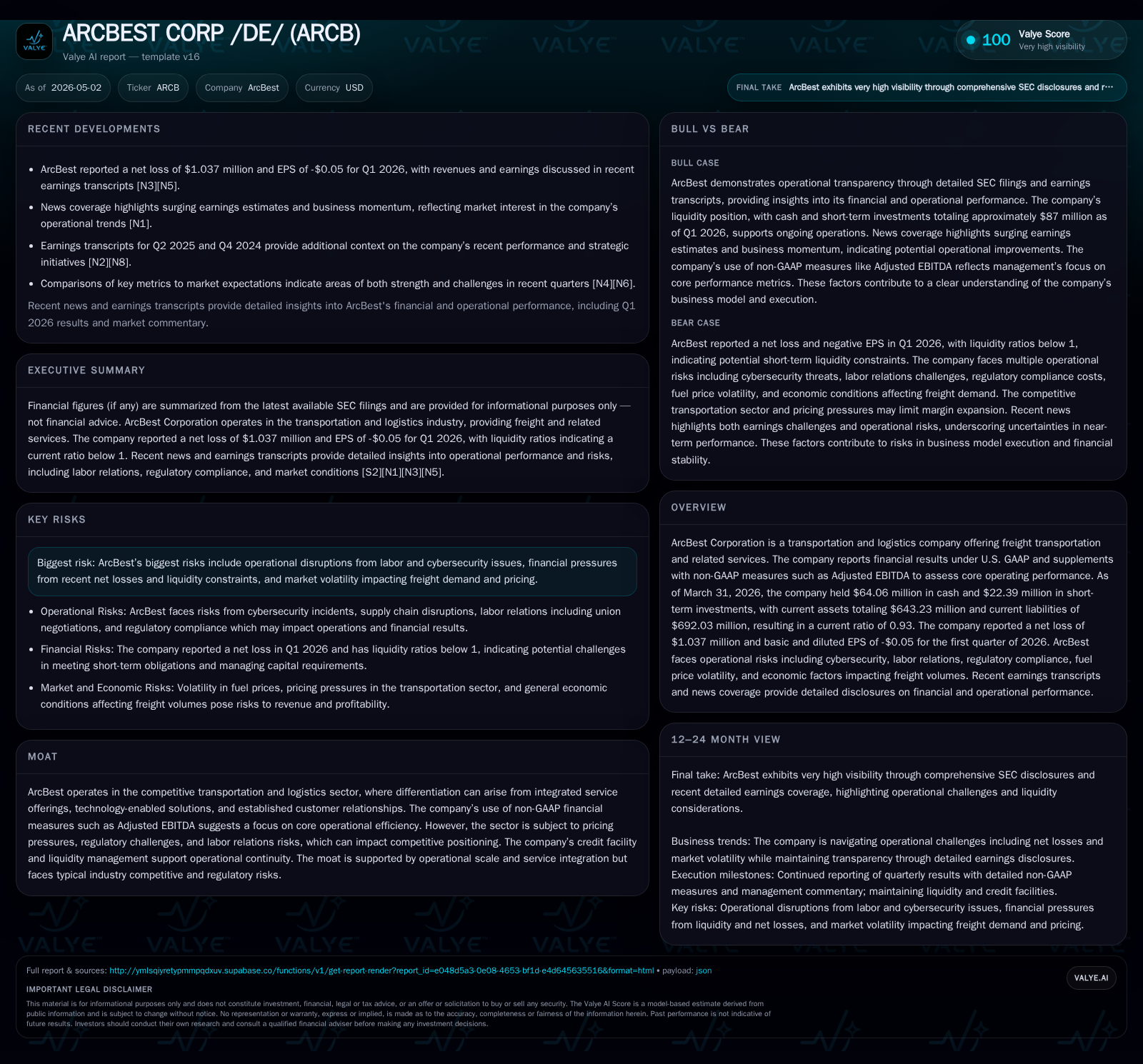
ArcBest reported a net loss of approximately $1.037 million and an EPS of -$0.05 in Q1 2026, pressured by cybersecurity incidents, labor challenges, and fuel price volatility [S2][S3]. The company's integrated business model combining asset-based freight with technology-driven logistics services provides a competitive differentiation amid industry-wide capacity constraints and pricing pressures [S1][N10]. Liquidity remains tight with a current ratio below 1.0, supported by $64 million in cash and equivalents as of March 31, 2026 [F1]. Growth drivers include digital supply chain transformation, expansion into niche routes, and margin improvement initiatives, balanced against risks from labor relations, regulatory compliance costs, cybersecurity threats, and volatile fuel prices.
Q1 2026 Operating Results and Challenges
ArcBest’s first quarter 2026 financial report showed a net loss of about $1.037 million with diluted EPS at -$0.05 [S2], signaling margin pressures during operational disruptions. These included cybersecurity incidents affecting system reliability and workforce productivity challenges linked to labor relations within its asset-based freight operations [S3]. Fuel price volatility further strained cost management despite fuel surcharge adjustments.
Freight volumes softened due to macroeconomic uncertainties impacting shipping demand [N3]. At quarter-end March 31, 2026, the company reported current assets of $643.23 million against current liabilities of $692.03 million resulting in a current ratio of 0.93—indicating constrained near-term liquidity despite cash reserves of $64.06 million [F1].
Management highlighted ongoing margin improvement programs aimed at reducing fixed costs and enhancing operational efficiency as core responses to these challenges [S3]. Adjusted EBITDA metrics also reflected the impact of inflationary pressures and non-recurring expenses.
Business Model: Integration of Asset-Based Freight and Technology-Enabled Logistics
ArcBest operates an integrated model combining traditional asset-based freight services with technology-driven logistics solutions that enhance shipment visibility, inventory management, and route optimization [S1]. This hybrid approach differentiates the company from asset-heavy pure carriers by offering bundled services tailored to complex customer supply chain needs.
The model supports diversified revenue streams through both company-owned assets and independent contractors across regional and national routes alongside value-added logistics offerings [S3]. Customer retention benefits from integrated service delivery reduce switching costs but introduce operational complexity requiring effective coordination across business units.
Industry Context and Competitive Positioning
The U.S. transportation sector remains fragmented with intense competition limiting pricing power for carriers like ArcBest. Key industry headwinds include persistent driver shortages impacting capacity utilization, rising fuel and equipment costs, evolving environmental regulations increasing compliance burdens, and wage pressures from unionized workforces [S1][S14].
ArcBest’s scale combined with its technology-enabled platforms provides competitive advantages in managing end-to-end logistics solutions beyond pure freight hauling—a moat during competitors focused strictly on asset-based operations [N10]. Nevertheless, regulatory compliance costs and aggressive pricing among regional competitors continue to compress margins.
Growth Drivers
Strategic growth is driven by accelerating customer adoption of ArcBest’s digital logistics capabilities that improve supply chain transparency and decision-making [N3]. The broader macro trend toward supply chain digitization creates opportunities to upsell higher-margin value-added services.
Expansion into underserved geographic regions or specialized vertical markets offers incremental volume capture where competition is less intense or customized solutions justify premium pricing [S3]. Pricing strategies are being refined post-pandemic to improve base freight rates complemented by dynamic fuel surcharge mechanisms mitigating input cost volatility.
Operational restructuring aims to improve fleet utilization—a critical capital-intensive KPI—and reduce fixed overheads aligned with adjusted EBITDA targets for profitability enhancement [N1].
Risks and Constraints
Labor relations present significant operational risk given collective bargaining agreements covering key employees in ABF Freight’s operations; potential disputes could disrupt service continuity [S14]. Cybersecurity threats remain ongoing vulnerabilities affecting system uptime essential for real-time tracking.
Fuel price volatility continues to challenge margin stability; inefficiencies in passing through surcharges can erode profitability during rapid swings in fuel costs [S2]. Regulatory changes imposing stricter emissions or safety standards may increase compliance expenditures.
Financially, the sub-1 current ratio (0.93) highlights tight liquidity conditions requiring rigorous working capital management during periods of margin compression [F1]. Continued net losses underline the importance of balancing growth investments with capital discipline.
Near-Term Catalysts to Monitor
Investors should track subsequent quarterly earnings for signs of margin stabilization or recovery alongside updates on cost rationalization efforts [S3]. Contract wins in higher-margin logistics segments could signal volume growth potential.
Developments in labor negotiations or regulatory frameworks are critical given their direct impact on operating costs and continuity [N2]. Fuel price trends relative to pricing adjustments will provide insight into margin sustainability.
Advances in technology platforms enabling deeper customer engagement or market expansion will be key indicators linking strategy execution to KPIs such as bookings growth or retention improvement.
Latest Financial Snapshot (as of March 31, 2026)
Latest financial snapshot
| Metric | Value | Period |
|---|---|---|
| Cash & equivalents | $64mm | |
| 2026-03-31 | ||
| Current assets | $643mm | |
| 2026-03-31 | ||
| Current liabilities | $692mm | |
| 2026-03-31 | ||
| Current ratio | 0.93x | |
| 2026-03-31 |
Source: SEC companyfacts cache [F1].
This snapshot underscores the liquidity constraints faced despite substantial cash balances supporting near-term obligations.
Disclaimer: This is research-only, informational analysis and not investment advice. It may include AI-generated interpretation and general industry context. Always verify important details using primary sources.

Comments