
Strategic Steps at Greenbriar Sustain Growth Potential Despite Capital Constraints
Greenbriar Sustainable Living advances key development phases at Sage Ranch and solar projects while managing tight liquidity and financing dependencies.
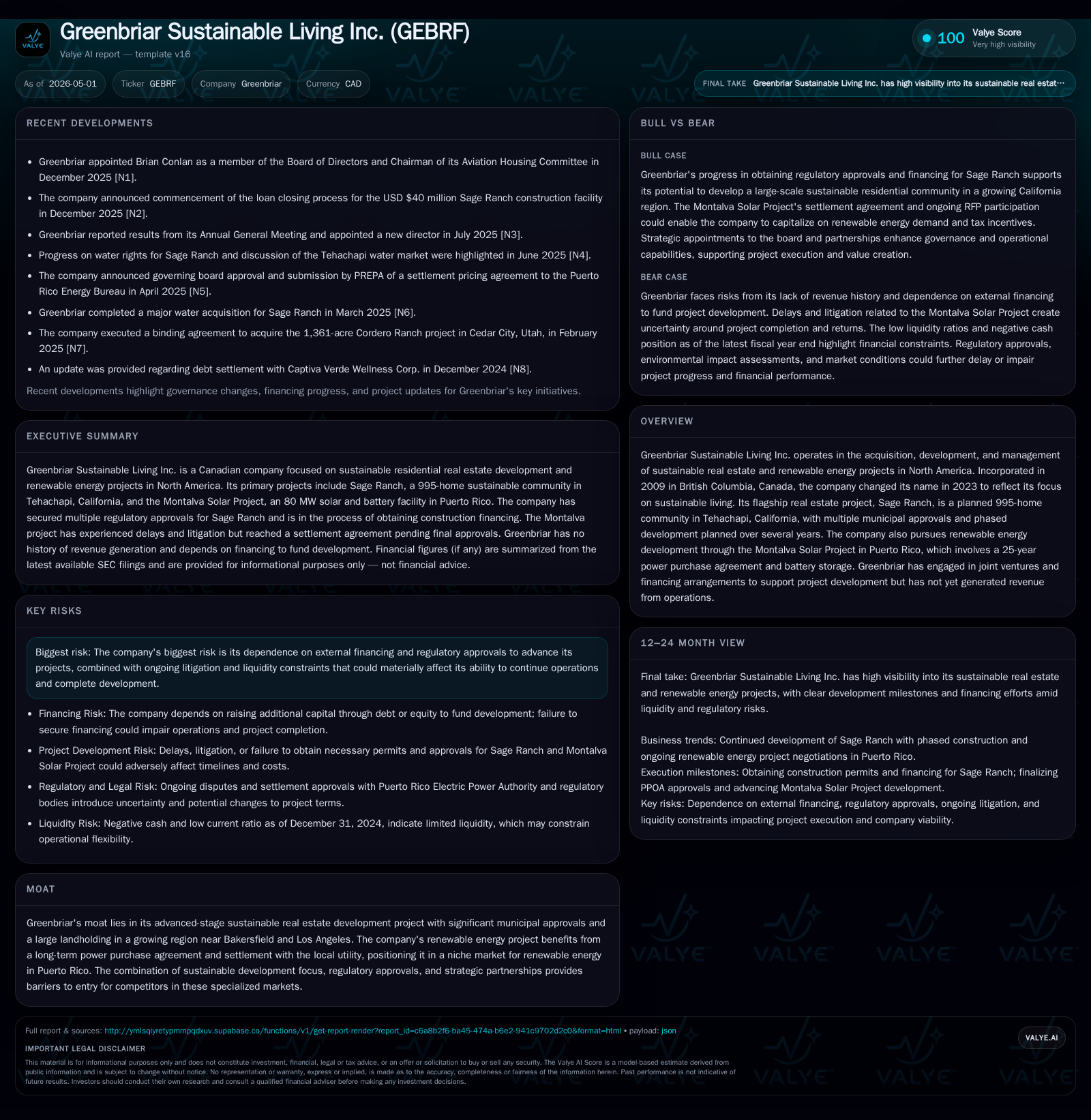
In its latest quarterly filings, Greenbriar Sustainable Living Inc. reported ongoing progress in its flagship Sage Ranch residential project and the Montalva Solar renewable energy initiative, both pivotal to its strategic repositioning toward sustainable living development. Despite no operating revenue yet, the company is actively securing financing frameworks including a potentially transformative US$40 million construction loan mandate for Sage Ranch. However, financial constraints persist with a stretched current ratio and substantial working capital deficit, underscoring critical reliance on timely capital raises and regulatory approvals. Litigation settlements and governance complexities linked to joint ventures further shape the risk landscape.
Latest Quarterly Operating Update: Project Developments and Capital Status
Greenbriar Sustainable Living’s March 16, 2026 quarterly filing [S2] provides critical insight into the company’s near-term operational progress juxtaposed with persistent financial constraints. While still pre-revenue, the filing confirms advancing development under phase-gated approvals for its signature Sage Ranch project in Tehachapi, California. The Phase 1 Precise Development Plan—the last major municipal hurdle before construction—was approved in November 2023 [S23], enabling applications for necessary building permits. Management anticipates commencing Phase 1 construction shortly after permit acquisition, though potential modifications remain following a recent court ruling concerning environmental review adequacy [S23].
On the renewable energy front, Greenbriar is actively engaged in negotiating a settlement power purchase agreement (PPA) with Puerto Rico Electric Power Authority (PREPA) for its Montalva Solar Project [S10][S28]. The agreement aims to establish a reduced but viable 80 MWac solar plus battery storage facility as part of Puerto Rico's clean energy transition. Progress hinges on final approvals from PREPA, the Puerto Rico Energy Bureau (PREB), and the Financial Oversight & Management Board of Puerto Rico (FOMB), which remain pending.
Capital expenditure activity continues centered on these projects despite annual operating cash outflows now improving from $2.2 million in 2023 to approximately $0.3 million in 2025 [S4]. This reduction evidences deliberate cost management amid funding challenges but underscores persistent liquidity pressure as project spending ramps up without offsetting revenues. Notably, recent settlements related to joint venture obligations reduced accrued liabilities by issuing shares valued at $625,000 [S26], easing some near-term balance sheet burdens.
Business Model Explained: Sustainable Real Estate and Renewable Energy Projects
Greenbriar functions primarily as a development-stage asset holder focused on integrated sustainable residential real estate alongside renewable energy infrastructure in North America [S1]. Its core economic drivers are deeply tied to progressing large-scale projects through acquisition, zoning approvals, phased permitting, construction initiation, and eventual home sales or sale/operation of energy facilities.
The Sage Ranch project exemplifies this model: acquired originally in 2011 as ~138 acres zoned for residential development with city council-approved plans for up to 995 housing units spanning single-family homes to apartments [S7][S26]. The company does not generate operating revenues until these homes are constructed and sold or leased—making Sage Ranch essentially an asset-heavy multi-year growth play dependent on municipal approvals and access to construction finance.
Similarly, Montalva Solar represents Greenbriar’s renewable energy arm. Starting from acquiring land leases and a legacy master PPOA arrangement with PREPA dating back to 2011 [S10], the project has negotiated down from an initial 165 MW AC proposal to an 80 MW AC facility under a long-term PPA agreed in principle but pending multi-agency signoffs [S28]. Revenues will emanate only once power production commences post-construction and full interconnection.
Joint ventures like the agreement with Captiva Verde Wellness Corp., which holds a 50% net profits interest contingent on funding development expenditures [S22], add complexity but also provide additional capital pathways. However, such arrangements introduce governance complexity given overlapping executives across entities.
Industry Positioning: Competitive Advantages and Regulatory Factors
Greenbriar occupies a niche intersection of sustainable real estate development combined with renewable power infrastructure—a pairing increasingly relevant in target markets but fraught with regulatory hurdles.
The company's competitive moat stems in part from securing comprehensive municipal zoning approvals—rarely fast nor guaranteed—in California's multifaceted regional planning environment [S23]. The advance to Final Master Plan status plus ongoing phase-specific approvals at Sage Ranch underscores this advantage versus early-stage competitors lacking such entitlements.
For renewables, holding an executed Master PPOA with PREPA positions Greenbriar favorably within Puerto Rico’s clean energy market where capacity acceptance remains tightly controlled by regulatory boards like FOMB [S28]. This designated "Legacy Project" status prevents facile entry by newcomers without legacy contractual rights.
Execution risks from contentious utility negotiations and local permitting delays remain high industry-standard challenges but Greenbriar’s established relationships combined with its lawsuit settlements mitigate immediate existential threats [S10][S23].
Growth Drivers and Development Catalysts
The near-to-mid term growth trajectory hinges on several concretely measurable milestones:
Phased Construction at Sage Ranch: Receipt of all required building permits post-Phase 1 Precise Plan approval will enable ground-breaking anticipated within mid-2026; phased home deliveries extending over subsequent years aim to trigger incremental revenue recognition upon sales closure [S23].
Voya Mandate Financing: The company executed a US$40 million senior secured loan mandate agreement with Voya Investment Management enabling construction funding for Sage Ranch subject to final underwriting terms [S22]. Successful drawdown here is vital for timely project execution.
Resolution of Montalva Delays: Completion of negotiations culminating in PREPA/PREB/FOMB approval of the revised PPA consolidates revenue visibility for the solar project [S28]. Submission under accelerated RFP processes may further enhance commercial terms.
Joint Venture Settlements: Timely repayment of amounts owed under Captiva JV agreements smooths profit-sharing clarity and reduces contingent liabilities [S22][S26].
Each driver is closely linked to external factors such as municipal compliance timelines or credit market conditions shaping financing availability.
Risks and Constraints: Financing, Regulatory Approval, and Governance Challenges
A constellation of risks distinctly shapes Greenbriar’s operational outlook:
Liquidity Fragility: With no history of operating revenue until substantial phases complete, reliance on debt/equity funding rounds creates execution volatility; the company reported a cash balance barely exceeding CA$57K as of December 31, 2025 against CA$15.9 million current liabilities resulting in a severely impaired current ratio below 0.15 [F1][S5]. Sustained fundraising challenges could materially impair going concern status.
Regulatory Uncertainty: Pending judicial decisions could invalidate environmental impact report certifications affecting Sage Ranch permitting timelines [S23], while PPA finalization delays pose ongoing revenue deferral risks at Montalva [S10][S28].
Litigation Exposure: Historical joint venture disputes necessitated complex settlement arrangements impacting corporate guarantees; residual legal uncertainties persist concerning past contractual execution [S1]
Governance Conflicts: Shared leadership roles between Greenbriar and affiliated entities such as Captiva raise potential conflict-of-interest issues that may affect negotiation impartiality or delay decision making [S1][S22]. Control mechanisms rely largely on fiduciary duties under British Columbia corporate law rather than explicit preventive policy enforcement.
These factors require careful monitoring given their capacity to constrain project delivery timelines or elevate cost-of-capital levels.
Key Milestones and What to Watch Next
Investor attention should focus on upcoming events likely within the next quarter:
- Completion of all necessary permits enabling physical construction commencement at Sage Ranch Phase I;
- Announcement of definitive financing drawdowns or amendments related to Voya’s US$40 million loan mandate;
- Regulatory adjudication outcomes linked to environmental rulings affecting site plans,
- PPA re-submission results from PREB/FOMB decision-making impacting Montalva’s progression;
- Quarterly disclosures expected May-June outlining updated cash flow burn rates and capital raising success;
- Regular updates regarding payment progress against Captiva joint venture settlement installments.
These milestones will serve as concrete demand markers signaling whether operational momentum can be sustained despite financial headwinds.
Financial Position and Liquidity Overview
As of fiscal year-end December 31, 2025 reported in its annual filing [F1][S4][S5], Greenbriar displayed minimal cash reserves totaling CA$57,539 against substantial current liabilities close to CA$16 million—reflecting significant working capital deficits consistent with pre-development stage realities. Operating cash outflow improved notably from prior years but remains negative reflecting ongoing investment into land use planning activities along with professional fees.
Financing inflows driven by incremental loans totaling approximately $1.1 million plus private placements suggest active attempts to bridge interim funding gaps; nonetheless long-term sustainability hinges on larger commitments such as Voya construction loans successfully materializing without prohibitive dilution or borrowing costs.
Non-cash accounting items—such as accretion expenses on convertible debentures exceeding half a million dollars annually—and unrealized securities gains indicate complex instrument structures underpinning the firm’s balance sheet dynamics rather than straightforward operating profitability.
In sum, despite cost discipline demonstrated through reduced general administrative expenses year over year ($1.9 million down from over $2 million) there remains acute sensitivity surrounding refinancing risk that necessitates continued vigilance from management.[F1]
Disclaimer: This analysis is based solely on publicly available SEC filings without any proprietary knowledge or forward-looking financial projections beyond stated facts. It does not constitute investment advice or recommendations.
Disclaimer: This is research-only, informational analysis and not investment advice. It may include AI-generated interpretation and general industry context. Always verify important details using primary sources.

Comments