
DNA X, Inc. Restructures Amid Asset Sale and Transition to On-Chain Trading Protocol
Following the divestiture of its enterprise 5G business, DNA X pivots toward decentralized finance with liquidity and execution risks in focus.
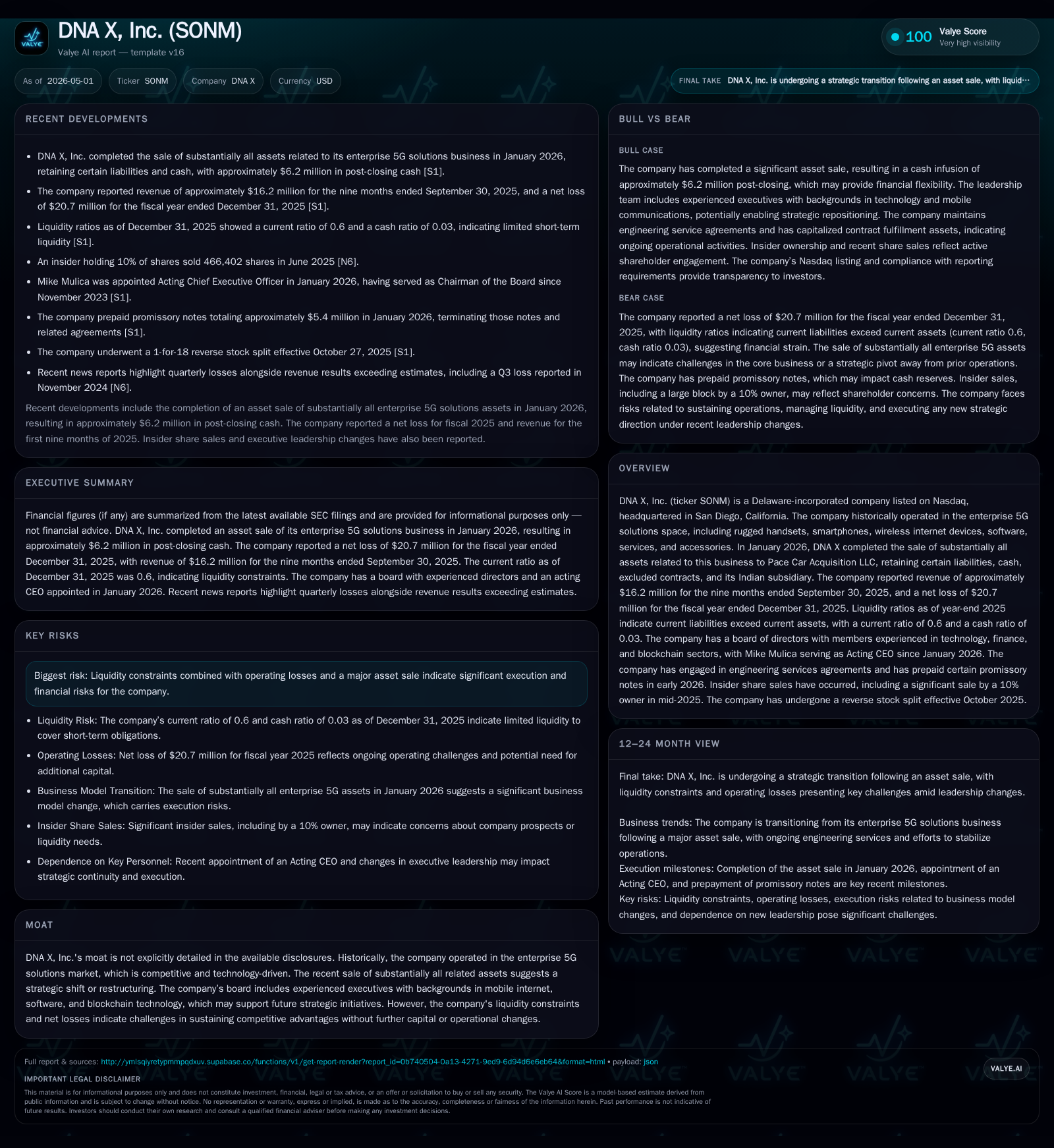
DNA X, Inc. completed in early 2026 a significant asset sale shedding its legacy enterprise 5G solutions business, transitioning to focus on an advanced on-chain trading protocol for decentralized exchanges. The company’s recent filings reveal ongoing liquidity constraints highlighted by a low current ratio and net losses for fiscal 2025. With the exit from its hardware-heavy segment, DNA X is repositioning to capitalize on decentralized finance automation via its DNAX DeFi platform, aiming to leverage blockchain expertise on its board. However, challenges include rebuilding revenue streams, managing cash flow amid net losses, and executing strategic transformation in a competitive DeFi landscape.
Recent Operating Update and Context
DNA X, Inc. (NASDAQ: SONM) signaled a marked transformation in early 2026 by completing the sale of substantially all assets tied to its enterprise 5G solutions business on January 23rd [S10]. This business included rugged handsets, smartphones, wireless internet devices, associated software services, and accessories — a segment that historically defined the company's operational identity but faced intense competitive pressure in telecommunications hardware.
Following this transaction with Pace Car Acquisition LLC, DNA X retained certain liabilities including golden parachute obligations along with cash reserves and specific contracts excluded from the sale. The company’s Indian subsidiary was also excluded from the deal [S10]. The proceeds from the sale contributed to approximately $6.2 million in post-closing cash.
Shortly thereafter in April 2026 filings [S3], DNA X announced engagement with a new independent auditor TAAD LLP for fiscal year ending December 31, 2026. This followed dismissal of Baker Tilly US LLP whose reports had included substantial doubt about the company’s ability to continue as a going concern due to financial stress [S22]. Such moves underscore governance recalibration alongside the strategic business shift.
Business Model Evolution
Historically active in enterprise-grade 5G hardware solutions—ranging from ruggedized phones tailored to harsh environments (e.g., construction sites) to wireless internet devices—and related software and support services, DNA X’s revenue was subject to cyclical capital spending trends by enterprise customers along with intense competition and margin pressure in hardware manufacturing.
The company's revenue was approximately $16.2 million over the nine months ended September 30, 2025 (prior to asset sale) with full-year net loss hitting $20.7 million driven by operational costs exceeding sales during declining demand [S1],[F1].
With divestiture complete, DNA X has pivoted towards DNAX DeFi — an advanced protocol designed for automating decentralized exchange (DEX) trading activities such as limit orders, grid or range orders, and recurring trades [S24],[S26]. This shift suggests transformation into primarily a blockchain-enabled SaaS/fintech entity focused on cryptocurrency markets rather than capital-intensive hardware production.
Revenue mechanics under this new model likely rely on transactional fees or subscription charges from users deploying automated trading strategies via their platform. While exact monetization details remain sparse publicly, durability depends heavily on user adoption within an increasingly crowded decentralized finance space.
Industry Structure and Competitive Position
The legacy enterprise telecommunications hardware market is characterized by established global incumbents competing on product robustness, network compatibility (e.g., multi-band LTE/5G), after-sales support services, and price efficiency — factors which generally compress margins and demand continuous innovation investment.
By contrast, transitioning into decentralized finance involves contending within an evolving fintech ecosystem driven by open-source protocols but crowded with startups offering layered automation tools for crypto traders ranging from retail through institutional clients.
DNA X enjoys some governance advantages as it recruited Scott Walker to its board in early 2026—a high-profile investor with substantive experience in blockchain venture capital and digital assets [S24]. This reflects an effort to align leadership expertise with new strategic imperatives.
However, DNA X remains a late entrant relative to prolific competitors like Uniswap interface developers or crypto-native hedge funds leveraging algorithmic trading platforms. Differentiation may come from integrating robust order types or bringing enhanced automation capabilities within DNAX DeFi's smart contract framework.
Growth Drivers
- Expanding DeFi Market: The continued growth in total value locked (TVL) and user count across decentralized exchanges fuels demand for reliable automation solutions.
- Crypto Trading Volume: Increasing overall trading volumes generate transaction fee opportunities for platforms enabling sophisticated order executions not natively supported by many DEXs.
- Automation Need: Traders seek tools that reduce manual intervention risk while optimizing price execution—DNAX’s platform addressing grid/range orders targets this pain point.
- Blockchain Expertise Governance: Appointment of digitally savvy directors aids navigating regulatory landscapes and technological innovation pathways.
- Potential Strategic Partnerships: Retaining certain contracts post-asset sale presents an opportunity for collaborations or technology integrations aiding go-to-market expansion.
Risks / Watchpoints / Growth Constraints
- Liquidity Constraints: As of December 31, 2025, cash stands at roughly $1.3 million against total debt near $5.65 million; current assets ($28.9 million) trail current liabilities ($48 million), leaving a weak current ratio at ~0.6 implying potential near-term liquidity stresses [F1].
- Negative Profitability: Operating losses remain entrenched (operating income -$5.4 million; net loss -$20.7 million FY2025) despite asset sale benefits [F1].
- Execution Risk: Shifting from hardware manufacturing to software/DeFi platform demands different operational competencies and customer acquisition models.
- Competitive DeFi Ecosystem: Prolific entrants wield well-funded platforms; breaking into sufficient scale may be costly.
- Regulatory Uncertainty: Crypto-related services face evolving jurisdictional oversight which can complicate compliance burden or platform design choices.
- Retention of Liabilities Post-Sale: The company still carries obligations related to golden parachutes and other retained contracts which could negatively affect free cash flow.
- Nasdaq Listing Risks: Post-divestiture compliance hinges on equity rule adherence; prior notices confirmed risks of delisting if criteria aren’t maintained [S19],[S12].
What To Watch Next
- Management updates regarding commercialization progress and user adoption rates for the DNAX DeFi trading protocol.
- Quarterly announcements (if available) clarifying revenue generation under new business lines versus residual legacy operations.
- Cash flow trajectory monitoring given tight liquidity position; signs of improving free cash flow conversion would be critical.
- Any disclosures around partnership agreements or technology upgrades enhancing DNAX DeFi’s competitive edge.
- Continued audit firm transition outcomes ensuring transparent financial reporting amid restructuring.
- Nasdaq notifications or compliance confirmations reflecting stock exchange status post-restructure.
Financial Profile Snapshot as of December 31, 2025 [F1]
Latest financial snapshot
| Metric | Value | Period |
|---|---|---|
| Cash & equivalents | $1303000 | |
| 2025-12-31 | ||
| Total debt | $6mm | |
| 2025-12-31 | ||
| Net debt | $4mm | |
| 2025-12-31 | ||
| Current assets | $29mm | |
| 2025-12-31 | ||
| Current liabilities | $48mm | |
| 2025-12-31 | ||
| Current ratio | 0.6x | |
| 2025-12-31 |
Source: SEC companyfacts cache [F1].
*Latest top-line figure for FY2024 was approximately $58.3 million prior to asset sale impact; no updated top-line post-sale disclosed yet indicating transition phase uncertainties.
Disclaimer: This analysis is based strictly on publicly available SEC filings up to April 30, 2026 ([S3], [S1]) and financial data from companyfacts ([F1]). It does not provide investment advice or recommendations but aims to contextualize operating developments within broader industry dynamics for analytical insight only.
Disclaimer: This is research-only, informational analysis and not investment advice. It may include AI-generated interpretation and general industry context. Always verify important details using primary sources.

Comments