
Mercantile Bank Corp Strengthens Michigan Footprint With Strategic Merger and Solid Q1 Performance
Mercantile Bank Corporation's recent quarterly results reflect the operational impact of a strategic merger and ongoing expansion within Michigan’s competitive banking landscape.
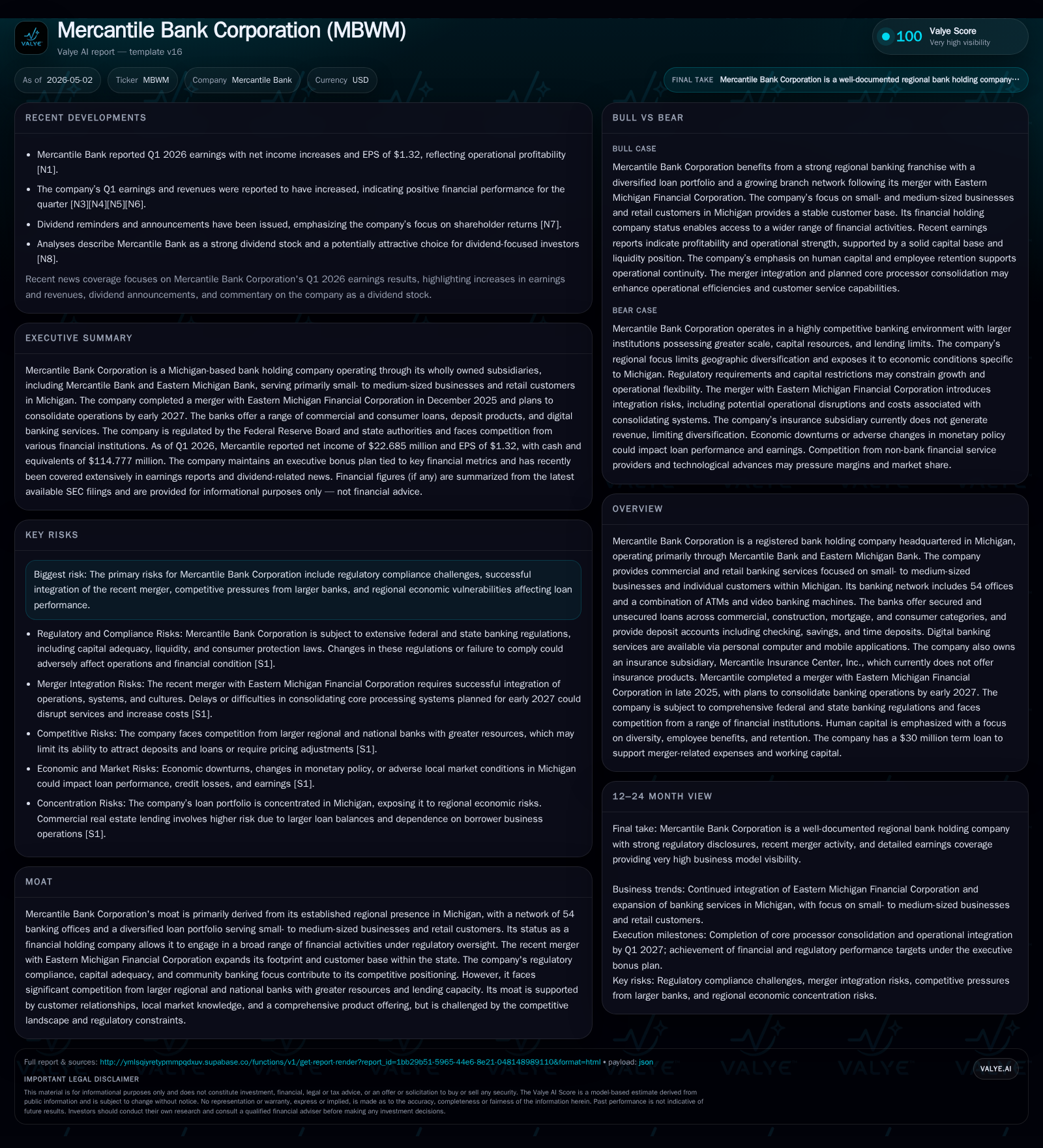
In Q1 2026, Mercantile Bank Corporation reported earnings that outperformed expectations, building on its December 2025 merger with Eastern Michigan Financial Corporation. The combined entity operates through 54 branches statewide, with integration efforts progressing toward core processing consolidation targeted for early 2027. Mercantile's business model centers on diversified commercial and retail lending focused on Michigan’s small- to medium-sized enterprises and consumers, complemented by deposit and digital banking services. While the regional footprint and customer relationships provide a competitive moat, the company faces regulatory compliance demands and pressure from larger banks. Near-term growth hinges on successful post-merger integration and digital platform adoption.
Q1 2026 Operational Results: Highlighting Momentum and Merger Impact
Mercantile Bank Corporation’s latest quarterly filing dated May 1, 2026 [S2] showcases a solid operational performance post-completion of its strategic merger with Eastern Michigan Financial Corporation at the end of 2025 [S1]. The combined entity now operates alongside each other with a total branch count reaching 54 across Michigan [S1], an expansion directly attributable to the merger. Earnings in Q1 topped analyst estimates as reported in multiple earnings transcripts [N1][N4][N5][N6], demonstrating early financial benefits from expanded scale.
While both Mercantile Bank and Eastern Michigan Bank continue operating separately until the anticipated core processor consolidation in early 2027 [S1], management has underscored ongoing efforts to harmonize operations. This transition phase allows careful integration of systems, product offerings, and client servicing enhancements without disrupting existing customer relationships. The extended timeline reflects industry best practices balancing operational risk with ambition to realize synergy-driven cost efficiencies.
Mercantile Bank’s Business Model: Localized Banking with Diversified Commercial and Retail Lending
As detailed in the February 2026 annual report [S1], Mercantile Bank Corporation primarily serves Michigan’s small- to medium-sized businesses and retail customers through its network comprised of the legacy Mercantile Bank and the newly acquired Eastern Michigan Bank. Revenue is generated predominantly via interest income from diverse loan portfolios including secured/unsecured commercial loans, construction loans, residential mortgages, and consumer lending products. Additionally, deposit accounts—such as checking, savings, and time deposits—form a stable liability base contributing fee income through service charges.
Digital banking services accessible through PCs and mobile devices augment traditional branch access, enhancing customer convenience especially in retail segments [S1]. Although the company owns an insurance subsidiary (Mercantile Insurance Center), it currently does not generate revenue therefrom, representing a non-core asset for now [S1]. The focus remains squarely on expanding lending volumes while maintaining underwriting discipline across sectors reflective of local economic conditions.
Competitive Positioning in Michigan's Banking Market: Moat Attributes and Industry Challenges
Mercantile’s foundational moat rests upon its entrenched presence in Michigan’s banking market highlighted by community proximity via its expanded branch footprint. Serving regional clients affords nuanced local market knowledge facilitating tailored lending solutions uncommon among larger national players whose focus dilutes over broad geographies. This closeness creates switching costs rooted in relationship banking dynamics.
However, as a registered bank holding company subject to Federal Reserve Board oversight [S1], Mercantile bears substantial regulatory compliance responsibilities. These impose governance structures ensuring risk management but also elevate operational costs relative to smaller unregulated peers. Furthermore, competition from resource-rich regional or national banks challenges market share gains given their superior lending capacity and pricing flexibility.
The company mitigates industry risks by adhering to conservative credit underwriting standards emphasizing borrower cash flow assessments backed by collateral evaluations performed by certified appraisers where appropriate [S9]. Portfolio diversification spanning commercial real estate, single-family residential loans, consumer credit products, and construction finance further spreads risk but remains sensitive to local economic cycles.
Growth Catalysts Through Merger Integration and Digital Services Expansion
The December 31, 2025 merger with Eastern Michigan Financial Corporation marks a pivotal growth catalyst for Mercantile [S1][S3]. This transaction immediately increased scale by adding new offices predominantly across eastern Michigan regions previously underserved by Mercantile. Geographic diversification enhances resilience against localized economic downturns.
Strategically notable is the planned consolidation of both banks into a singular entity upon completion of the core processor conversion targeted for Q1 2027 [S1][S3]. This technical integration promises streamlined operations delivering cost savings from reduced redundancies while improving customer experience through uniform product platforms.
Parallel investment in digital banking capabilities serves as a dual growth lever; enabling enhanced service delivery to retail segments while generating cross-sell opportunities for loans tied to deposit relationships [N1]. These initiatives align with broader sector trends where regional banks emphasize digital transformation as critical for competing effectively against larger institutions with established online presences.
Risks and Headwinds: Regulatory Oversight, Merger Execution, and Competitive Pressure
Mercantile reaffirms continuity in disclosed risk factors per its latest Form 10-Q filing stating no material changes since its annual report [S2]. Key risks include potential challenges associated with fully executing seamless merger integration encompassing systems unification and cultural alignment between legacy banks.
Regulatory scrutiny remains high given the company’s bank holding status [S11], imposing rigorous oversight across cybersecurity (headed by a dedicated board member expert in information security), capital adequacy monitoring, compliance frameworks, and credit risk management protocols [S1]. Regional economic vulnerabilities inherent in Michigan markets expose loan portfolios—particularly commercial real estate—to cyclical sensitivities despite conservative underwriting practices.
Competition intensifies as larger regional banks continue leveraging scale advantages to offer more attractive pricing or broader product suites which may pressure Mercantile’s margin profile or market share if not countered effectively through relationship management and product differentiation.
Investor Outlook: Key Milestones to Monitor in Near Term
Investors should closely monitor specific milestones relevant to realizing synergies from the recent merger including:
- Completion of core processor migration projected for Q1 2027 enabling operational consolidation of Eastern Michigan Bank into Mercantile Bank as one entity [S1][S3].
- Quarterly updates on loan portfolio asset quality indicators such as nonperforming assets ratio given regional economic headwinds impacting borrower performance [% referenced indirectly in S18).
- Digital platform adoption metrics measuring customer engagement trends which underpin fee income potential outside traditional interest margins [N1].
- Regulatory developments that could affect capital requirements or operational permissions under Federal Reserve Board oversight impacting growth flexibility.
Latest Financial Overview: Supporting Evidence from Q1 Results
Supportive financial commentary embedded within recent filings underscores earnings resilience aligned with operating expansion goals [S2][S3]. While cash equivalents data available from older filings do not reflect current liquidity status [F1], management disclosures reassure adequacy of capital buffers consistent with regulatory guidelines supporting dividend distributions to shareholders principally funded through bank dividends [S22].
Nonaccrual loans remain at low single-digit basis points levels relative to total loans signaling maintained asset quality despite incremental increase from prior periods [S18]. The company’s allowance for loan losses is calibrated per comprehensive grading systems overseen independently bolstering confidence around provisioning sufficiency.
In summary, Mercantile demonstrates solid execution fueled by strategic acquisition-driven expansion within its home state complemented by prudent risk controls; however operational integration complexities alongside competitive dynamics warrant attentive monitoring over coming quarters.
This analysis incorporates information from Mercantile Bank Corporation’s latest SEC filings including the May 1, 2026 Form 10-Q (File No. 000-26719), April 21, 2026 Form 8-K reports, February 27, 2026 Form 10-K annual report filings, along with relevant investor call transcripts publicly available via Nasdaq.com. No investment advice is offered herein; readers should consult further data sources before forming conclusions about this issuer.
Disclaimer: This is research-only, informational analysis and not investment advice. It may include AI-generated interpretation and general industry context. Always verify important details using primary sources.

Comments