
OneMeta Reinforces Enterprise AI Language Solutions with Secure Multi-Tenant Platform
OneMeta updates highlight its strategic shift toward secure, enterprise-preferred AI language solutions amid financial recalibration.
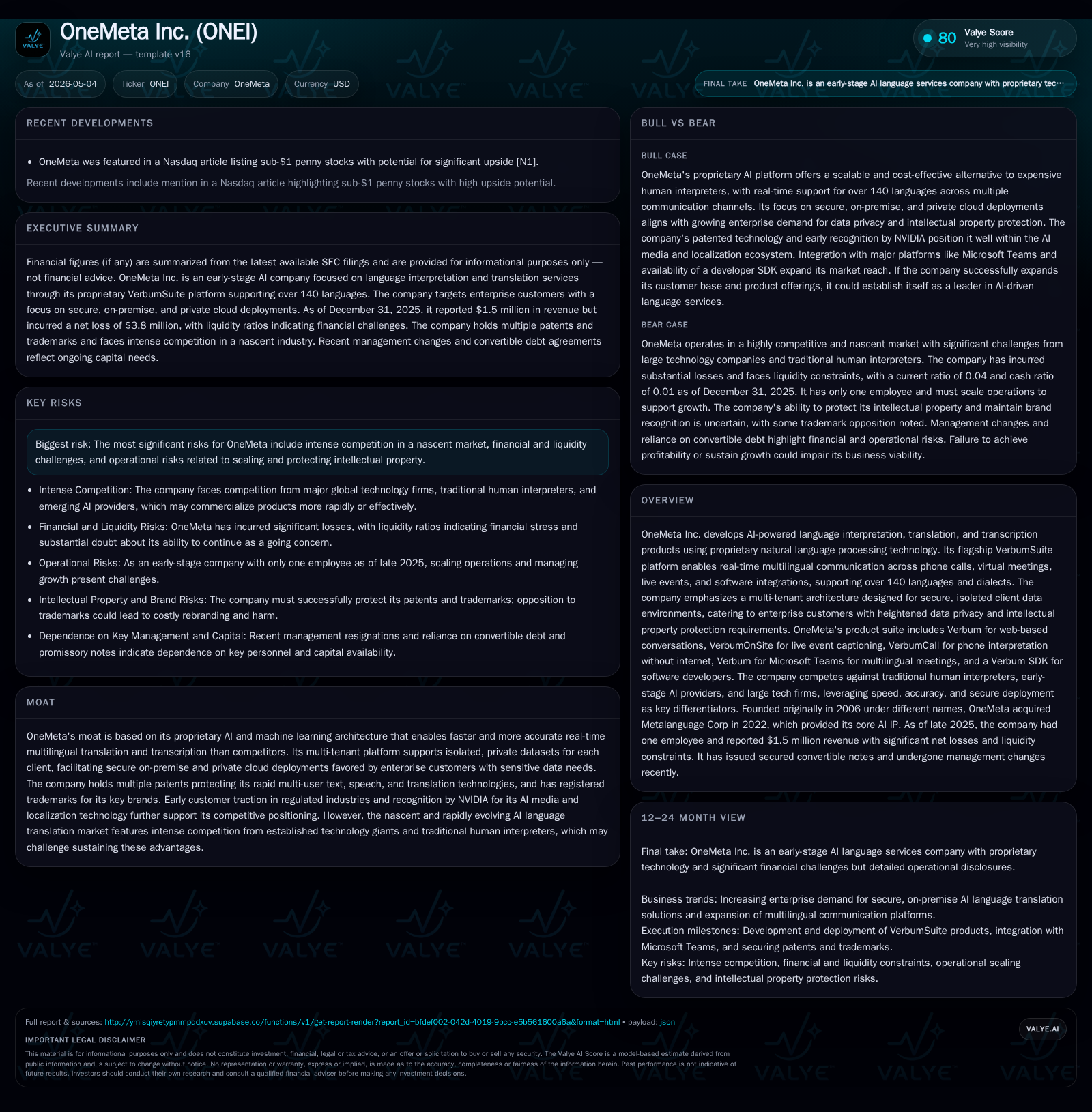
OneMeta’s latest 10-Q and recent event filings reveal a clear orientation toward on-premise and private cloud deployments driven by increasing enterprise demand for data privacy and intellectual property protection. The issuance of warrants to Avaya signals ongoing efforts to manage capital structure amid liquidity challenges that coexist with a strong technology moat anchored in proprietary, multi-tenant NLP architecture. OneMeta faces fierce competition but leverages technical differentiation and partnerships to penetrate regulated industries. Financials reflect operating losses and tight liquidity, underscoring execution risks despite promising growth catalysts in sovereign AI and AI-enabled multilingual communication.
Latest Operating Update: Assessing Recent Filings and Material Agreements
OneMeta’s most recent quarterly filing dated November 14, 2025 (S2) sets the near-term operational backdrop spotlighting the company’s ongoing transition driven by customer preferences towards on-premise and private cloud solutions. This shift is fueled by heightened requirements for data privacy and intellectual property protection—an important evolution given the growing sensitivity around AI-fueled language translation technologies. The April 2026 event filing (S3) marks a notable development with OneMeta issuing a warrant to Avaya LLC to purchase up to 22.2 million shares at $0.135 per share exercisable for ten years. This transaction ties directly into the company's broader strategy to secure flexible capital while aligning partnership incentives.
The warrant structure, coupled with the registration rights agreement granting Avaya both demand and piggyback registration rights, reflects OneMeta's effort to balance near-term working capital needs against dilution concerns. Meanwhile, internal corporate changes including a key executive’s departure (S11) contextualize management realignment during this financial recalibration phase. Together, these filings signal a company actively managing its capital stack while responding to evolving market demands.
Business Model and Product Suite: Proprietary AI Architecture Powering VerbumSuite
OneMeta earns revenue primarily through licensing its AI-powered language interpretation, translation, and transcription software products targeted at enterprises requiring multilingual communication solutions. Its flagship offering—VerbumSuite—is built on a proprietary natural language processing platform supporting real-time conversation across more than 140 languages and dialects. Products under this suite include Verbum for web-based chat translation; VerbumCall that functions without internet connectivity for phone interpretation; VerbumOnSite for live event captioning; integrations for Microsoft's Teams platform; and an SDK enabling third-party software developers to embed multilingual capabilities.
A core strategic strength lies in the multi-tenant platform design enabling isolated client datasets within shared infrastructure—enabling secure on-premise or private cloud deployment options highly valued by clients in regulated industries such as healthcare, legal services, and government agencies [S1]. This architecture supports compliance with stringent data sovereignty requirements while protecting intellectual property embedded within client communications.
Technologically, OneMeta boasts significant IP protection through multiple patents covering rapid multi-user text transcription and speech-to-text translation innovations. The company combines proprietary training models for enhanced NLP accuracy with low latency system design optimized for real-time interaction speed—a critical differentiator given typical delays seen in competing human or less advanced machine translation services.
Competitive Landscape: AI Language Solutions Versus Traditional Interpreters and Tech Giants
OneMeta operates in a fiercely competitive environment where large incumbent technology companies with extensive resources (Google, Microsoft Azure Cognitive Services) compete head-to-head alongside traditional human interpreter networks. However, OneMeta’s distinctive value stems from its ability to provide enterprise-grade security via on-premise/private cloud deployment capabilities that many public cloud rivals lack.
Additionally, the firm’s recognition by NVIDIA as part of their AI media and localization ecosystem underscores its credibility in cutting-edge GPU-accelerated machine learning environments [S1]. Nonetheless, competitors benefit from deeper pockets allowing faster R&D cycles and broader market reach—pressuring smaller entities like OneMeta both in product innovation pace and customer acquisition cost.
The company's multi-tenant model paired with patented algorithms occupies a niche emphasizing customization and client data isolation—features increasingly demanded by customers wary of offloading sensitive conversations onto shared public clouds or unvetted platforms.
Growth Catalysts: Enterprise Shift to On-Premise and Private Cloud Deployments
Enterprise customers’ escalation in prioritizing data privacy laws such as GDPR in Europe or HIPAA in healthcare has fueled demand for AI translation services deployable within their own secure environments rather than public clouds [S1]. This trend plays directly into OneMeta’s architectural advantages.
Simultaneously, vertical-specific expansion—particularly within regulated industries like finance, legal services, government agencies, and healthcare organizations—offers an expanding addressable market where language barriers represent operational bottlenecks.
Growth is further catalyzed by increased interest in predictable cost structures around AI deployments; enterprises are increasingly cautious about uncertain pricing models embedded within some SaaS agreements tied to usage volume or API calls [S2]. OneMeta's platform enables contractual stability via subscription or enterprise license models with dedicated resource allocation aligned with customer risk profiles.
Combined with potential adoption of the Verbum SDK offering—which can increase customer stickiness via embedded integration options—the company is positioned to deepen wallet share among existing clients while attracting new users seeking controlled multilingual communications infrastructure.
Risks and Headwinds: Competition, Financial Constraints, and Scale Challenges
Key risks confronting OneMeta include intense competition from both well-capitalized AI powerhouse firms as well as entrenched human interpreter services that retain a premium appeal due to nuanced cultural context understanding not easily automated [S1]. This competitive intensity can limit pricing power or elongate sales cycles especially in conservative enterprise procurement environments.
Financially, OneMeta remains an early-stage entity experiencing significant operating losses ($3.8 million net loss in 2025) with only modest revenue traction totaling approximately $1.5 million for the same year—highlighting commercial scaling challenges [F1][S1]. The company's balance sheet reveals a precarious liquidity position evidenced by minimal cash on hand ($18K) relative to substantial current liabilities totaling over $3 million resulting in a current ratio of just 0.04 [F1]. Such figures underpin substantial going concern disclosures raising material uncertainty about sustaining operations absent additional financing or profitable contract ramp-up.
Operationally, scaling proprietary technology demands continuous investment in R&D plus marketing efforts to capture new enterprise accounts while addressing integration complexities posed by diverse IT infrastructures across prospective customers. Protecting intellectual property amid rapid technological changes also remains challenging given evolving standards around open-source NLP frameworks.
Furthermore, the company’s reliance on key investors like Avaya for capital infusion introduces dependency risk if further equity or debt raises cannot be executed on favorable terms.
Upcoming Milestones and Market Signals: What Investors Should Monitor
Important near-term indicators include:
- Execution progress on repaying convertible note obligations per amended agreements including timely settlement of stock repurchases connected with management transitions detailed in late 2025 filings [S11][S15].
- Uptake metrics concerning Verbum SDK deployment among developer communities signaling deeper ecosystem engagement beyond direct enterprise licenses.
- Expansion of partnerships beyond Avaya demonstrating diversified channel strategies capable of fueling broader market penetration.
- Revenue growth trends disaggregated by deployment type (on-premise vs public cloud) clarifying whether enterprise demand for privacy-driven solutions translates into sustainable business volume.
- Any announcements regarding regulatory approvals or certifications relating to secure data handling especially relevant for entry into highly regulated verticals such as healthcare or government sectors.
- Updates on intellectual property portfolio expansions or litigation outcomes impacting competitive posture.
Tracking these milestones will clarify if OneMeta systematically mitigates its early-stage risks towards scalable execution paths aligned with structural market opportunities.
Financial Overview: Key Balance Sheet and Profitability Metrics
Latest financial snapshot
| Metric | Value | Period |
|---|---|---|
| Current assets | $121937 | |
| 2025-12-31 | ||
| Current liabilities | $3mm | |
| 2025-12-31 | ||
| Current ratio | 0.04x | |
| 2025-12-31 |
Source: SEC companyfacts cache [F1].
As of December 31, 2025 [F1], OneMeta maintained cash reserves just over $18K juxtaposed against total debt exceeding $79K. Current liabilities substantially outstrip current assets yielding an extremely low current ratio of approximately 0.04—a pronounced indicator of liquidity distress requiring urgent capitalization measures.[F1]
The net loss figure nearing negative $3.8 million underscores ongoing investments in product development alongside constrained sales penetration typical of early-stage technology ventures.[F1] Independent auditors expressed substantial doubt regarding going concern viability citing these financial metrics.[S1]
This setting necessitates prudent monitoring of burn rate relative to cash inflows from financing activities as well as timely achievement of revenue inflection points consistent with market demand forecasts discussed earlier.
Disclaimer: This analysis is intended solely for informational purposes based on publicly available filings as of May 2026. It does not constitute investment advice or recommendations.
Disclaimer: This is research-only, informational analysis and not investment advice. It may include AI-generated interpretation and general industry context. Always verify important details using primary sources.

Comments