
Liberty Global's European Telecom Footprint Faces Inflationary and Competitive Pressures in Q1 2026
A regional leader in broadband and mobile services, Liberty Global faces margin pressure from rising costs amid competitive and regulatory challenges.
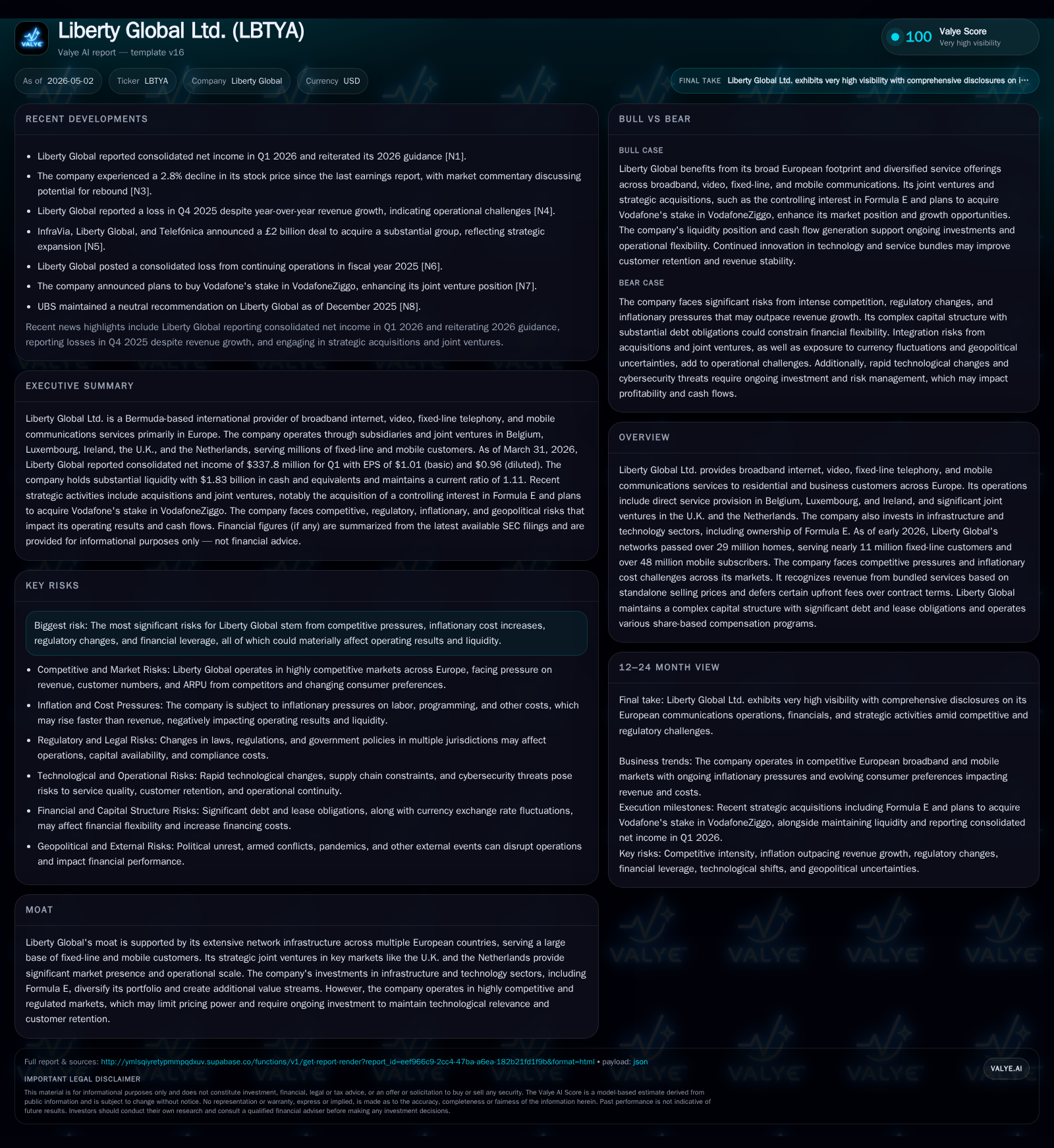
Liberty Global Ltd. reported its Q1 2026 results reflecting ongoing inflationary cost pressures and competitive headwinds across its European markets, including Belgium, Ireland, the U.K., and the Netherlands. The company operates a hybrid business model spanning direct operations and joint ventures, serving over 29 million homes and nearly 11 million fixed-line customers. Despite efforts to grow revenue through bundled services and technology investments such as Formula E ownership, Liberty Global contends with constrained pricing power and elevated leverage. Its recent filings underscore cautious guidance on inflation risks and competition while reaffirming strategy focused on infrastructure scale and diversified offerings.
Recent Operating Update
Liberty Global Ltd.'s latest quarterly filing for Q1 2026 [S2] unveils an operating landscape marked by persistent inflationary pressures coupled with competitive intensity across its core European markets. The company reported networks passing more than 29 million homes with close to 11 million fixed-line customers and a mobile subscriber base exceeding 48 million as of March 31, 2026 [S19]. These scale metrics confirm Liberty Global's position as one of the continent's leading telecommunications providers.
The Q1 disclosures highlight that while the company continues to generate revenue from bundled broadband, video, telephony, and mobile services using standalone selling prices—with some upfront fees deferred over contract terms—it faces margin compression as costs rise faster than top-line inflation [S2]. Management reiterated full-year guidance but acknowledged heightened risks from rising labor expenses, programming costs, and device supply chain issues [N1][S2].
Further updates were provided via an event filing on May 1, 2026 [S3], which included releasing VM Ireland's financial report reflecting ongoing integration within Liberty Global's broader portfolio structure.
Business Model Overview
Liberty Global operates a complex business model blending wholly owned operations in Belgium (Telenet), Luxembourg, Ireland (VM Ireland), alongside influential joint ventures including a 50% stake in VMO2 (U.K.) and VodafoneZiggo (Netherlands) [S19]. This diversification balances direct market control with partnership exposure where it lacks outright ownership.
The company derives revenues primarily through subscription-based models offering bundled fixed-line broadband internet access combined with video content packages, fixed-line telephony services, supplemented increasingly by mobile communications plans. Revenue mechanics revolve around per-subscriber monthly fees augmented by device sales (e.g., set-top boxes and smartphones) where margins vary considerably.
Given the contract nature of offerings, some upfront customer acquisition fees are deferred over service term lengths to smooth revenue recognition [S1]. Pricing impacts are influenced by local market competition levels that also drive promotional discounts and bundling strategies aimed at retaining customers amid crowded telecom landscapes.
Underlying margins benefit from owning extensive network infrastructure—enabling control over access layers such as cable or fiber optic backbones—yet significant ongoing capital expenditure requirements reduce free cash flow potential in the near term.
The firm also invests strategically beyond core telecommunications through controlling interest in Wyre (Belgian infrastructure) and the ownership of Formula E motorsport series [S19], adding alternative revenue streams outside traditional service subscriptions.
Industry Structure & Competitive Position
Europe's telecom sector is characterized by intense multi-operator competition across national borders frequently involving both wireline incumbents and mobile network operators. Liberty Global’s broad geographic footprint provides scale advantages but also entails navigating heterogeneous regulatory environments.
Pricing power is generally constrained due to competing alternatives—including DSL providers, satellite internet options, emerging low-earth orbit satellite services targeting rural areas—and regulations mandating network sharing in some jurisdictions (notably Belgium) which erodes exclusivity [S25].
Nevertheless, Liberty Global's competitive moats derive principally from its extensive existing fiber-cable network infrastructure supporting high-speed internet demands—a segment with structural demand growth driven by increased consumer adoption of streaming services, cloud applications usage at home/workspaces, and mobility.
Strategic joint ventures amplify purchasing power for content rights acquisition and shared technology investment risk. For example:
- The VMO2 JV consolidates two major U.K. entities providing robust fixed-mobile convergence platforms.
- VodafoneZiggo harnesses synergy between mobile operator Vodafone Netherlands and cable provider Ziggo.
However, legacy technologies embedded within parts of its network necessitate continued modernization investments to avoid obsolescence and maintain service parity versus newer greenfield competitors [S2].
Growth Drivers
Structural Demand for High-Speed Data Services
The underlying demand dynamics hinge on consumers’ accelerating need for higher bandwidth capacity driven by video streaming proliferation (4K/8K content), gaming growth trends leveraging cloud platforms, smart home device proliferation enhancing data traffic volume, and increased remote working requirements enhancing broadband prioritization.
Bundled Service Offerings & Cross-Selling Opportunities
Bundling broadband with video subscriptions plus telephony adds stickiness contributing to customer retention metrics while enabling incremental ARPU uplift via multi-product penetration per household or business customer.
Expansion in B2B Communications Services
Growth in providing managed services to businesses aligns with trends favoring outsourcing of IT infrastructure components such as SD-WAN solutions combining physical connectivity with software-defined networking overlays.
Infrastructure & Content Investment Diversification
Controlling stakes in non-traditional assets like Formula E signal strategic diversification aiming at long-term brand enhancement plus exposure to emerging sports-media convergence monetization avenues that could supplement telco-income volatility times.
Risks & Growth Constraints
Inflationary Cost Risks Exceeding Revenue Growth Potential
Labor wage inflation along with surges in programming expenses particularly for proprietary content rights could squeeze operating margins if pricing pass-through is limited by competitive resistance [S2][S25].
Regulatory & Market Access Challenges
Regulatory obligations mandating third-party access to owned networks potentially dilute subscriber exclusivity benefits or induce commoditization effects reducing differentiation factors [S25].
Technological Obsolescence & Legacy Systems Complexity
Efficiency degradation associated with older legacy infrastructure creates headwinds necessitating continual capex deployment which pressures near-term free cash generation while navigating evolving standards such as DOCSIS upgrades or fiber-to-the-home rollouts.
Financial Leverage & Liquidity Constraints
With total debt hovering around $8.4 billion contrasted against cash equivalents near $1.8 billion as of Q1 end [F1], resulting net debt approximates $6.6 billion implying meaningful interest obligations and refinancing execution necessity within volatile credit market contexts [F1]. This weighting could limit flexibility for opportunistic investments or bulk acquisitions.
Competition Impacting Pricing Power & Customer Churn
Market fragmentation leads to aggressive pricing battles potentially undermining ARPU gains while introducing churn risk especially amongst price-sensitive segments actively solicited by multiple players leveraging discounting campaigns or novel product bundles [S19].
What to Watch Next
- Execution progress on technology network upgrades targeting legacy asset replacement or supplementation to improve reliability latency metrics vital for next-generation use cases such as VR/AR streaming.
- Evidence of ARPU stabilization or growth from enhanced bundled offers including mobile convergence products across core markets like Belgium/U.K./Ireland.
- Updates on joint venture operational performance detailing synergies realized or cost rationalizations achieved post-integration cycles.
- Inflation trajectory impact compounded by geopolitical uncertainties affecting European economies influencing disposable consumer incomes thereby indirectly shaping service uptake velocity.
- Debt refinancing activities timed around maturities moving toward mid-to-late 2020s horizons given elevated net leverage figures fostering scrutiny from rating agencies or capital providers against macroeconomic backdrop.
- Potential regulatory changes affecting wholesale access rights or spectrum allocations impacting competitive positioning long term.
Financial Profile Summary (Q1 2026)
Latest financial snapshot
| Metric | Value | Period |
|---|---|---|
| Cash & equivalents | $1828mm | |
| 2026-03-31 | ||
| Total debt | $8.4bn | |
| 2026-03-31 | ||
| Net debt | $6.6bn | |
| 2026-03-31 | ||
| Current assets | $3.1bn | |
| 2026-03-31 | ||
| Current liabilities | $2.8bn | |
| 2026-03-31 | ||
| Current ratio | 1.11x | |
| 2026-03-31 |
Source: SEC companyfacts cache [F1].
| Metric | Value | Period End |
|---|---|---|
| Cash & Equivalents | $1.83 billion | |
| 2026-03-31 | ||
| Total Debt | $8.42 billion | |
| 2026-03-31 | ||
| Net Debt | ~$6.6 billion | |
| 2026-03-31 | ||
| Current Assets | $3.11 billion | |
| 2026-03-31 | ||
| Current Liabilities | $2.81 billion | |
| 2026-03-31 | ||
| Current Ratio | 1.11 | |
| 2026-03-31 |
The balance sheet status reflects a moderately pressured liquidity position relative to short-term obligations but consistent with typical capital-intensive telecom enterprises managing substantial network investments alongside refinancing needs [F1]. Operating income remains under pressure due to elevated costs despite stable revenues reported earlier periods [F1][N1].
Disclaimer
This report is an industry analysis based on publicly available SEC filings dated up to May 2026 regarding Liberty Global Ltd. It does not constitute investment advice or recommendations. Financial figures are cited strictly from referenced sources without extrapolations. Readers should conduct further due diligence incorporating real-time market developments where relevant.
Disclaimer: This is research-only, informational analysis and not investment advice. It may include AI-generated interpretation and general industry context. Always verify important details using primary sources.

Comments