
Terex Corp Faces Inflation and Trade Pressures in Q1 2026 Results
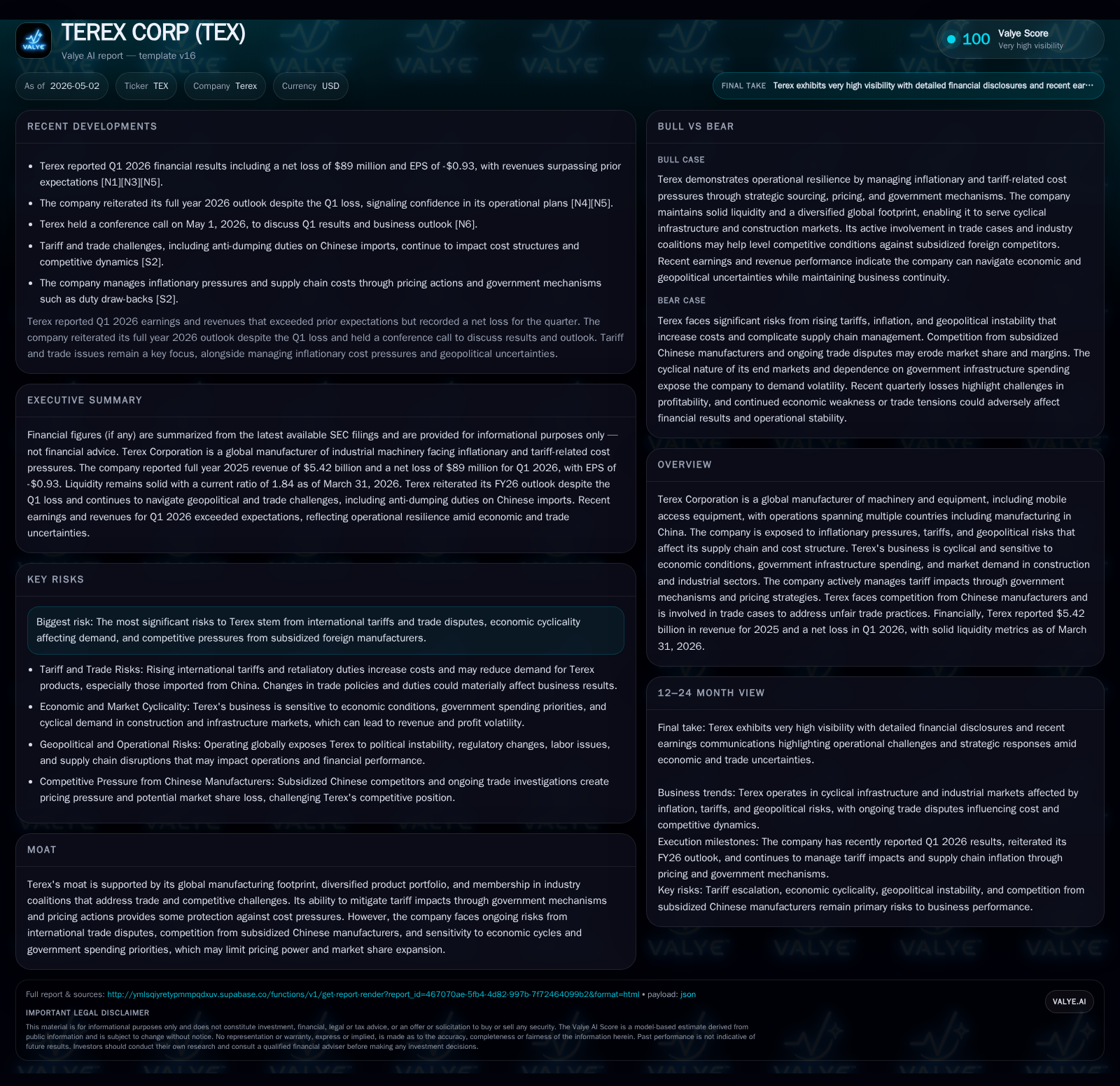
Terex reported a first-quarter net loss amid persistent inflation and tariff challenges, underscoring its strategic efforts to manage cost pressures amid cyclical market conditions.
In Q1 2026, Terex Corporation posted a net loss despite resilient revenue, reflecting ongoing inflationary pressures and the complex impact of tariffs on its cost structure. The company continues to leverage government mechanisms and pricing strategies to mitigate these effects but remains exposed to cyclical demand dynamics and competitive pressures from subsidized foreign manufacturers. Terex's diversified machinery portfolio and global manufacturing footprint support resilience, though risks from trade disputes and economic sensitivity persist. Key growth drivers include anticipated infrastructure spending and aftermarket expansion, while upcoming quarters will test demand stability and margin recovery efforts.
Q1 2026 Operating Update: Results and Immediate Drivers
Terex Corporation’s latest quarterly report dated May 1, 2026 [S2] reveals that the company slipped to a net loss in the first quarter despite revenues holding firm relative to expectations [N3]. This negative earnings outcome underscores the persistence of inflationary inputs elevating production costs alongside the ongoing challenge of international tariffs affecting raw materials and imported components. While the company leverages government duty draw-back mechanisms and pricing initiatives to alleviate the impact of tariffs on margins, these measures have not fully offset cost pressures. The operating income margin contracted accordingly even as management reaffirmed its full-year guidance [N8]. This quarter’s dynamics reflect both external supply chain disruptions and internal cost management demands shaping profitability in a still-cyclical construction equipment market.
The company’s strategic geographic production spread—including operations in China—places it at the intersection of competing trade policies impacting costs. Inflation throughout the supply chain continues to push up labor, material, and logistics expenses [S1,S17], which has tempered margin recovery despite improved tariff handling.
Terex’s Business Model: Diverse Machinery Portfolio and Customer Value
Terex operates as a diversified manufacturer of industrial machinery focused on mobile access equipment, infrastructure machinery, and other heavy industrial products fitting construction and maintenance applications [S1]. Its customers span private contractors to government agencies involved in infrastructure projects—markets sensitive to spending cycles but supported by long asset replacement lifecycles.
Terex’s global manufacturing footprint enables dynamic sourcing but also exposes it to tariffs both on finished goods imported from China and components sourced through suppliers [S17]. This multi-product approach serves as a partial hedge against cyclical downturns in any one segment; however, end-market cyclicality remains significant due to dependence on governmental infrastructure budgets and capital expenditure by industrial firms.
Customer retention is driven by product reliability, brand presence in key geographies, service networks for maintenance parts, and compliance with evolving safety standards. The company’s footprint allows some operational flexibility to adjust sourcing in response to shifting tariffs or inflation.
Industry Dynamics: Competition, Tariffs, and Supply Chain Realities
The broader industry context is defined by robust competitive pressures from Chinese manufacturers benefiting from government subsidies that undercut pricing for comparable mobile access equipment [S21]. Terex participates in the Coalition of American Manufacturers targeting unfair trade practices through anti-dumping and countervailing duty cases—a legal framework that provides partial protection but does not eliminate competitive disadvantages entirely.
Trade relations between the U.S., E.U., China, and other regions remain unsettled. Recent anti-dumping duties imposed by U.S. authorities on Chinese imports offer some margin relief but are contested through appeals processes that could alter duty structures [S21]. Supply chain inflation—from wage increases to transportation costs—adds complexity beyond tariff impacts alone [S17]. These factors collectively constrain the firm’s ability to expand share or raise prices aggressively without risking lost volume.
Growth Drivers: Infrastructure Spending and Pricing Strategy Execution
Key growth vectors for Terex hinge on expectations surrounding major public infrastructure investments domestically under acts like the Infrastructure Investment & Jobs Act alongside analogous programs globally [S1,S14,N10]. Such policies support steady demand for construction equipment replacements paired with incremental capacity additions driven by private sector projects.
Terex aims to capitalize on these drivers with targeted pricing strategies designed to pass through portionally rising input costs without substantially eroding customer demand. Additionally, growth in aftermarket parts sales presents an attractive higher-margin opportunity linked to installed machine bases requiring ongoing service [N10].
Backlog levels indicate moderate replenishment suggesting cautious optimism about medium-term demand stability. Geographic expansion into emerging markets may provide incremental revenue streams although requires tailored product adaptations.
Risks and Constraints: Trade Disputes, Economic Sensitivity, and Competitive Pressure
While no material changes in risk factors were disclosed recently [S2], existing risks weigh heavily on Terex’s outlook. Persisting international tariff uncertainty could prompt further cost escalations or disrupt supplier relationships. Economic cyclicality tied to interest rates or delays in public spending projects threatens volume contraction.
Competitive pressure from well-subsidized Chinese manufacturers limits pricing flexibility. Exchange rate fluctuations add another layer of volatility given Terex’s multinational operations.
Labor cost inflation globally alongside periodic shortages creates operational challenges amid tightening market conditions [S19]. These constraints necessitate ongoing vigilance in execution across supply chain management and pricing.
Forward-Looking Indicators: What To Watch in Upcoming Quarters
Investors should focus closely on second-quarter order trends as a barometer for customer confidence amid persistent economic uncertainties [N8,S3]. Key signals will include raw material price trajectories (e.g., steel), efficacy of tariff mitigation actions via government rebates or exclusions, currency impacts on cross-border sales margins, and progress on margin recovery initiatives per management commentary.
Regulatory developments on trade cases involving Chinese equipment imports will also influence competitive positioning materially over coming quarters. Monitoring backlog changes may provide early insights into shifting market momentum before official guidance updates.
Financial Overview: Liquidity and Profitability Snapshot
Latest financial snapshot
| Metric | Value | Period |
|---|---|---|
| Cash & equivalents | $392mm | |
| 2026-03-31 | ||
| Current assets | $3.2bn | |
| 2026-03-31 | ||
| Current liabilities | $1724mm | |
| 2026-03-31 | ||
| Current ratio | 1.84x | |
| 2026-03-31 |
Source: SEC companyfacts cache [F1].
Despite reporting a Q1 net loss linked primarily to cost pressures rather than top-line contraction, Terex’s balance sheet remains sound heading into the mid-2026 period [F1,S2].
Disclaimer: This is research-only, informational analysis and not investment advice. It may include AI-generated interpretation and general industry context. Always verify important details using primary sources.

Comments