
Dominion Energy 2026 Q1 Results Highlight Strategic LNG and Nuclear Ambitions
Q1 2026 earnings reveal favorable weather impacts and advances in renewable natural gas and nuclear initiatives amid evolving regulatory landscapes.
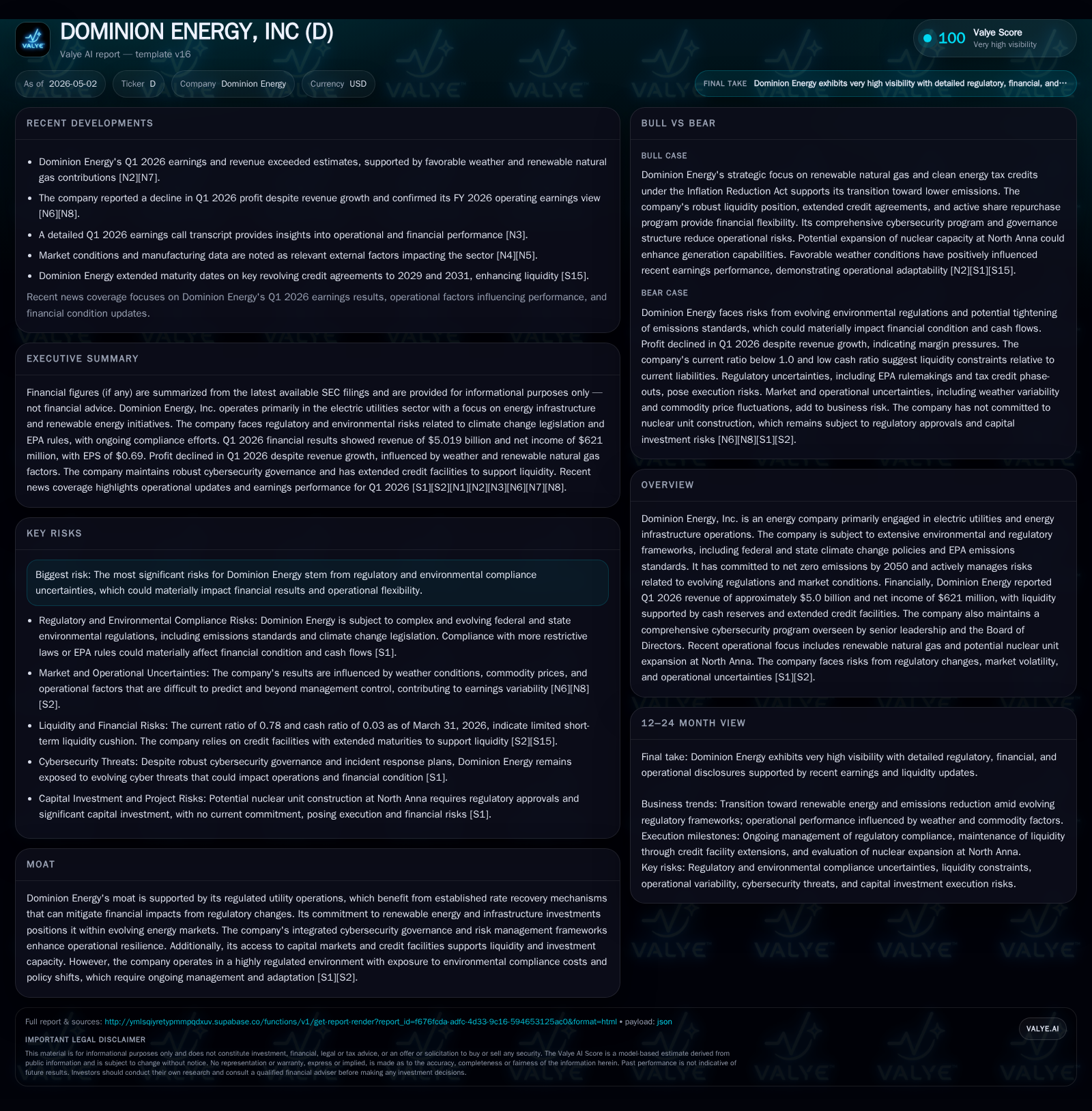
Dominion Energy's first quarter of 2026 showcased resilience with revenue around $5.0 billion and net income of $621 million supported by Renewable Natural Gas (RNG) growth and benign weather conditions. The company’s integrated utility and infrastructure model leverages regulated rate recovery mechanisms to mitigate regulatory risks despite ongoing environmental compliance challenges. Strategic focus continues on expanding RNG capacity and potential nuclear project development at North Anna, positioning Dominion within shifting industry paradigms. Vigilance remains on regulatory uncertainties and execution challenges, supported by a solid liquidity profile.
Q1 2026 Operating Highlights and Implications
Dominion Energy’s results for the first quarter ended March 31, 2026, reflect operational progress alongside external climate and policy dynamics. The company reported revenue around $5.0 billion bolstered by favorable winter weather conditions increasing electric demand and delivering higher volumes in renewable natural gas (RNG) sales, as detailed in the May 1, 2026, Form 10-Q [S2] and corroborated by contemporaneous market commentary [N2]. Net income stood at approximately $621 million, underscoring sustained profitability amid volatile energy markets.
The RNG segment notably contributed to the top line, evidencing Dominion’s strategic push into lower-carbon fuel sources aligned with its environmental targets. Weather impacts also played a material role: colder temperatures in the service territories led to elevated distribution volumes for both electricity and gas segments relative to normal patterns [N2]. While these effects are partly cyclical, the underlying growth in RNG reflects a structural pivot toward decarbonization solutions.
Furthermore, the company’s recent event filing (8-K) emphasized continued evaluation of nuclear expansion at the North Anna site, where licensing from the Nuclear Regulatory Commission remains in place though final construction decisions are pending [S3]. This signals long-term strategic intent to diversify fuel sources with low-carbon baseload generation.
Dominion Energy’s Integrated Business Model and Service Offerings
Dominion Energy combines regulated electric utility operations primarily serving Virginia and adjacent regions with substantial energy infrastructure assets including natural gas pipelines and renewable fuel facilities [S1]. This dual operating model generates revenue through: (a) regulated rate-based utilities benefitting from stable tariff structures allowing cost recovery over extended time horizons; (b) infrastructure segments deriving fees or commodity margin on pipeline throughput and RNG sales.
The regulated electric utility segment leverages state-approved rate recovery methodologies designed to offset capital investments and compliance expenses over time, mitigating financial volatility associated with environmental regulations or fuel cost inflation. The inclusion of RNG within the portfolio adds a renewables growth dimension that aligns with emissions reduction mandates while maintaining regulated or contract-backed returns [S1][S4].
Customer payments flow chiefly from residential, commercial, and industrial end users under tariff regimes approved by state commissions; infrastructure revenues are driven by long-term contracts or regulated tariffs tied to asset usage. These dynamics afford revenue visibility while positioning Dominion to selectively ramp investments in cleaner energy vectors without jeopardizing earnings consistency.
Regulatory Environment and Industry Dynamics Shaping Dominion’s Operations
Dominion operates within a tightly regulated environment shaped by multifaceted federal and state policies targeting greenhouse gas emissions reductions. Notably, the U.S. completed its withdrawal from the Paris Agreement in January 2026, although various states have pursued separate legislative initiatives such as Virginia’s Clean Economy Act (VCEA), which impose renewable portfolio standards and emissions caps [S1][S10].
Environmental compliance costs arise principally from adherence to evolving EPA standards governing air pollutants including particulate matter (MATS standards) as well as CO2 emission limits for fossil-fueled power plants. Recent EPA proposals issued in mid-2025 indicate a rollback of stringent 2024 rules on mercury air toxics and greenhouse gases, presenting possible regulatory relief; however, final outcomes remain uncertain pending rulemaking processes [S9].
Dominion has committed to achieving net zero carbon emissions by 2050 across its operations—a target demanding sustained investment in renewables, RNG, nuclear capacity, and grid modernization [S1]. The Inflation Reduction Act imposes annual fees on methane emissions starting from calendar year 2024 but Dominion currently anticipates minimal impact due to emissions thresholds applied under forthcoming EPA regulations [S10].
Importantly, Dominion benefits structurally from embedded rate recovery mechanisms that allow pass-through of many compliance-related costs via regulatory filings. This framework provides some insulation against price shocks but requires timely management engagement with regulators to maintain earnings quality.
Growth Vectors: Expanding Renewable Natural Gas and Nuclear Initiatives
Dominion’s near-term capital allocation underscores priority given to expanding RNG production capacity—a lower-carbon alternative recognized under clean energy tax credits extended through 2029—supporting favorable economics relative to traditional natural gas supply chains [S12]. RNG integration sits at the confluence of environmental objectives and market demand for sustainable fuels across heating and industrial applications.
Parallelly, Dominion evaluates construction of a third nuclear unit at the North Anna plant site where it already holds NRC Combined Construction Permit and Operating License issued in June 2017 [S8][N2]. Nuclear generation offers scalable baseload power supporting grid reliability while aligning with carbon reduction mandates; however, such projects face high upfront capital costs along with permitting complexity that may prolong timelines.
These growth pathways represent strategic diversification enhancing Dominion’s carbon portfolio resilience while leveraging its regulated framework for attractive returns. RNG facilities benefit from relatively rapid build cycles versus nuclear units’ developmental lead time but both contribute critical fuel mix flexibility 8 decarbonization alignment.
Key Risks: Regulatory Uncertainty and Compliance Costs
Despite embedded rate recovery advantages, Dominion faces considerable uncertainties arising from pending environmental legislation at federal/state levels including potential tightening of emissions limits or imposition of new fees linked to methane or other pollutants [S20]. Execution risk related to capital projects—particularly complex nuclear undertakings—introduces timing/cost variability impacting financial outcomes.
Market conditions also present volatility risks affecting commodity prices influencing throughput margins or wholesale electricity prices embedded within certain contractual structures. Regulatory reversals create ambiguity complicating long-term planning assumptions although current EPA rule proposals may alleviate near-term pressures somewhat [S9][S20]. Continuous monitoring remains critical given policy shifts can materially affect operational flexibility or capital allocation priorities.
Operational risks include cybersecurity threats managed via a converged security model overseen directly by seasoned executives including a former FBI chief security officer plus periodic external expert assessments ensuring defensive posture adequacy—a key factor underpinning enterprise resilience within increasingly digitized grid/infrastructure contexts [S1].
Monitoring Upcoming Catalysts and Execution Milestones
Key indicators warranting attention include finalization of EPA rulemakings related to methane emission fee implementation providing clarity on financial exposure thresholds; quarterly updates on RNG capacity additions reflecting scaling momentum; progress reports on North Anna’s nuclear licensing or construction decisions delineating timetable expectations; continual weather pattern trends impacting electric/gas volumes; management comments guiding FY26 operating earnings based on realized demand/pricing dynamics [S2][N3][S3].
Regulatory docket developments will shape Dominion’s compliance strategy efficacy while execution milestones on infrastructure projects signal commercialization timelines fundamental to medium-term growth projections.
Latest Financial Snapshot Supporting Operational Analysis
Latest financial snapshot
| Metric | Value | Period |
|---|---|---|
| Cash & equivalents | $351mm | |
| 2026-03-31 | ||
| Total debt | $46.3bn | |
| 2025-12-31 | ||
| Net debt | $46.0bn | |
| 2025-12-31 | ||
| Current assets | $9.0bn | |
| 2026-03-31 | ||
| Current liabilities | $11.6bn | |
| 2026-03-31 | ||
| Current ratio | 0.78x | |
| 2026-03-31 |
Source: SEC companyfacts cache [F1].
A concise snapshot using the latest published figures provides context for dominating operational themes:
Liquidity positions remain supported by available cash balances and recent maturity extensions on revolving credit agreements through April 2031 supporting ongoing capex needs tied to renewables expansion and potential nuclear development [F1][S26]. It refrains from forward-looking projections beyond documented milestones or speculative financial extrapolations.
Disclaimer: This is research-only, informational analysis and not investment advice. It may include AI-generated interpretation and general industry context. Always verify important details using primary sources.

Comments