
Qualcomm Reinforces Its Semiconductor Leadership with Strategic Growth in Connectivity and AI
The latest quarterly filing highlights Qualcomm's sustained revenue concentration risks alongside emerging growth in automotive, IoT, and AI integration markets.
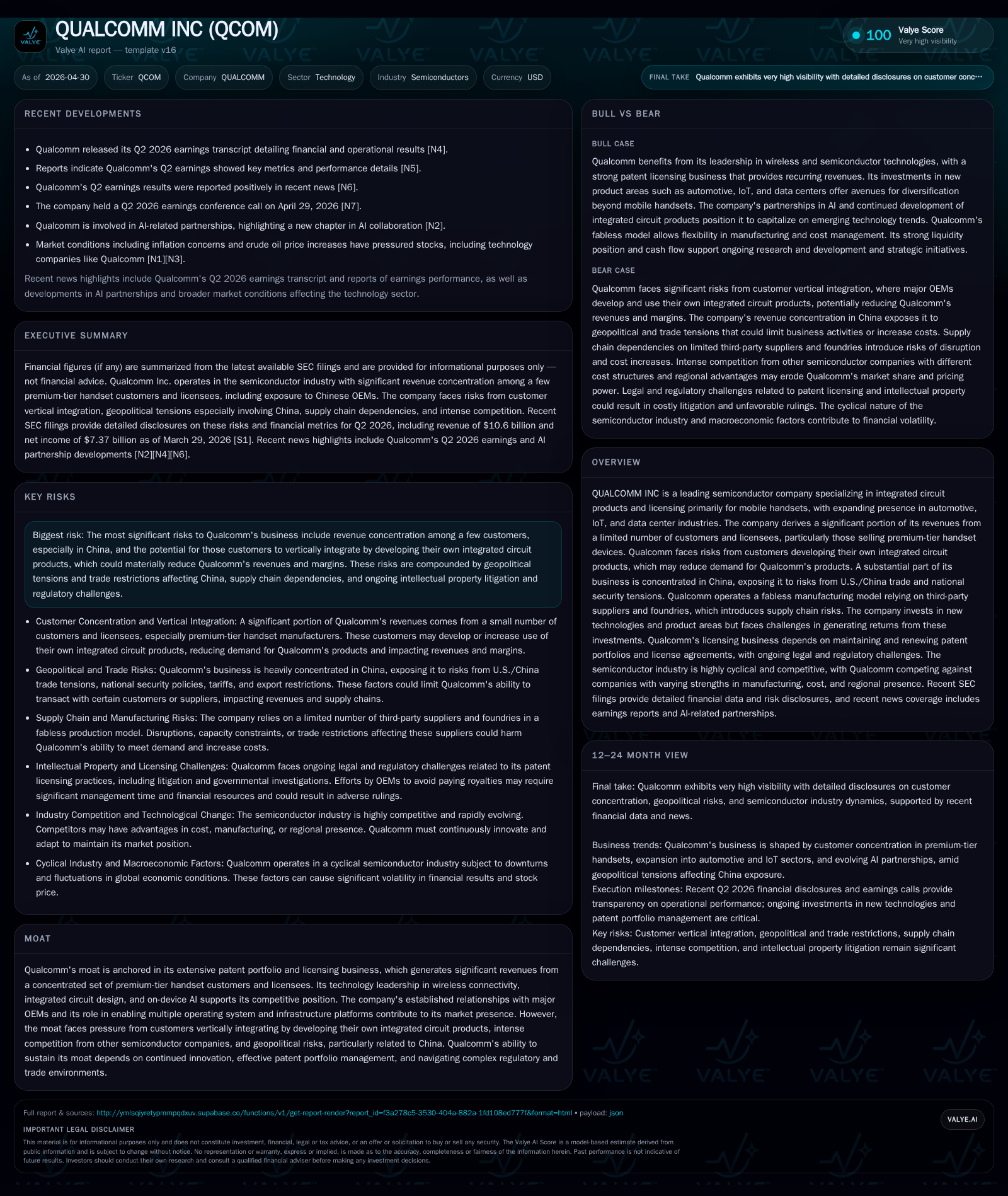
Qualcomm's Q2 FY2026 update reveals solid performance despite customer concentration and vertical integration challenges. The company’s dual business model—anchored in IP licensing and fabless chipset sales—continues to face competitive pressure but benefits from an extensive patent portfolio. Expansion into automotive connectivity, data center products, and on-device AI platforms represent structural growth avenues. Key risks include dependency on a limited number of premium-tier handset OEMs, geopolitical exposure in China, and supply chain vulnerabilities inherent in its fabless model. Near-term milestones to monitor include execution on new product launches and outcomes from licensing negotiations amid evolving regulatory scrutiny.
Latest Quarterly Operating Update: Growth Signals and Customer Concentration Risks
The Q2 FY2026 Form 10-Q filed April 29, 2026 [S2], reinforced Qualcomm’s entrenched reliance on a narrow set of premium-tier handset OEMs and licensees as primary revenue drivers. Despite this concentration risk, reported results showed earnings above consensus estimates [N5], suggesting effective execution amid challenging market conditions. Management commentary also acknowledged ongoing customer vertical integration efforts — particularly by major players like Apple — which pose headwinds by reducing demand for Qualcomm’s modems and combined chipset solutions [S16]. Supply chain execution remained robust but uncertain given geopolitical tensions and the complexity of the fabless production ecosystem [S2]. The accompanying 8-K press release summarized these themes while introducing optimism regarding the company’s broader diversification into adjacent growth markets [S3].
This latest period highlights how seasonal fluctuations or shifts in product cycles among a small number of licensees could materially affect results, underscoring the structural vulnerability of heavily concentrated revenue streams [S16]. Nonetheless, revenue stability was supported by ongoing demand for premium devices globally.
Business Model and Product Differentiation: Licensing, Chipset Sales, and Fabless Strategy
Qualcomm operates a dual-revenue stream business model anchored by two core pillars: first, licensing its vast portfolio of wireless connectivity-related patents; second, selling semiconductor integrated circuit products — principally chipsets that incorporate cellular modems combined with application processors [S1]. This hybrid approach allows Qualcomm to monetize both intellectual property (IP) embedded across device ecosystems and tangible hardware components.
Key to this model is Qualcomm's fabless semiconductor approach: it designs chips internally while outsourcing manufacturing to third-party foundries [S1]. This structure affords flexibility and lower fixed capital expenditure relative to vertically integrated semiconductor companies but introduces supply chain execution risks linked to supplier capacity constraints or geopolitical disruptions [S6].
On the licensing side, Qualcomm derives significant revenues from royalties paid by OEMs incorporating its patented technology in mobile devices — predominantly at the premium tier where advanced wireless standards like 5G dominate [S16]. However, licensing revenues are susceptible to changes in royalty calculation bases or regulatory scrutiny affecting traditional pricing structures [S4,S5,S20].
Increasingly the company emphasizes product differentiation through advanced wireless connectivity IP (including 5G and emerging 6G technologies), integration of on-device AI accelerators within chipsets, and support for diverse OS platforms — all reinforcing its position as a preferred partner for OEMs worldwide [S13].
Competitive Positioning and Industry Structure: Patent Moat Amid Rising Vertical Integration
Qualcomm’s dominant competitive advantage stems from its extensive portfolio of standard-essential patents (SEPs) covering cellular communications technologies. This legal moat underpins its high-margin licensing business segment by granting leverage over OEMs needing access to foundational technologies [S1,S13]. The company also maintains preferred status among many leading manufacturers due to its early investments in wireless innovation.
Nevertheless, competitive pressures are mounting. Some large OEM customers are increasingly developing proprietary integrated circuits — particularly modem components — diluting Qualcomm's addressable market share in chip sales [S16]. Apple exemplifies this trend with plans to expand deployment of its own modem products in coming device generations [S16]. The licensing business similarly faces headwinds from regulatory challenges contesting historic royalty rate calculations or demanding multi-level licensing frameworks that complicate revenue recognition and enforcement [S4,S5,S20].
Further fragmentation arises as competitors like MediaTek, Samsung, Broadcom, Nvidia (in AI-related chips), and Mobileye (for automotive solutions) vie aggressively across overlapping segments. Regulatory scrutiny also extends globally with government investigations impacting patent enforcement practices [S14,S19].
Qualcomm must continue technological innovation to maintain relevance; its success depends on sustaining leadership in next-generation wireless standards while defending intellectual property rights amid this evolving landscape.
Growth Drivers: Expansion into Automotive, IoT, Data Center, and AI-Enabled Platforms
Beyond mobile handsets, Qualcomm has strategically intensified focus on growing application areas leveraging its core competencies in wireless technology:
Automotive: Qualcomm offers specialized integrated circuits supporting connectivity (e.g., cellular V2X), infotainment systems, and increasingly autonomous driving sensor fusion modules. Adoption rates for these automotive products are rising due to electrification trends and connected vehicle mandates [N1,S1,S2].
Internet of Things (IoT): The proliferation of connected devices across industrial automation, smart homes, wearables, and healthcare creates substantial volume potential for low-power chipsets embedding Qualcomm’s connectivity IP and processing cores [S16].
Data Centers: Targeting edge computing applications involves delivering high-performance compute combined with low-latency wireless interfaces; Qualcomm invests resources here with platforms tailored for AI inference workloads acting locally rather than centralized datacenters [N1,S2,S16].
AI Integration: On-device AI accelerators within SoCs reflect increasing demand for efficient AI processing directly on handsets or edge devices without continuous cloud dependence. Partnerships announced recently emphasize this initiative as a cornerstone growth vector going forward [N1].
These diversification steps attempt to reduce dependence on cyclical handset markets subject to saturation or pricing pressure while capitalizing structurally growing tech segments aligned with next-generation connectivity trends.
Risks and Constraints: Customer Concentration, Geopolitical Tensions, and Supply Chain Fragility
Fundamental risks persist around Qualcomm's concentrated customer base where a few OEMs contribute disproportionately to revenue — primarily via high-margin premium-tier handsets sold globally but heavily weighted towards China-based manufacturers as well [S16,S18]. Any revenue decline or renegotiation involving these key partners could disrupt top-line stability.
Moreover, U.S.-China trade tensions exacerbate operational risk given sizeable Chinese exposure not only at the customer level but also through contracts with suppliers situated largely in Taiwan and South Korea — pivotal foundry locations essential for advanced semiconductor nodes servicing Qualcomm’s designs [S16,S22,S26].
The company also faces considerable regulatory uncertainty regarding patent enforcement policies worldwide. Ongoing investigations question whether Qualcomm's royalty rates adhere fairly to FRAND principles; unfavorable rulings might force royalty reductions or more onerous multi-level licensing systems that would compress profitability [S4,S5,S20]. Additionally, litigation related to claims of anti-competitive practices demands continued management attention consuming resources that could otherwise support innovation.
Supply chain dependencies inherent to the fabless model pose additional fragility risks including lead-time variability or component shortages stemming from external macro disruptions such as pandemics or geopolitical instability affecting logistics hubs or manufacturing plants located across Asia-Pacific regions [S6,S8,S22].
Near-Term Milestones and What to Watch Next
Investors monitoring Qualcomm should focus closely on execution against several actionable markers:
- Announcements regarding expansion or launch timing of automotive-grade connectivity modules demonstrate traction into growth verticals beyond handsets.
- Progress reported on IoT endpoint shipments or partnerships validating broader market adoption will indicate success scaling new business lines.
- Outcomes from licensing negotiation phases remain critical; any shifts in contract terms renewing key premium-tier OEM relationships could impact future revenue visibility.
- Regulatory developments related to ongoing patent litigations or government investigations may materially alter licensing revenue profiles.
- Adoption trends observed through quarterly guidance updates reflecting chipset volumes integrated with enhanced AI capabilities serve as bellwethers for sustaining tech leadership amidst competition.
Successful navigation through these milestones will clarify whether Qualcomm can offset handset-related headwinds through diversified growth channels effectively.
Financial Snapshot and Capital Structure Highlights
Latest financial snapshot
| Metric | Value | Period |
|---|---|---|
| Cash & equivalents | $5.4bn | |
| 2026-03-29 | ||
| Current assets | $23.1bn | |
| 2026-03-29 | ||
| Current liabilities | $9.8bn | |
| 2026-03-29 | ||
| Current ratio | 2.37x | |
| 2026-03-29 |
Source: SEC companyfacts cache [F1].
As of quarter-end March 29, 2026 (latest available balance sheet date per companyfacts snapshot) Qualcomm held $5.44 billion in cash and equivalents against current liabilities totaling approximately $9.77 billion yielding a healthy current ratio of 2.37—a solid liquidity position supporting near-term operational needs despite elevated net debt approximating $10.1 billion using best-effort debt figures last publicly disclosed in mid-2019 [F1]. This indicates a capital structure capable of enduring cyclical volatility within semiconductor industries.
This analysis synthesizes SEC filings dated April 29, 2026 (10-Q) as primary source material alongside complementary annual disclosures from November 2025 (10-K) plus corroborative market news from Nasdaq sources up to April 30, 2026. It aims solely to provide an operational perspective on QUALCOMM INC without offering investment recommendations or forecasting future stock price movements.
Disclaimer: This is research-only, informational analysis and not investment advice. It may include AI-generated interpretation and general industry context. Always verify important details using primary sources.

Comments