
PACCAR Slows Truck Deliveries but Grows Parts and Finance Revenue in Q1 2026
PACCAR’s Q1 2026 results reveal truck sales declines amid tariff and economic pressures, offset by strength in parts and financial services.
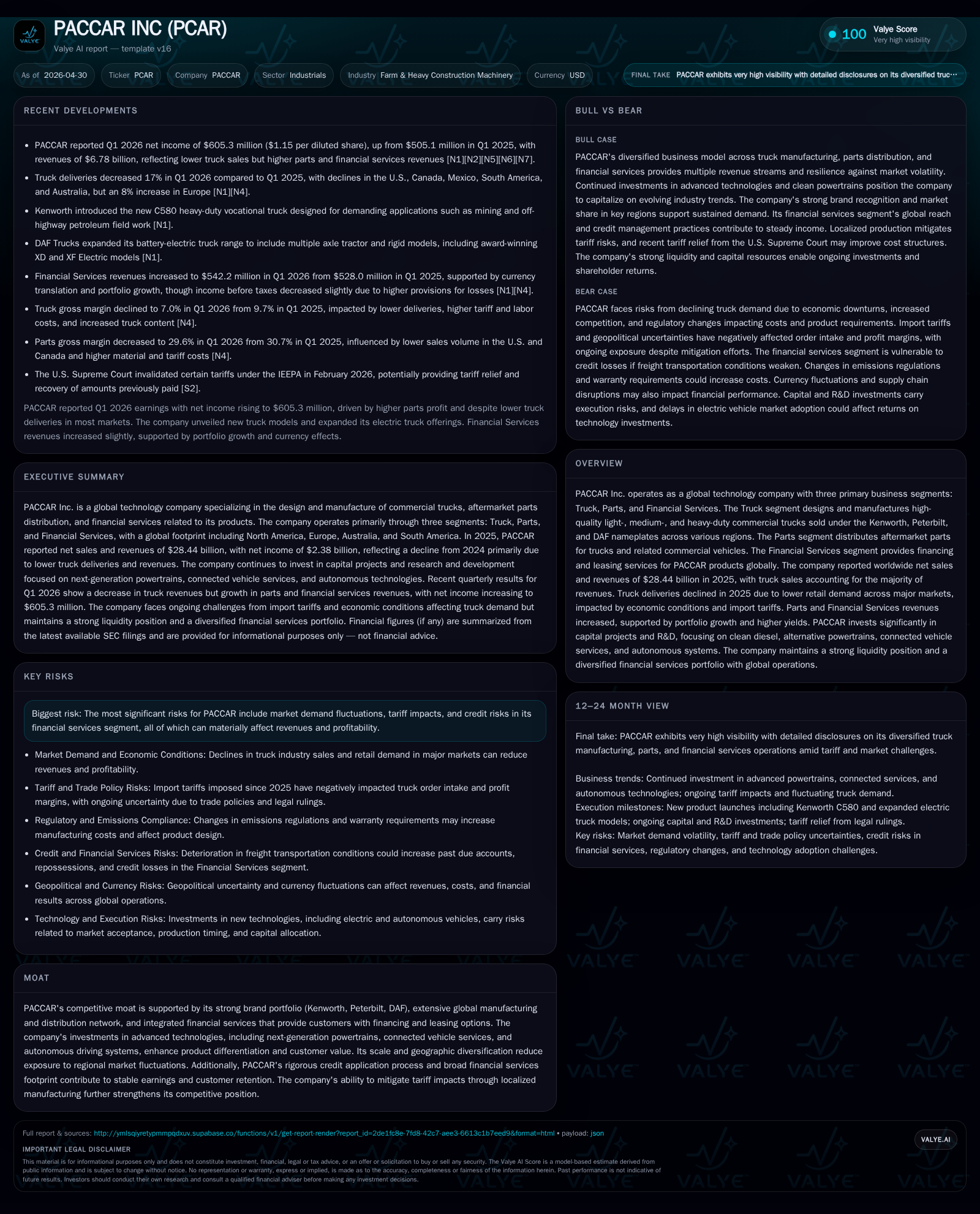
In the first quarter of 2026, PACCAR experienced a decline in truck deliveries across most markets, driven by weaker retail demand and tariff-related cost increases, which pressured truck revenue and segment income. Meanwhile, its Parts and Financial Services segments delivered modest revenue growth, supported by stable aftermarket demand and improved portfolio yields. PACCAR's integrated business model and localized manufacturing have cushioned the impact of tariffs, while ongoing investments in electrification and autonomous systems position the company for future growth. Key risks include macroeconomic cycles affecting truck demand and financial credit exposure. The company's liquidity remains robust with substantial cash reserves and available credit facilities.
First Quarter 2026 Operating Update: Demand Decline and Cost Pressures
PACCAR's first-quarter results underscore a challenging start to 2026 for its core Truck segment. Net sales for trucks fell to $4.53 billion from $5.23 billion year-over-year, primarily reflecting lower unit deliveries across its major markets except Europe [S2]. This contraction aligns with subdued retail demand influenced by hesitant freight activity amid global economic volatility.
The company faced elevated cost pressures as average truck cost of sales rose by $162.3 million compared with Q1 2025. This increase chiefly stemmed from a mix of higher truck content—suggesting either more feature-rich models or added regulatory compliance costs—alongside tariffs imposed since late 2025 under Section 232 and increased labor costs [S2]. Despite mitigating efforts like localized assembly facilities across Ohio, Texas, and Washington state to shield against tariff impact on North American customers, these costs still compressed segment income before taxes.
Conversely, PACCAR's Parts segment demonstrated resilience with revenues rising modestly to $1.71 billion versus $1.69 billion last year [S2]. Stable aftermarket demand combined with continued expansion of parts distribution infrastructure—highlighted by a new Calgary Parts Distribution Center opened recently—helps sustain this steady performance despite headwinds elsewhere [S1].
Financial Services also improved revenue to $542.2 million from $528 million a year prior [S2]. This gain resulted mainly from an increased average retail loan portfolio size coupled with better portfolio yields internationally, bolstered further by favorable currency translation effects due to strengthening euros, Mexican pesos, and Brazilian reals against the U.S. dollar [S12]. However, pre-tax income declined slightly as provisions for losses rose modestly amid cautious credit management in a softening truck leasing environment.
PACCAR’s Business Model: Integrated Truck Manufacturing, Parts Distribution, and Financial Services
PACCAR operates a tightly integrated business with three complementary segments that collectively provide revenue diversification mitigating cyclicality typical of heavy-duty truck manufacturing [S1]. The Truck segment designs and manufactures premium vehicles under the well-regarded Kenworth, Peterbilt (U.S./Canada), DAF (Europe), and regional variants such as Kenworth-DAF hybrids in Mexico and South America.
Revenue is driven primarily by commercial truck sales volume adjusted for pricing/mix factors reflecting product upgrades or changes in customer configuration preferences. However, given competitive pricing pressure compounded recently by tariffs impacting input costs (steel/aluminum) and labor expenses during tight industry supply-demand balance cycles, margin compression risks persist.
The Parts segment benefits from high aftermarket penetration rates; its broad global distribution network enables rapid parts delivery supporting fleet uptime—a critical value driver in logistics operations where vehicle downtime can be costly [S1]. This steady parts revenue stream tends to be more recession-resilient relative to new truck orders.
Financial Services extends financing solutions including retail loans or leases for PACCAR products across four continents covering nearly three dozen countries [S1]. The Financial Services business stabilizes earnings somewhat through fee income streams linked to portfolio volumes and financing margins rather than direct vehicle sales alone.
By embedding rigorous credit underwriting practices globally alongside risk management calibrated to local market dynamics—including residual value guarantees embedded in lease contracts—PACCAR maintains favorable asset quality even as used truck prices fluctuate [S12]. Moreover, medium-term note programs across European (Euro MTF), Mexican (up to 10 billion pesos), Australian (unlimited), Canadian (unused facility), Brazilian finance subsidiaries along with solid collections underpin robust financing liquidity [S22][S11].
Competitive Moat Built on Premium Brands, Global Footprint, and Technology Investment
PACCAR’s secular competitive advantage largely arises from its premium-brand portfolio that has strong acceptance among professional operators valuing reliability, fuel efficiency, resale value, driver comfort/safety features—and long operating lifecycles often exceeding industry norms [S1]. Kenworth’s recent introduction of the C580 heavy-duty vocational truck exemplifies focus on specialized demanding applications like mining/off-highway petroleum where durability under extreme conditions is paramount [S2]. Meanwhile DAF is expanding its electric powertrain lineup including multiple axle battery-electric tractors/rigids building on its acclaimed XD/XF Electric series—which won International Truck of the Year 2026—to address electrification trends especially prevalent in European urban construction/city logistics markets [S2][N1].
Global manufacturing scale allows PACCAR flexibility against geographic disparities—North American production shields much truck volume from U.S.-imposed import tariffs through localized assembly supporting NAFTA corridor customers directly [S1][S2]. Meanwhile European operations mitigate Brexit-related disruptions affecting supply chains.
Crucially technological investments into next-generation powertrains spanning clean diesel combustion enhancements plus hybrid drivetrains extend product cycle life while positioned for evolving emissions regulations requiring NOx reductions reaffirmed by EPA in early 2026 [S2][S14]. Autonomous driving platform development also complements traditional OEM strengths promising enhanced safety/performance metrics increasingly demanded by fleet owners competing for driver recruitment/retention.
Operating leverage benefits arise from scale efficiencies negotiating raw material costs among tier one suppliers amid inflationary commodity environments observed since late 2024.[N2]
Growth Drivers: Electrification, Autonomous Systems, Connected Vehicle Services
Catalysts fueling PACCAR’s long-term growth include aggressive deployment of battery-electric trucks primarily via DAF’s expanding vocational chassis portfolio targeting urban/regional haul segments impacted most severely by pollution regulations [S2][N1]. These models build upon proven electric capabilities winning market accolades while addressing tightening carbon-emission standards globally.
The Company anticipates capital expenditures between $725 million-$775 million alongside R&D expense guidance near $450-$500 million during fiscal 2026 aimed at accelerating electrification efforts as well as refining hybrid system architectures integrating AI-enabled advanced driver-assistance systems (ADAS) foundational for full autonomy ambitions communicated during recent earnings discussions[N1][S8][S10].
Connected vehicle ecosystem solutions leveraging telematics offer fleet operators real-time diagnostics optimizing maintenance scheduling reducing unscheduled downtime—a growing trend among fleets aiming at digitization-driven productivity gains.[S10]
Simultaneously new vocational truck product platforms such as Kenworth’s C580 open opportunities penetrating niche but lucrative haul markets involving heavy-load mining/off-highway operations where premium marginal pricing remains viable due to highly specialized requirements.[S2]
Risks and Constraints: Economic Sensitivity, Tariff Uncertainty, Credit Exposure
Significant risks clouding PACCAR’s near-term outlook hinge on cyclical weakness impacting retail heavy-duty truck order books sensitive to broader economic activity including freight volumes correlated closely with GDP growth patterns.[S1][S2] Economic softness will likely sustain subdued industry retail sales estimates forecasted midpoint ranges around 230K-270K units for North America over full year 2026 suggesting limited upside absent macro recovery.[S2]
Tariff-related headwinds are partially alleviated following a landmark February 2026 U.S. Supreme Court ruling invalidating certain International Emergency Economic Powers Act tariffs possibly enabling refunds or relief on past payments,[S2][N13] but uncertainty persists over potential policy shifts driven by geopolitical tensions or renegotiations underlying supply chain cost structures.[N13]
Credit quality concerns reside within Financial Services where worsening transportation market fundamentals could prompt elevated delinquencies/repossessions increasing provisions impairing profitability.[S12] Current used truck inventory valuations represent notable assets ($354 million at quarter-end) subject to market price swings.[S12] However prudent credit screening balanced by diversified geographic lending portfolios mitigate some downside exposures.
Capacity constraints appear manageable currently due to strategic facility expansions enhancing throughput efficiency mitigating supply bottlenecks evident earlier cycles.[N14][S10]
Outlook and Key Milestones to Monitor Through 2026
Management projects stable-to-moderately declining heavy-duty unit sales trajectories through calendar year end across key geographies including North America (230K-270K units), Europe (280K-320K units), South America (100K-110K units) relative to recent historical levels [S1][S2]. Watchpoints include quarterly reported unit deliveries signaling possible deviation from forecast ranges.
Parts segment promises mid-single-digit growth offsets depending on economic conditions maintaining aftermarket strength plus geographical mix enhancements especially Canada/Europe following facility openings.[S1]
Financial Services average earning assets expected flat reflecting cautious loan originations against used truck market trends; monitoring credit loss provisions quarterly is imperative given sector cyclicity.[S1][S12]
Further developments on tariff matters post-Supreme Court ruling merit close observation including any material claim recoveries impacting effective costs.
Advancements on product development milestones involving battery-electric vehicle launches—including expanded chassis models—and autonomous platform operability will shape competitive stance longer term.
Financial Profile: Liquidity Position, Capital Allocation, and Profitability Trends
Unutilized committed bank lines stand near $5.25 billion providing ample backup liquidity for short-term debt maturing obligations particularly within the Financial Services segment which issued around $400 million in medium-term notes during the quarter replenishing funding capacity [S2][S22].
Capital investment outlays slowed moderately during Q1 ($135.5 million vs $171.9 million prior year) reflecting timing shifts but remain on track toward full-year targets between $725-$775 million focused heavily on expanding advanced manufacturing capabilities supporting next-gen powertrain production lines [S2][S8]. R&D expenditures decreased slightly aligned with planned budgets near $109 million quarterly aiming at technology pipeline progressions critical for product differentiation.[S8]
Despite declining truck sales impacting top line growth negatively overall net income improved notably relative to prior Q1 ($605 million vs $505 million) aided partly by lower litigation charges carried last year—as well as higher margins realized in parts operations plus ongoing financial service yield improvements offsetting tariff cost headwinds [S2][N2].
In summary, PACCAR’s diverse business structure leveraging integrated manufacturing-financing capabilities combined with robust brand equity continues providing resilience amid cyclical trucking industry softness heightened tariff challenges experienced early 2026. The company’s strategic investment stance aimed at electrification adoption autonomous technologies positions it to capitalize on structural shifts while navigating near-term macro risks prudently.
This analysis is based solely on publicly disclosed SEC filings dated through April 29, 2026 ([S1],[S2],[S3]) complemented by associated earnings call transcripts ([N1],[N2]) without offer or invitation for investment advice or recommendations.
Disclaimer: This is research-only, informational analysis and not investment advice. It may include AI-generated interpretation and general industry context. Always verify important details using primary sources.

Comments