
Carpenter Technology Surpasses Q3 Margins with Aerospace Demand and Strategic Pricing
Record operating income driven by Aerospace growth offsets Performance Engineered Products sales pressures.
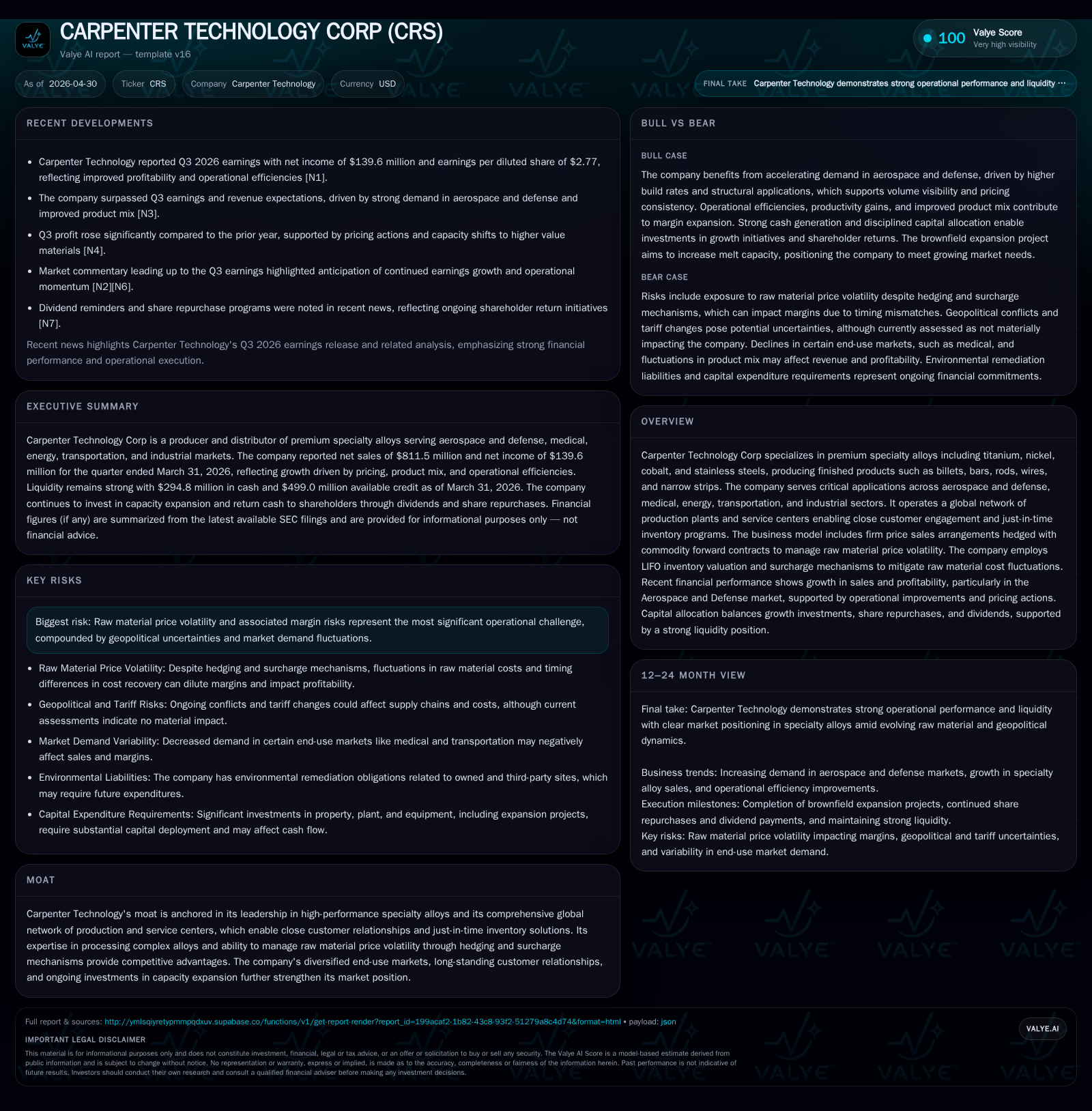
In Q3 fiscal 2026, Carpenter Technology (CRS) reported a 35% surge in operating income to $186.5 million, fueled by robust Aerospace and Defense demand and improved product mix in its Specialty Alloys Operations (SAO) segment. Despite a 9% decline in its Performance Engineered Products (PEP) segment sales, the company’s just-in-time global distribution network and raw material hedging strategies underpin strong operational resilience. Growth is structurally supported by accelerating aerospace build rates and pricing mechanisms, while risks stem from raw material price volatility and end-market cyclicality. Share repurchases and capital investments in melt capacity signal confidence in long-term aerospace-driven demand expansion.
Recent Operating Update: Q3 Fiscal 2026 Results
Carpenter Technology reported record operating income of $186.5 million for Q3 ended March 31, 2026, a notable increase of 35% compared to the prior year quarter and surpassing the high watermark set in the previous quarter by 20% [S2]. This performance was largely underpinned by the Specialty Alloys Operations (SAO) segment delivering $208.0 million in operating income at a strong margin of 28.3%, or an adjusted margin of 35.6% when excluding surcharge revenue effects [S2, S20]. SAO sales volumes rose significantly (+16% pounds sold), reflecting accelerating Aerospace and Defense demand, particularly in structural components that require high-performance alloys [S25].
Conversely, the Performance Engineered Products (PEP) segment faced headwinds with net sales down 9% for the nine months ended March 31, 2026 — falling from $300.8 million to $274.5 million — driven primarily by weaker Medical and Distribution markets, offset partially by gains in Aerospace/Defense and industrial sectors [S15]. Operating income for PEP correspondingly declined to $23.0 million for the nine-month period but maintained stable margins near prior-year levels when normalized for surcharge effects [S15]. The narrow-strip, wire, and powder metals portfolio within PEP remains strategically important but appears more sensitive to cyclical pressures.
Business Model Overview
At its core, Carpenter Technology generates revenue by producing premium specialty alloy materials—chiefly titanium, nickel-based superalloys, cobalt alloys, powder metals, stainless steels—and value-added finished forms such as billets, bars, rods, wires, narrow strips, metal powders and fabricated parts used in critical applications. Customer industries include aerospace & defense (largest), medical devices, energy production (including oil & gas), transportation equipment manufacturing, and general industrial uses [S23].
Revenue mechanics involve both direct plant shipments and deliveries via Carpenter's proprietary global network of service centers across North America, Europe and Asia enabling just-in-time inventory programs for key customers [S21]. This global footprint distinguishes Carpenter from competitors that rely more heavily on independent distributors.
Pricing incorporates firm price contracts often hedged using commodity forward contracts on nickel, cobalt, titanium, etc., mitigating the impact of raw material cost swings [S22]. The company applies LIFO inventory accounting meaning cost of goods sold reflects latest market prices while monthly surcharges based on raw material indices adjust customer pricing upward or downward accordingly; however, timing mismatches create temporary margin variability [S23].
Margin improvement is supported by shifting product mix toward complex alloys commanding premium pricing alongside continual operational productivity gains.
Industry Structure and Competitive Position
Carpenter holds a leadership position anchored by deep metallurgical expertise in processing complex alloys critical to aerospace structural integrity and high-reliability applications. The company's longstanding customer relationships—often formalized via multi-year supply agreements with volume commitments—and integrated distribution network build substantial switching costs.
The specialty alloys market is structurally favorable due to barriers like expensive melting/refining capacity expansion hurdles alongside stringent quality certification requirements unique to aerospace/defense customers. Competitors such as Special Metals Corporation or ATI face similar long lead times for capacity investments but may lack Carpenter's extensive downstream value-added services.
Geopolitical tensions increasing demand security concerns reinforce Carpenter's role as a trusted supplier ensuring supply chain resilience for national security applications.
Growth Drivers
Aerospace & Defense Recovery: Increasing commercial aircraft build rates after pandemic disruptions drive higher demand for titanium and nickel-based superalloys used in airframe structures; Carpenter benefits both volume growth (+16%) and improved pricing power facilitating margin expansion [S11, S25].
Brownfield Expansion: Investments underway to expand primary melting and secondary processing capacity enable scaling up production of higher-value alloys supporting future aerospace platform launches [S11].
Product Mix Optimization: Strategic shift towards complex alloys displaces commoditized stainless steels boosting profitability metrics across SAO operations [S14].
Just-in-Time Inventory Programs: Service centers enhance customer satisfaction through improved logistics responsiveness helping retain client contracts amidst competitive pressures [S21].
Fiscal Discipline & Capital Allocation: Robust free cash flow generation allows share repurchases ($133.9 million shares retired in nine months) alongside dividend payments demonstrating balanced capital stewardship signaling management confidence [S11].
Risks / Watchpoints / Growth Constraints
Raw Material Price Volatility: While surcharges provide some cost pass-through protection against nickel or cobalt price swings, lagged recognition creates exposure to margin erosion during periods of rapid price changes; this risk remains significant given commodity market fluctuations currently uncertain globally [S23, S26].
Lag Between Commodity Hedge Accounting and Revenue Recognition: Timing mismatches can distort quarterly earnings comparisons causing potential noise despite underlying steady state economics [S22].
Market Cyclicality Impact on PEP Segment: The medical device sector softness illustrates vulnerability outside core aerospace end markets; distribution channel challenges moderate growth visibility there [S15].
Legal & Regulatory Risks: Routine patent disputes or employee health-related lawsuits including asbestos exposure claims typical in manufacturing warrant ongoing monitoring without immediate material impact disclosed thus far [S2].
Capital Intensity & Capacity Utilization: Brownfield expansion requires careful deployment; incomplete utilization could pressure margins if demand softens unexpectedly.
What To Watch Next
- Quarterly updates on SAO shipment volumes relative to aerospace build rate targets will be critical evidence of sustainable demand momentum.
- Progress reports on brownfield melt capacity expansions detailing capital spend milestones will indicate execution effectiveness.
- Pricing realization trends amid evolving raw material costs combined with surcharge adjustments will offer insight into margin durability.
- PEP segment recovery or stabilization signals especially within medical device markets could broaden growth avenues.
- Updates on any significant shifts in tariff regimes or supply chain disruptions impacting input costs or delivery lead times.
- Adjusted earnings per diluted share guidance accompanying upcoming filings could clarify near-term profit trajectory.
Financial Profile Snapshot As Of March 31, 2026
Latest financial snapshot
| Metric | Value | Period |
|---|---|---|
| Cash & equivalents | $295mm | |
| 2026-03-31 | ||
| Current assets | $1898mm | |
| 2026-03-31 | ||
| Current liabilities | $508mm | |
| 2026-03-31 | ||
| Current ratio | 3.73x | |
| 2026-03-31 |
Source: SEC companyfacts cache [F1].
| Metric | Value | Period End |
|---|---|---|
| Cash & Equivalents | $294.8 M | |
| 2026-03-31 | ||
| Current Assets | $1.898 B | |
| 2026-03-31 | ||
| Current Liabilities | $508.3 M | |
| 2026-03-31 | ||
| Current Ratio | 3.73x | |
| 2026-03-31 | ||
| Total Debt | ~$692.7 M* | Most recent* |
| Approx Net Debt | ~$397.9 M* | Most recent* |
| *Total debt figure from year-end data March 2023; current estimates subject to confirmation but no significant refinancing indicated post-November 2025 credit facility amendment extending maturity to November 2030 with available revolver at $499 M [F1],[S2],[S5]. |
Conclusion
Carpenter Technology's Q3 fiscal year results reinforce its entrenched leadership across premium specialty alloys serving vital aerospace/defense markets now entering a sustained build phase favorable for volume growth and margin expansion. Its sophisticated pricing architecture utilizing surcharges indexed to volatile raw materials alongside comprehensive hedging reduces earnings risk while expanding operational efficiency optimizes product mix further boosting returns.
The contrasting PEP segment softness highlights areas requiring tactical attention but overall does not materially impair the company's outlook given its smaller scale relative to SAO’s robust momentum supported by structural aerospace demand drivers.
Strategic brownfield expansions in melt capacity underscore commitment to scaling high-value alloy production aligning long-term operations with anticipated industry growth trajectories while disciplined capital allocation ensures preservation of balance sheet strength enabling strategic optionality.
Investors tracking Carpenter should monitor key volume/pricing milestones emanating from aerospace OEM activity alongside operational execution against capacity enhancement plans as fundamental indicators shaping next phases of corporate growth trajectory.
This report synthesizes publicly filed SEC disclosures as of April 29–30, 2026 ([S2], [S3], others) alongside structured financial data ([F1]) without offering investment advice or price predictions.
Disclaimer: This is research-only, informational analysis and not investment advice. It may include AI-generated interpretation and general industry context. Always verify important details using primary sources.

Comments