
Crescent Biopharma Advances Bispecific Antibody and ADC Pipeline While Maintaining Strong Liquidity
The company reported progress initiating Phase 1/2 trials for its lead bispecific antibody and plans for ADC studies amidst substantial R&D investment.
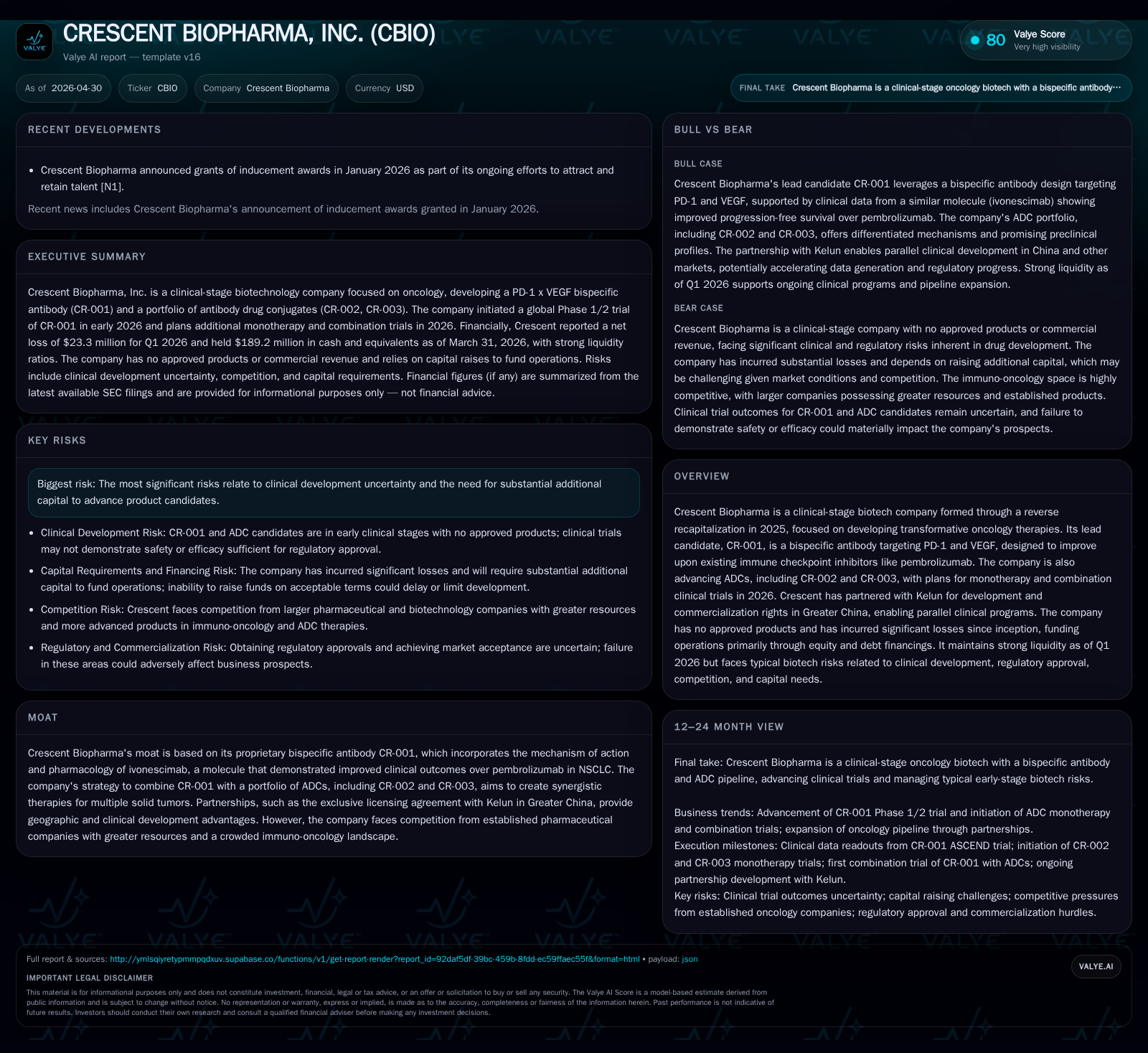
Crescent Biopharma, a clinical-stage biotech newly established via reverse merger in 2025, reported in its latest quarter beginning pivotal clinical development of CR-001, a PD-1 x VEGF bispecific antibody intended as an immune checkpoint inhibitor replacement. The company also plans to initiate monotherapy and combination trials for its antibody drug conjugates CR-002 and CR-003 in 2026. Crescent maintains strong liquidity with approximately $189 million in cash and a healthy current ratio of nearly 14. The company’s strategic focus on combining immunotherapy with ADCs targets a broad solid tumor market but faces typical early-stage development risks and requires continued capital to sustain operations.
Recent Operating Update
In the first quarter of 2026, Crescent Biopharma initiated its global Phase 1/2 ASCEND trial for CR-001, a PD-1 x VEGF bispecific antibody designed to enhance immune checkpoint inhibition beyond existing therapies like pembrolizumab [S2, S3]. This milestone marks a critical advancement from preclinical to clinical stages and aligns with the company's strategy to establish CR-001 as a next-generation backbone immunotherapy. Additionally, Crescent disclosed plans to file an Investigational New Drug (IND) application for CR-002 mid-year 2026, with initiation of monotherapy trials anticipated thereafter. Similarly, CR-003 monotherapy and combination trials with CR-001 are also slated for commencement within 2026 [S2]. These developments affirm tactical progress toward building a diversified oncology pipeline encompassing both bispecific antibodies and antibody drug conjugates (ADCs).
Financially, as of March 31, 2026, the company reported cash and equivalents of approximately $189 million against current liabilities near $14 million, yielding a robust current ratio of nearly 14 [F1]. This strong liquidity position offers operating cushion needed for costly clinical programs. However, despite this capital runway, Crescent remains entirely pre-revenue with no products approved or commercialized thus far [S1].
Business Model
Crescent Biopharma operates exclusively as a clinical-stage biotechnology company targeting oncology indications characterized by significant unmet needs. Its business model is predicated on generating value through innovative biologic drug candidates centered around two pillars: the lead bispecific antibody (CR-001) that simultaneously targets PD-1 immune checkpoints and VEGF angiogenesis pathways, potentially improving efficacy over single-target checkpoint inhibitors; combined with a growing portfolio of ADCs (CR-002 and CR-003) intended to deliver cytotoxic agents selectively to tumors.
Revenue generation will depend primarily on successful product development milestones culminating in regulatory approvals followed by commercialization. Current funding comes solely from equity and convertible debt financings since no commercial revenues exist [S2]. The company leverages collaborations such as the exclusive licensing agreement with Kelun Biopharma granting Greater China rights which allows parallel clinical advancement in important geographies while retaining global development control [S1].
Margins will initially be negative due to high R&D efforts. Future margins will reflect manufacturing efficiencies in biologics production alongside pricing strategies in competitive immuno-oncology segments where premium pricing is common but reimbursement landscapes remain volatile.
Industry Structure and Competitive Position
The immuno-oncology space is highly competitive and dominated by large pharmas like Merck (Keytruda), Bristol Myers Squibb (Opdivo), and Roche (Tecentriq) whose immune checkpoint inhibitors have set high efficacy benchmarks across multiple solid tumors. Crescent’s approach fundamentally aims to disrupt this market by introducing a bispecific molecule that combines checkpoint blockade with VEGF inhibition - an emerging rationale given angiogenesis’ role in immune resistance.
ADCs similarly represent a fast-growing segment with leaders like Seagen advancing multiple FDA-approved constructs. Crescent’s ADC candidates target validated oncology antigens but face an uphill battle requiring differentiation either through improved therapeutic indices or complementary combination regimens.
Partnerships such as the Kelun agreement give Crescent strategic geographic positioning leveraging local expertise. However, scalability challenges remain due to limited internal infrastructure compared to major pharmaceutical companies capable of orchestrating broad late-stage trials and global commercial launches.
Growth Drivers
Key growth drivers hinge on several upcoming execution points: the ongoing ASCEND trial serving as de-risking proof-of-concept readout expected around Q1 2027; IND filings and trial initiations for CR-002 which expand pipeline breadth; subsequent CR-003 clinical progression; plus any demonstration of synergistic effects when combining CR-001 with ADC therapies [S2,S3,S25]. Success here is critical not only scientifically but also commercially given competition risks.
Additional growth may derive from the expansion into Greater China via Kelun partnership allowing accelerated regional presence without direct capital burden. Moreover, regulatory approvals contingent upon positive trial data open paths towards reimbursement discussions which underpin commercial viability.
Risks / Watchpoints / Growth Constraints
Crescent’s most immediate risk factors relate to inherent drug development uncertainties including failure to meet safety or efficacy endpoints in clinical trials leading to delays or discontinuations [S2,S16]. The company’s very limited operating history intensifies execution risk. Regulatory dynamics impose further uncertainty especially given evolving healthcare laws influencing pricing and market access [S19,S23].
Capital demands remain substantial; ongoing R&D expenses coupled with general administrative costs necessitate further financing rounds which may dilute existing shareholders or impose restrictive terms. Market conditions tightening access to biotech capital may compound these challenges.
The crowded immuno-oncology landscape pressures Crescent into rapid innovation cycles while competing with incumbents deploying legacy data sets alongside emerging biotechnologies backed by extensive resources.
What To Watch Next
Upcoming catalysts pivotal for monitoring Crescent’s trajectory include interim safety and pharmacokinetic data releases from the ASCEND trial scheduled within the next year. Successful IND clearance followed by patient enrollment updates for CR-002 and CR-003 programs provide additional signposts. Investor communications around financing initiatives or strategic partnerships beyond Kelun could impact operational sustainability.
Regulatory feedback will also be critical — both from FDA interactions regarding trial designs and potential accelerated approval pathways — shaping timelines significantly.
Financial Profile Summary
Latest financial snapshot
| Metric | Value | Period |
|---|---|---|
| Cash & equivalents | $189mm | |
| 2026-03-31 | ||
| Current assets | $196mm | |
| 2026-03-31 | ||
| Current liabilities | $14mm | |
| 2026-03-31 | ||
| Current ratio | 13.78x | |
| 2026-03-31 |
Source: SEC companyfacts cache [F1].
This strong liquidity base stems from prior financings completed post-reverse recapitalization executed in mid-2025, providing operating runway ahead of product commercialization. Operating losses persist as expected given early stage status without recurring revenues [S1,S2]. Capital management remains critical moving forward.
This analysis consolidates publicly available information as of April 30, 2026 from SEC filings including Crescent Biopharma’s latest quarterly report (10-Q), annual report (10-K), recent event filings (8-K), plus financial fact sets. It aims solely to provide an informed perspective on company positioning within biotech oncology without investment advice or price commentary.
Disclaimer: This is research-only, informational analysis and not investment advice. It may include AI-generated interpretation and general industry context. Always verify important details using primary sources.

Comments