
FinVolution Group Boosts Dividends Amid Regulatory and Market Challenges
A dividend increase highlights FinVolution’s financial resilience as it contends with regulatory complexities and evolving market dynamics in China’s online consumer finance sector.
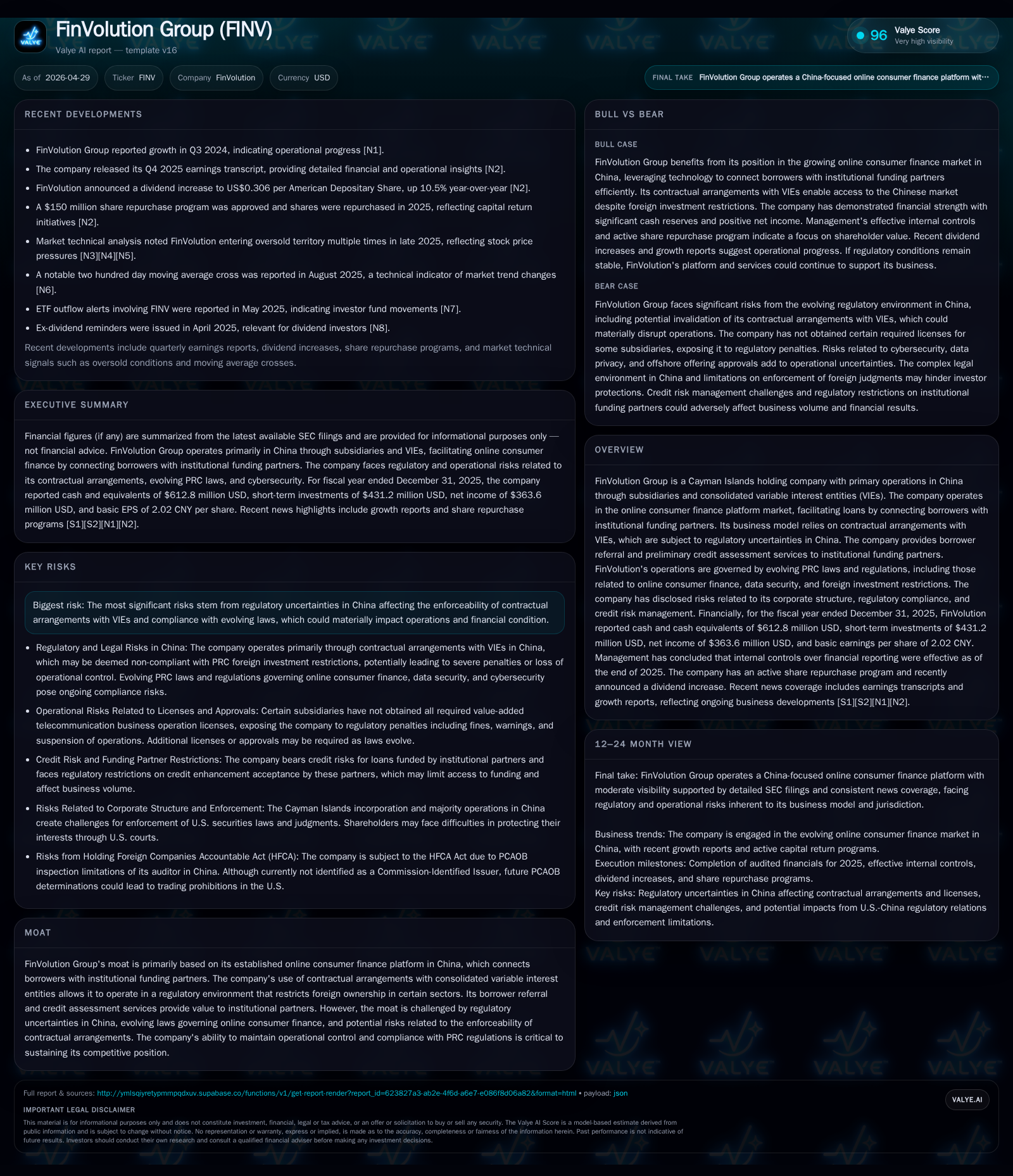
In its latest quarterly filing, FinVolution Group announced a 10.5% increase in its dividend per ADS, signaling confidence in earnings stability despite ongoing regulatory and market uncertainties. The company operates an online consumer finance platform in China, leveraging contractual arrangements with VIEs that expose it to regulatory compliance risks unique to the Chinese fintech landscape. Growth is driven by rising digital loan demand and institutional funding partners’ behavior, although interest rate fluctuations and legal ambiguities around VIE structures pose persistent risks. Near-term focus will be on monitoring regulatory developments, loan volume metrics, and capital allocation decisions.
Recent Quarterly Update and Dividend Policy
In its March 2026 interim disclosure ([S2]), FinVolution Group announced a 10.5% year-over-year increase in its dividend to US$0.306 per American Depositary Share (ADS). This increase signals management’s confidence in the stability of underlying earnings despite the complex regulatory environment in China’s online fintech space where the company operates. While macroeconomic pressures and regulatory shifts persist in shaping investor sentiment toward Chinese fintech firms, this tangible dividend uplift communicates resilience in earnings generation and a commitment to shareholder returns amidst uncertainty.
Business Model and Service Offering Deep Dive
FinVolution’s core business centers on its online consumer finance platform primarily operating through subsidiaries and consolidated variable interest entities (VIEs) based in China ([S1]). These VIE contractual arrangements enable FinVolution—a Cayman Islands incorporated holding company—to control key operations despite PRC restrictions on foreign ownership in certain financial services sectors.
Unlike traditional loan originators, FinVolution generates revenue chiefly by connecting individual borrowers with institutional funding partners who provide capital for loans. The company’s contribution includes borrower referral services combined with preliminary credit risk assessments designed to enhance underwriting efficiency for partners ([S1]). Revenue mechanics therefore derive predominantly from fees earned as a percentage or fixed charge linked to referrals and credit evaluation services rather than direct lending spreads.
This model leverages technology-enabled platforms allowing scale through network effects: more borrowers attract more institutional partners seeking quality transaction flow. However, reliance on contractual rather than equity ownership—typical for VIEs—introduces execution risks tied to enforceability of these contracts under evolving PRC laws ([S26]). Strategic strength lies in the established loan facilitation network and integrated credit analytics that improve interface quality between demand and supply sides.
Competitive Environment and Regulatory Framework
China's fintech sector remains tightly regulated with frequent policy recalibrations affecting foreign investment structures like VIEs ([S15],[S17]). FinVolution benefits from regulatory arbitrage by using contractual arrangements but faces persistent scrutiny over these mechanisms. Its primary competitors are domestic online lending platforms similarly navigating VIE frameworks or directly owned entities under permissible regulatory schemas.
Additional layers of regulation address data security mandates, cybersecurity compliance, oversight of credit reference activities, and licensing obligations ([S17],[S18]). For instance, if FinVolution’s affiliated entities providing credit reference services fail to secure necessary licenses timely, they risk penalties including operational suspension or fines. These regulatory demands elevate the operational bar within which FinVolution must innovate without breaching evolving compliance thresholds.
Despite these challenges, operating scale combined with established partnerships provide some competitive moats but the sustainability of advantage depends on adaptive governance aligning with shifting PRC supervisory expectations.
Macroeconomic and Industry Growth Levers
Growth prospects hinge on structural trends such as rising consumer demand for digital lending products within China’s large internet-savvy population segments ([S1]). Increased smartphone penetration combined with gaps in traditional credit accessibility fuel adoption of fintech lending platforms.
Institutional funding partner appetite remains a critical growth lever. These partners adjust required yields depending on interest rate environments; elevated rates increase their cost of capital potentially tempering investment activity on FinVolution’s platform ([S1],[S27]). Conversely, falling rates might drive greater borrower volume but compress partner returns.
Product innovation efforts expanding beyond basic loans into diversified financial services can also unlock revenue growth. Building robust borrower data sets enhances credit risk modeling accuracy—a vital factor given China’s relatively nascent credit infrastructure—which can reduce default risk and improve margin profile over time ([S15]).
Risks and Structural Constraints
Foremost risks reside in legal uncertainties surrounding FinVolution’s VIE corporate structure. If PRC authorities tighten foreign investment restrictions or disallow current contract-based control models compelling relinquishment of business interests, FinVolution’s operational model faces severe disruption ([S15],[S18],[S26]).
Credit risk management remains another significant constraint. Since most loans are funded by third-party institutions yet originated via borrower referrals introduced by FinVolution, deterioration in portfolio quality or spikes in overdue loans hurt financial outcomes ([S15]). The early-stage development status of China’s credit reporting systems complicates precise risk calibration.
The licensure regime adds further exposure: failure to maintain appropriate operational permits for services such as credit reference provision could trigger sanctions or curtail business segments ([S17],[S18]).
Externally driven shifts like interest rate volatility directly impact transaction volumes facilitated on the platform—contributing to transaction flow cyclicality contrary to purely structural growth assumptions ([S1],[S27]). This introduces unpredictability to near-term revenue streams.
Upcoming Catalysts and Watchpoints
Key near-term monitoring points include upcoming quarterly earnings disclosures which will reveal ongoing loan volume trends, partner activity levels, margin movement dynamics as well as the effectiveness of risk control measures ([N1],[N2],[S1]).
Regulatory developments remain pivotal: any new recruitment or renewal requirements for fintech operator licenses or clarifications affecting VIE contracts will materially influence operational certainty.
Variations or shifts within the institutional funding partner base—their willingness or cost thresholds—also serve as leading indicators for platform throughput health.
Finally, borrower acquisition metrics provide early signals for demand sustainability underpinning future revenue expansions.
Brief Financial Profile and Capital Position
Latest financial snapshot
| Metric | Value | Period |
|---|---|---|
| Cash & equivalents | $613mm | |
| 2025-12-31 | ||
| Total debt | $13mm | |
| 2025-12-31 | ||
| Net debt | $-600mm | |
| 2025-12-31 |
Source: SEC companyfacts cache [F1].
FinVolution exhibits a sound balance sheet foundation supportive of both dividend increases and ongoing share repurchase programs (the latter approved through March 2027) ([F1],[S2],[S25]). Cash & equivalents stand robust at approximately $613 million with minimal total debt around $12.8 million as of year-end 2025 resulting in a net cash position near $600 million ([F1]).
This analysis reflects insights drawn strictly from disclosed filings up to early 2026 without speculative forecasting or investment recommendations. It aims to elucidate FinVolution Group's current strategic positioning within China's dynamic online consumer finance ecosystem under regulatory flux conditions.
Disclaimer: This is research-only, informational analysis and not investment advice. It may include AI-generated interpretation and general industry context. Always verify important details using primary sources.

Comments