
Sabra Health Care REIT Advances Portfolio and Maintains Strong Liquidity in Q1 2026
Recent acquisitions and steady capital management underscore Sabra's strategic positioning in healthcare real estate.
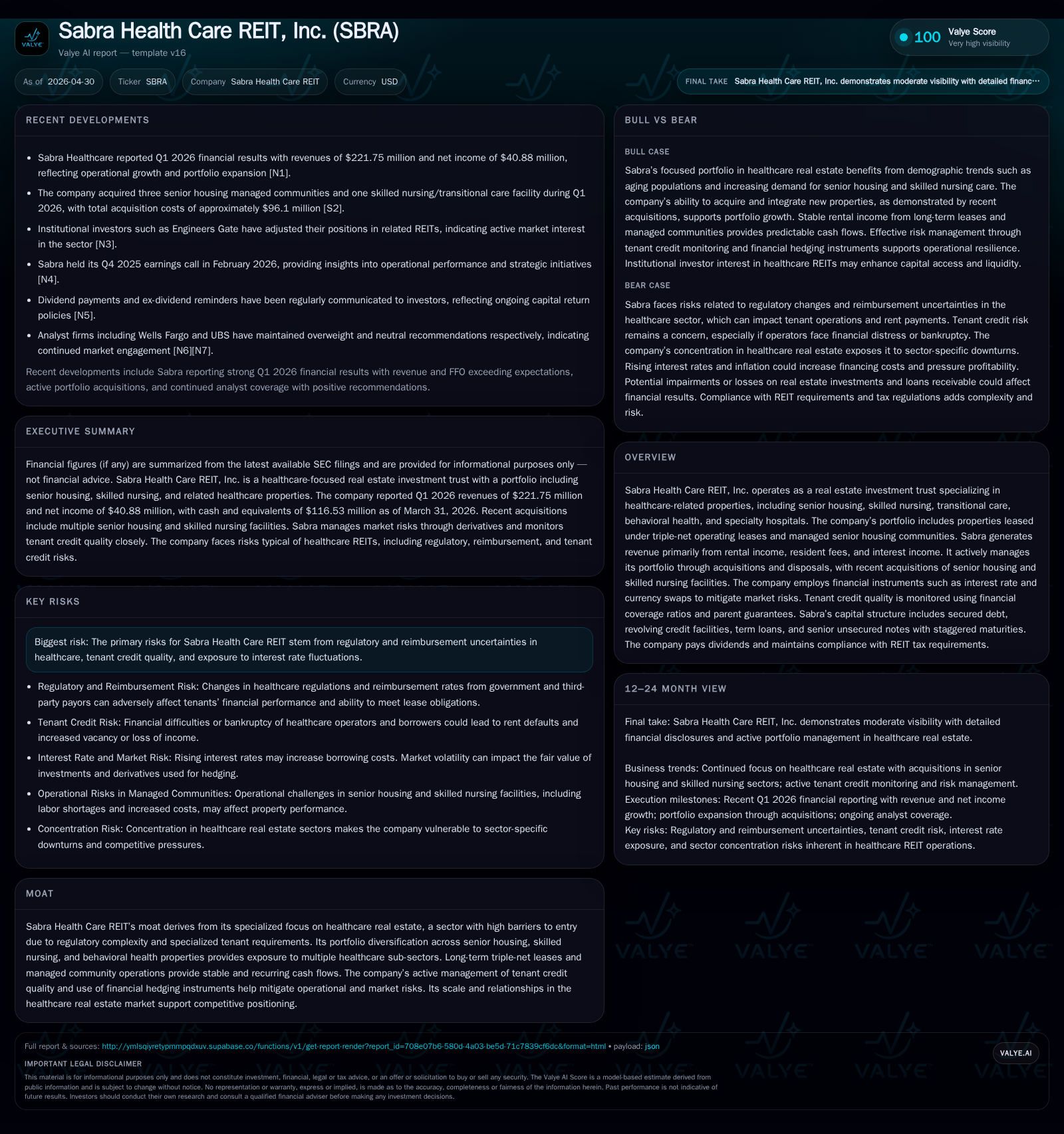
In its Q1 2026 filing, Sabra Health Care REIT demonstrated active portfolio management with acquisitions of senior housing and skilled nursing facilities, reinforcing its foothold in specialized healthcare properties. The company maintains strong liquidity with $645 million available on its revolving credit facility and continues to manage interest rate exposure through hedging. Sabra’s business model leverages triple-net leases and managed senior housing operations to generate stable revenue streams amidst regulatory and market headwinds. Growth hinges on expanding healthcare real estate demand and disciplined capital deployment, while watchpoints include tenant credit risk and interest rate volatility.
Recent Operating Update: Q1 2026 Highlights
Sabra Health Care REIT’s latest quarterly report dated April 29, 2026, reveals continued strategic momentum in its core healthcare real estate business. During Q1, the company completed acquisitions of three senior housing managed communities plus one skilled nursing/transitional care facility with a total acquisition cost of approximately $96.1 million [S16]. These investments enhance Sabra’s exposure to diversified healthcare end-markets such as senior living operators managing day-to-day resident services.
The company also reports managing two variable interest entities (VIEs) that own three senior housing communities and operate them under third-party property management agreements, positioning Sabra as primary beneficiary for consolidated reporting purposes [S2]. This structure allows Sabra operational influence over select high-performing assets while optimizing balance sheet flexibility.
As of March 31, 2026, Sabra had $355 million drawn against its revolving credit facility with $645 million available for borrowing [S2]. In addition to this facility, Sabra holds secured debt of approximately $43.5 million at fixed rates averaging 2.86% maturing through 2051 [S2].
Sabra actively uses derivative instruments for risk management: $930 million USD notional value of interest rate swaps fixes part of its debt cost, while $150 million CAD derivatives protect against currency fluctuations relating to Canadian exposures [S2]. This hedging mitigates interest rate volatility—a critical factor given current macroeconomic uncertainties.
Business Model Overview
Sabra operates exclusively within the healthcare real estate investment trust (REIT) sector, specializing in properties including triple-net leased skilled nursing facilities, senior housing (both leased and managed), transitional care centers, behavioral health facilities, specialty hospitals, and related healthcare real estate. Its revenue derives primarily from:
- Rental income under long-term triple-net leases where tenants pay property expenses,
- Fees from resident services in managed senior housing communities,
- Interest income from loans receivable backed by healthcare-related properties.
This dual structure combines passive income generation from stable leased assets with operational revenue linked to resident fees in managed properties—a relatively uncommon model within traditional REITs.
Sabra's portfolio strategy emphasizes diversification across multiple healthcare subsectors and geographies. Long-term triple-net leases provide contracted cash flows insulated from direct operating costs or labor disruptions. Conversely, managed communities necessitate active operational oversight but allow Sabra to capture ancillary revenues tied to resident occupancy and service delivery.
Tenant credit quality is rigorously assessed using financial coverage ratios and guarantees where possible. The company’s active monitoring aims to reduce exposure to reimbursement policy changes affecting resident payors since Medicare/Medicaid funding dynamics materially impact tenant viability.
Portfolio decisions are guided by returns optimization via acquisitions, selective dispositions (portfolio recycling), and joint ventures such as the VIE arrangements cited in Q1 filings which grant Sabra significant control without outright ownership dilution.
Industry Structure and Competitive Position
Healthcare real estate is characterized by high entry barriers driven by regulatory complexity surrounding licensure, building standards specific to medical use cases, operator specialization, and capital intensity required for development or repositioning.
Sabra occupies a competitive position as one of the specialized REITs focusing solely on healthcare properties, which differ greatly from traditional commercial or multifamily real estate segments. Its scale enables favorable access to capital markets and partnership opportunities with established operators. Moreover, the company’s blend of leased assets with managed operations distinguishes it from peers reliant solely on net-leased models.
Competition arises from other healthcare-focused REITs such as Welltower or Ventas but also from private equity funds investing opportunistically in niche sub-sectors like behavioral health or outpatient medical campuses. Sabra’s leverage of long-term lease structures partially insulates earnings stability amid sector cyclicality.
Growth Drivers
Structural demand for Sabra’s asset categories is propelled by demographic trends—namely aging populations driving increased utilization of senior housing, skilled nursing care, behavioral health services, and transitional care facilities. This secular tailwind supports occupancy sustainability across the portfolio.
Strategically, growth is pursued through:
- Acquisitions: Focused on core competencies in senior living communities (leased or managed) and skilled nursing assets consistent with operational expertise—exemplified by recent Q1 transactions exceeding $96 million [S16].
- Portfolio Optimization: Disposition of non-core or underperforming assets frees capital for higher-yielding investments improving overall portfolio quality.
- Joint Ventures: Use of VIE structures expands footprint selectively without full capital deployment.
- Operational Efficiency: Active management of resident fees in managed communities offers margin enhancement opportunities versus purely leased models.
- Risk Management: Hedging strategies mitigate interest rate inflation impacting financing costs.
Execution risks also stem from successful integration of acquired assets into existing portfolios and retaining high occupancy amidst evolving consumer preferences for senior care models.
What to Watch Next
Key indicators for subsequent quarters will include:
- Occupancy rates trends in both triple-net leased facilities and managed senior housing,
- Lease renewal outcomes particularly for large tenants with potential bargaining power,
- Tenant credit developments especially if reimbursement policy shifts arise,
- New acquisition announcements indicating deal pipeline strength,
- Refinancing activity surrounding the revolving credit facility due January 2027,
- Interest rate hedging adjustment disclosures reflecting macro rate movements,
- Operational performance updates highlighting managed community margins under labor cost pressures.
Monitoring these elements will offer insight into Sabra’s strategic resilience amid sector headwinds.
Financial Snapshot (As of March 31, 2026) [F1], [S2]
Latest financial snapshot
| Metric | Value | Period |
|---|---|---|
| Cash & equivalents | $117mm | |
| 2026-03-31 | ||
| Total debt | $2.7bn | |
| 2026-03-31 | ||
| Net debt | $2.6bn | |
| 2026-03-31 |
Source: SEC companyfacts cache [F1].
| Metric | Value (USD millions) | Period End |
|---|---|---|
| Cash & Equivalents | 116.5 | |
| 2026-03-31 | ||
| Total Debt | 2,686 | |
| 2026-03-31 | ||
| Net Debt | 2,570 | |
| 2026-03-31 |
The company's capital structure features a balanced mix of secured debt ($43.5 million) at low fixed rates (~2.86%) maturing through 2051 and substantial unsecured senior notes aggregating $1.25 billion at coupon rates ranging from 3.20% to 5.38% maturing between 2027–2031 [S9], [S13]. Compliance with all financial covenants is affirmed as of the latest quarter ending March 31, 2026 [S6]. Interest expense rose slightly year-over-year reflecting increased borrowings but includes non-cash components related to amortization of deferred costs [S22].
Effective use of interest rate swaps lowers the weighted average interest cost relative to market floating rates enhancing margin stability despite the prolonged low-rate environment starting to normalize post-pandemic inflationary cycles.
Conclusion
Sabra Health Care REIT displays strategic execution aligned with structural healthcare megatrends in aging populations demanding specialized real estate solutions. Its combination of triple-net leased properties complemented by strategically managed senior housing communities offers both income stability and margin expansion pathways. The recent Q1 acquisitions further strengthen portfolio diversification within core sub-sectors while liquidity reserves provide flexibility against refinancing risks ahead.
Risks related to regulation and tenant solvency warrant attention but are mitigated through rigorous underwriting standards combined with active hedging programs cushioning interest rate volatility exposure. Near-term focus will remain on integrating new assets efficiently while safeguarding occupancy levels amid an increasingly competitive operator market influenced by labor cost headwinds.
Overall, Sabra continues consolidating its niche leadership position in the specialized healthcare REIT space backed by disciplined capital allocation frameworks essential for navigating evolving sector dynamics.
Disclaimer: This analysis is informational only based on publicly available SEC filings up to April 29, 2026. It does not constitute investment advice or a recommendation regarding any securities mentioned herein.
Disclaimer: This is research-only, informational analysis and not investment advice. It may include AI-generated interpretation and general industry context. Always verify important details using primary sources.

Comments