
Mirion Technologies Reinforces Market Leadership with Strategic Acquisitions and Innovation in Q1 2026
Q1 2026 results highlight Mirion’s expanding presence in nuclear and medical radiation safety amid geopolitical and supply chain challenges.
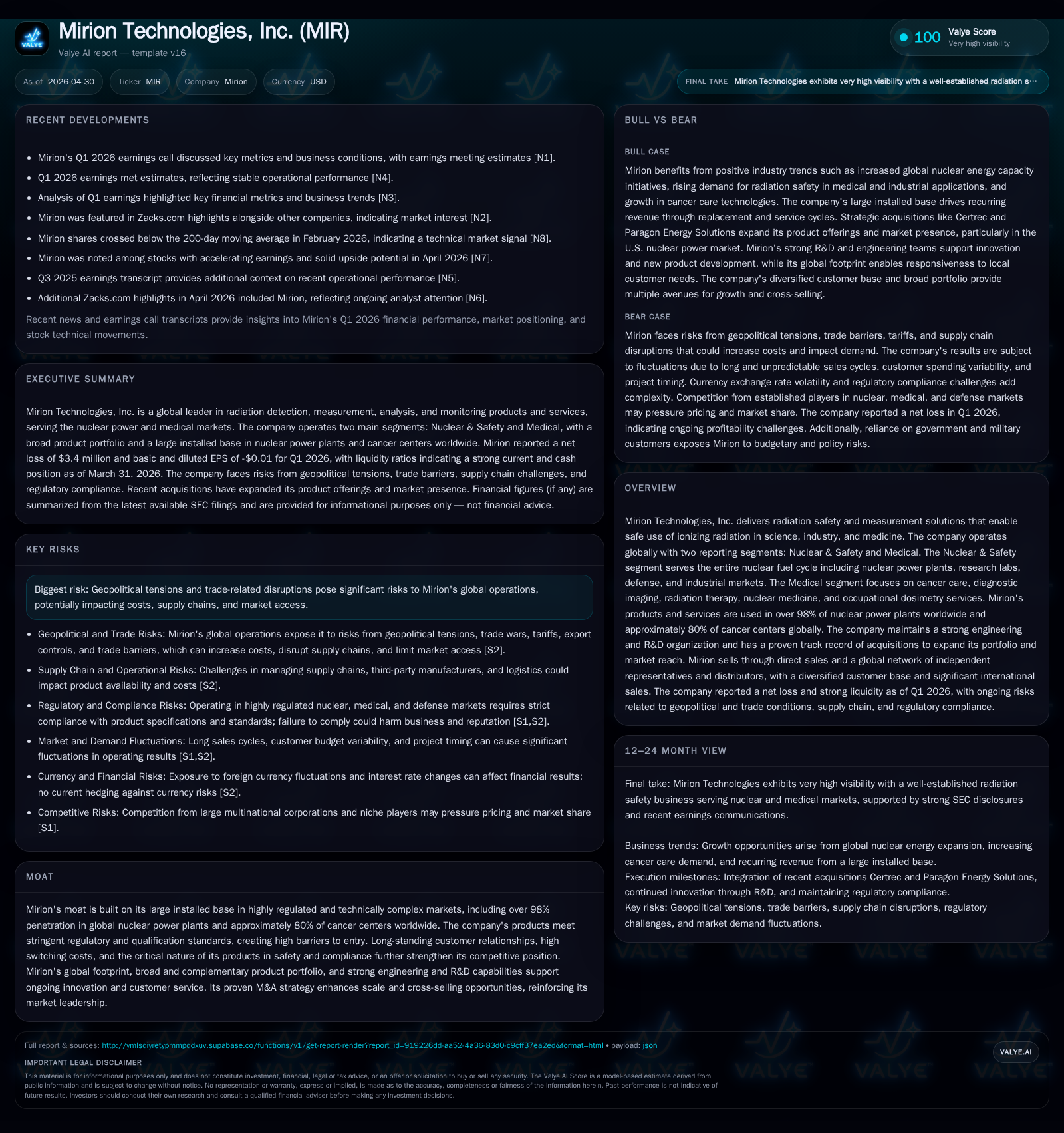
In the first quarter of 2026, Mirion Technologies maintained steady operational momentum, leveraging recent acquisitions to broaden its product portfolio and deepen U.S. nuclear market penetration. The company’s dual-segment business model — Nuclear & Safety and Medical — benefits from entrenched regulatory barriers and strong customer relationships across global nuclear facilities and cancer centers. Strategic focus on emerging markets such as small modular reactors (SMRs) and software-driven radiation safety platforms positions Mirion for structural growth. However, ongoing geopolitical tensions and global trade uncertainties present notable headwinds for the supply chain and market access.
Q1 2026 Operating Update Highlights
Mirion Technologies released its latest quarterly report on April 29, 2026 [S2], supplemented by an earnings press release on April 28 [S3]. The company continues steady operational execution amid challenging macroeconomic factors including global geopolitical tensions notably involving the U.S., China, Russia, and the Middle East conflict [S2]. Supply chain constraints persist but have been managed through supplier consolidation initiatives. Importantly, recent acquisitions—Paragon Energy Solutions acquired late 2025 and Certrec earlier that year—have been integrated into the Nuclear & Safety segment enhancing its U.S. market positioning in nuclear instrumentation [S12]. This expanded portfolio complements Mirion’s established dominance across the entire nuclear fuel cycle.
The quarter did not report revenue figures explicitly but confirmed ongoing strength in backlog orders exceeding $1 billion at year-end 2025 [S20], with nearly half expected to be realized in 2026. Management highlighted continued investments in product innovation including software-as-a-service offerings under the award-winning Vital platform intended to unify radiation instrument ecosystems across end markets [S18]. Such digital-forward strategies aim to simplify workflows for customers spanning nuclear power plants to cancer treatment centers.
Business Model Overview
Mirion operates through two core segments:
Nuclear & Safety: This segment delivers mission-critical solutions including radiation measurement instruments, monitoring systems, analytical software, protective equipment, and services supporting nuclear power plants (NPPs), defense installations, research labs, waste management facilities, and emerging small modular reactor (SMR) designs. The nuclear sector demands vendors meet rigorous regulatory approvals (e.g., NRC Appendix B in the U.S.) combined with engineering qualifications ensuring product reliability in extreme environments such as high radiation fields or harsh industrial settings [S17]. Given the critical safety role of Mirion’s products — deployed in over 98% of global NPPs — switching suppliers is naturally limited by technical integration challenges and regulatory re-certifications.
Medical: Focused on oncology and diagnostic imaging markets, this segment offers radiation therapy QA devices, radiopharmaceutical manufacture monitoring tools, nuclear medicine detectors, dosimetry services ensuring occupational safety for workers exposed to ionizing radiation, alongside software managing these complex compliance tasks. Mirion controls an estimated 80% penetration among cancer centers worldwide [N1][S24]. The business benefits from patent protection covering core product innovations expiring between now and early 2040s [S1]. Rising global cancer incidence fuels demand for advanced diagnostic equipment with precise radiation control.
Revenue is driven primarily by capital equipment sales complemented by recurring service contracts including calibration and maintenance—ensuring steady long-term income streams aligned with customer asset lifecycles. Software subscriptions under the Vital ecosystem represent a growing component offering scalable insights analytics. Highly specialized applications command premium pricing supported by technical differentiation rooted in decades-long expertise.
Industry Structure & Competitive Positioning
Mirion enjoys a defensible competitive moat grounded in:
- Extensive installed base within heavily regulated sectors requiring consistent compliance verification delaying competitor entry.
- High switching costs especially in critical Nuclear & Safety applications where recertification cycles span years.
- Robust R&D pipeline staffed by over 500 engineers driving continuous product advancements including recent digital platform rollouts [S19].
- Strategic acquisitions that broaden solution breadth (e.g., Paragon’s HIPS platform for radiation portal monitoring) enhance cross-selling opportunities across defense and energy sectors.
- Global footprint with manufacturing capabilities across key geographies including North America and Europe meeting local procurement regulations.
Competitors are generally fragmented regional players or diversified firms without Mirion’s focused niche expertise or global scale. Yet innovation cycles require constant investment while maintaining stringent compliance demands.
Growth Drivers
Several structural trends underpin growth prospects:
- Nuclear Resurgence: Rising electricity demand coupled with decarbonization policies reviving interest in existing reactors and new builds including SMRs that promise flexible safer power generation up to 2050 projections of ~700 GW installed capacity [S18]. Such deployments require new instrumentation solutions that Mirion can uniquely provide.
- Privatization & Outsourcing: Governments increasingly outsource radiation safety services creating opportunities for Mirion to extend offerings beyond hardware to managed solutions enabled by remote monitoring software.
- Digital Transformation: The push toward integrated digital ecosystems via platforms like Vital addresses customer needs for real-time data aggregation simplifying regulatory reporting burdens while improving operational insights.
- Geographic Expansion: Though present historically in over 120 countries [S1], targeted growth focuses on Asia Pacific regions where infrastructural modernization drives incremental demand.
- Medical Market Expansion: Growing oncology diagnosis/treatment volumes globally create increasing consumable/equipment spending enhancing Medical segment revenues.
Risks & Watchpoints
Mirion faces a constellation of risks:
- Geopolitical / Trade Tensions: Tariffs, export controls (e.g., OFAC sanctions regimes), and trade wars particularly between the U.S. and China impose uncertainty on supply chains including component procurements for proprietary sensor technologies [S10][S21]. Any escalation could disrupt manufacturing costs or restrict access to key international markets.
- Budgetary Cycles: Government funding reductions or delays may impact project timelines in both main segments where public agencies represent a significant portion of customers [S2][S20].
- Supply Chain Constraints: Dependence on certain commodities such as precious metals (e.g., rhodium used internally) subjects production cost volatility [S17].
- Regulatory Compliance Costs: Environmental regulations or changes in certification requirements could increase expenditure adversely impacting margins though so far historical impacts have been manageable [S21].
- Technology & Cybersecurity Risks: As reliance grows on AI/ML-enabled services within operations or cloud-based software distributions there are increasing exposure risks related to cyber-attacks or system breaches [S13].
- Acquisition Integration Outcomes: While M&A has contributed to growth scale effects recently (Certrec/Paragon), risk remains around realizing projected synergies without operational disruption [S12].
What To Watch Next
Investors should track several near-term indicators:
- Execution on backlog conversion given large remaining performance obligations nearing $1.1 billion at year-end 2025 with nearly half slated for recognition during 2026 [S20].
- Progress releasing next Vital platform applications or updates enhancing SaaS penetration into legacy hardware installed base as a proxy for recurring revenue traction.
- Further expansion activity either via selective acquisitions or entry into newly privatized state markets domestically or internationally.
- Contract awards connected to emerging SMR projects notably in North America where Paragon acquisition grew exposure.
- Impact of macroeconomic conditions specifically trade policy developments affecting supply chain efficiency or regulatory approval timelines.
Financial Profile Brief & Snapshot
Latest financial snapshot
| Metric | Value | Period |
|---|---|---|
| Cash & equivalents | $398mm | |
| 2026-03-31 | ||
| Total debt | $452mm | |
| 2026-03-31 | ||
| Net debt | $54mm | |
| 2026-03-31 | ||
| Current assets | $891mm | |
| 2026-03-31 | ||
| Current liabilities | $279mm | |
| 2026-03-31 | ||
| Current ratio | 3.19x | |
| 2026-03-31 |
Source: SEC companyfacts cache [F1].
Mirion reported cash and equivalents at $397.9 million against total debt near $451.6 million at end-Q1 March 31, 2026 resulting in net debt around $53.7 million—reflecting a conservative leverage profile supporting reasonable capital return options while funding organic investments [F1]. The current ratio stands at a healthy 3.19 indicating ample liquidity covering short-term liabilities comfortably [F1]. Operating income was $51.5 million with net income at $28.8 million reported for full fiscal year ended December 2025 reflecting profitability gains post-acquisition integration efforts [F1][S1]. Ongoing initiatives targeting manufacturing footprint optimization and supplier consolidation complement cost discipline goals further underpinning sustainable margin improvement potential.
This analysis presents an informed view based on Mirion's latest filings without investment guidance or price forecasts. Readers should consider forward-looking risks described herein alongside evolving market conditions when evaluating company developments.
Disclaimer: This is research-only, informational analysis and not investment advice. It may include AI-generated interpretation and general industry context. Always verify important details using primary sources.

Comments