
Ultra Clean Holdings Strengthens Market Foothold with Broad Integrated Solutions in Semiconductor Supply Chain
UTC’s Q1 2026 report highlights robust demand driven by AI-related semiconductor growth alongside increased leverage from a recent convertible notes issuance.
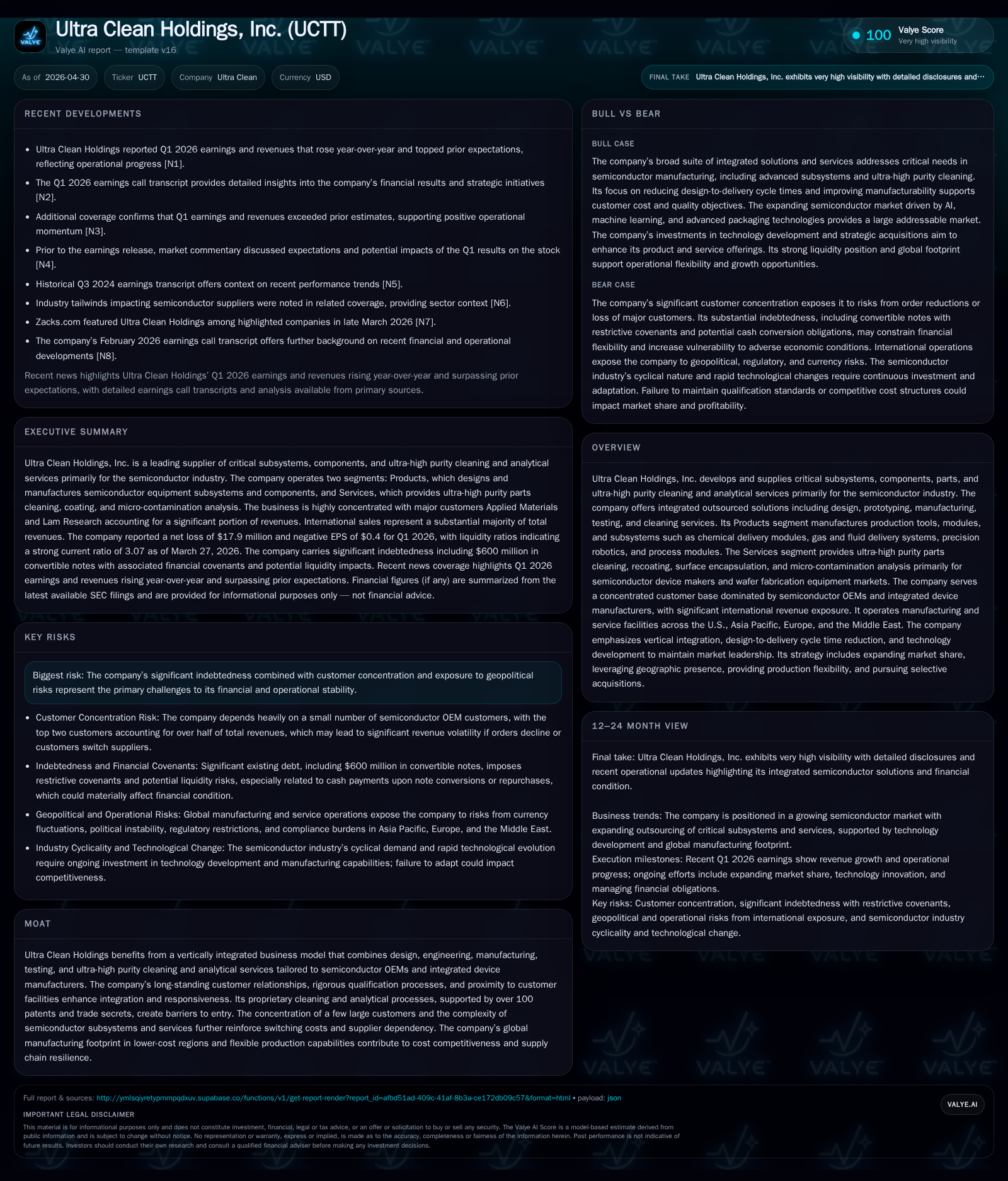
Ultra Clean Holdings (UCTT) reported strong first quarter 2026 results marked by sustained revenue growth fueled primarily by artificial intelligence-driven demand in semiconductors. The company's vertically integrated business model spanning subsystem manufacturing and ultra-high purity cleaning services enhances its strategic position amid semiconductor OEMs’ outsourcing trends. While elevated demand supports expansion, significant indebtedness arising from the recent $600 million convertible notes issuance presents liquidity and leverage risks. Customer concentration and semiconductor industry cyclicality remain watchpoints influencing revenue visibility. Management’s announced CFO retirement adds an operational governance transition aspect to monitor moving forward.
Latest Quarterly Operating Update: Demand Strength Meets Elevated Debt
In its Q1 2026 Form 10-Q filed April 29, Ultra Clean Holdings reported continued revenue growth buoyed by historically elevated semiconductor industry demand driven by expansion in AI and machine learning workloads [S2]. The company confirmed strong volume increases in its Products segment — producing chemical delivery modules, gas/fluid systems, precision robotics — alongside rising volumes in the Services segment involving ultra-high purity parts cleaning and analytical testing vital for advanced wafer fabrication processes.
A material development disclosed was the March 2026 issuance of $600 million principal aggregate of 2031 Convertible Senior Notes adding to the company's indebtedness profile alongside a smaller credit agreement balance [S2]. This significant new debt raises the gross leverage ratio considerably and introduces repurchase obligations that could strain liquidity if not managed prudently.
Furthermore, the announcement on April 28, just before quarter-end close, of CFO Sheri Savage's upcoming retirement underscores a leadership transition phase that may impact finance function continuity during an already complex operating environment [S3].
Operational execution remains focused on ramping manufacturing and service capacity swiftly while maintaining stringent quality standards amid competitive components sourcing pressures characteristic of current semiconductor cycles. Failure to meet accelerated demand or missteps in scaling could prompt customers to seek alternate suppliers given highly competitive dynamics described in previous annual disclosures.
Business Model Overview: Vertically Integrated Solutions for Semiconductor OEMs
Ultra Clean Holdings crafts its competitive advantage through a vertically integrated platform combining subsystem design, engineering prototyping, precision manufacturing, testing and proprietary ultra-high purity cleaning/coating analytical services tailored predominantly to semiconductor original equipment manufacturers (OEMs) and integrated device manufacturers (IDMs) [S1].
This integration enables UCTT to shorten design-to-delivery cycle times – a critical factor given accelerating node transitions and increasingly complex chip architectures driven by AI workloads. Proprietary cleaning techniques supported by over 100 patents help sustain switching costs as qualified suppliers must meet rigorous contamination control standards demanded by customers.
The Products segment covers critical subsystems including chemical delivery modules (gas/liquid transport), precision robotics assemblies & process modules essential for wafer fab equipment. Services provide ultra-pure parts cleaning/coating along with micro-contamination analytics verifying tool cleanliness — these are indispensable for device makers pushing nodes toward gate-all-around structures and backside power distribution schemes.
Proximity to customers via geographically distributed manufacturing facilities across US, Asia-Pacific and EMEA further strengthens collaboration and responsiveness — factors that cement long-standing client relationships within an ecosystem increasingly reliant on outsourcing critical subsystems rather than internal fabrication.
Industry and Competitive Dynamics: Outsourcing Trends and Key Competitors
The semiconductor capital equipment supplier landscape is characterized by high barriers to entry stemming from intricate qualification processes imposed by OEMs, stringent performance/reliability requirements, intellectual property constraints and limited number of trusted vendors [S1].
Key competitors vary across product & service lines: gas delivery systems see competition from Ichor Systems and Fujikin; broader subsystem assemblies face rivals including Foxsemicon Integrated Technology, Jabil, VDL ETG. Cleaning/coating services compete with specialized providers like KoMiCo or EnPro while analytical services face competition from Air Liquide’s Balazs subsidiary.
Emerging industry dynamics feature OEMs intermittently toggling between insourcing capabilities versus deepening outsourcing partnerships depending on cost-benefit analyses influenced by capacity demands, technology roadmaps, and strategic priorities. This shifting landscape imposes continuous pressure on UCTT to innovate products/services while leveraging integration strengths to maintain differentiation through quality consistency, rapid cycle times and intellectual property protections.
Growth Drivers: AI-Infused Market Expansion and Service Penetration
The acceleration of AI/ML applications is expanding the total addressable market (TAM) for Ultra Clean as chip node advancements require ever more sophisticated subsystems supporting higher throughput and tighter contamination controls [S1][S2].
The Products business benefits from increased materials throughput needs—demanding larger volumes of gas/fluid delivery systems and precision robotics enabling advanced patterning processes. Rising wafer fab equipment capital expenditure related especially to high bandwidth memory chips fuels subsystem consumption globally.
On the Services front, growing reliance on precision parts cleaning/coating arises from shrinking device geometries where contamination can severely impact yield. UCTT’s proprietary micro-contamination analytical methods offer crucial process verification helping clients optimize tool maintenance schedules—incrementally reducing total cost of ownership.
Risks and Constraints: Customer Concentration and Leverage Profile
Financially the company bears elevated leverage following its substantial $600M convertible notes issuance complemented by existing credit facility borrowings totaling approximately $619M against cash reserves near $324M yielding a net debt position close to $296M at quarter-end March 27 [F1]. This capital structure limits financial flexibility particularly under cyclical industry conditions where sudden capital expenditure slows challenge revenue predictability.
Convertible note terms requiring potential repurchases or cash settlements upon conversion events pose liquidity risks should inflows not sufficiently cover obligations leading to cross-default scenarios impairing access to further financing.[S2]
Geopolitical risks related to export controls impacting semiconductor equipment supply chains underscore uncertainties where enforcement changes could disrupt operations or necessitate costly compliance adjustments.[S24]
What to Monitor Next: Milestones, Guidance & Industry Signals
In coming quarters investors will closely watch order books aligned with semiconductor capex shifts driven by ongoing AI hardware investments as principal demand barometers [N4]. Any alteration in product/service booking velocity will signal sustainability of current elevated revenue levels.
Monitoring execution progress on scaling manufacturing capacity without compromising quality or delivery cadence is critical given customer intolerance for delays amid tight fab schedules.
CFO succession timeline transparency will be an operational governance focus influencing investor confidence regarding financial discipline during this growth phase [N11].
Authorities’ enforcement or relaxation of export restrictions impacting international sales channels may materially affect geographic revenue contributions warranting scrutiny.[N4]
Latest Financial Snapshot: Liquidity, Leverage, and Cash Flow Context
| Metric | Value | Period |
|---|---|---|
| Cash & equivalents | $324mm | |
| 2026-03-27 | ||
| Total debt | $619mm | |
| 2026-03-27 | ||
| Net debt | $296mm | |
| 2026-03-27 | ||
| Current assets | $1098mm | |
| 2026-03-27 | ||
| Current liabilities | $358mm | |
| 2026-03-27 | ||
| Current ratio | 3.07x | |
| 2026-03-27 |
Source: SEC companyfacts cache [F1].
This snapshot highlights a solid current ratio above three indicating short-term liquidity adequacy despite a sizeable gross debt load reflecting the recent convertible notes issuance [S2].
Operating losses reported annually reflect ongoing investments supporting capacity expansion aligned with anticipated multi-year TAM growth but underscore near-term profitability headwinds requiring careful cost management.[F1]
This analysis is based exclusively on publicly available SEC filings including the latest quarterly Form 10-Q (April 29, 2026), recent event Form 8-K filings (April 28, 2026), annual Form 10-K (February 23, 2026), company facts data as of March-end quarter close (April 30 update), plus supplementary earnings commentary from Nasdaq sources within the prescribed knowledge cutoff. It aims solely to provide an informed operational overview without offering investment recommendations or price guidance.
Disclaimer: This is research-only, informational analysis and not investment advice. It may include AI-generated interpretation and general industry context. Always verify important details using primary sources.

Comments