
Microsoft Accelerates Cloud and AI Growth with Strategic Investments and Expanding Ecosystem in Q3 2026
Microsoft’s Q3 2026 results underscore robust cloud revenue growth fueled by AI integration despite rising operating expenses.
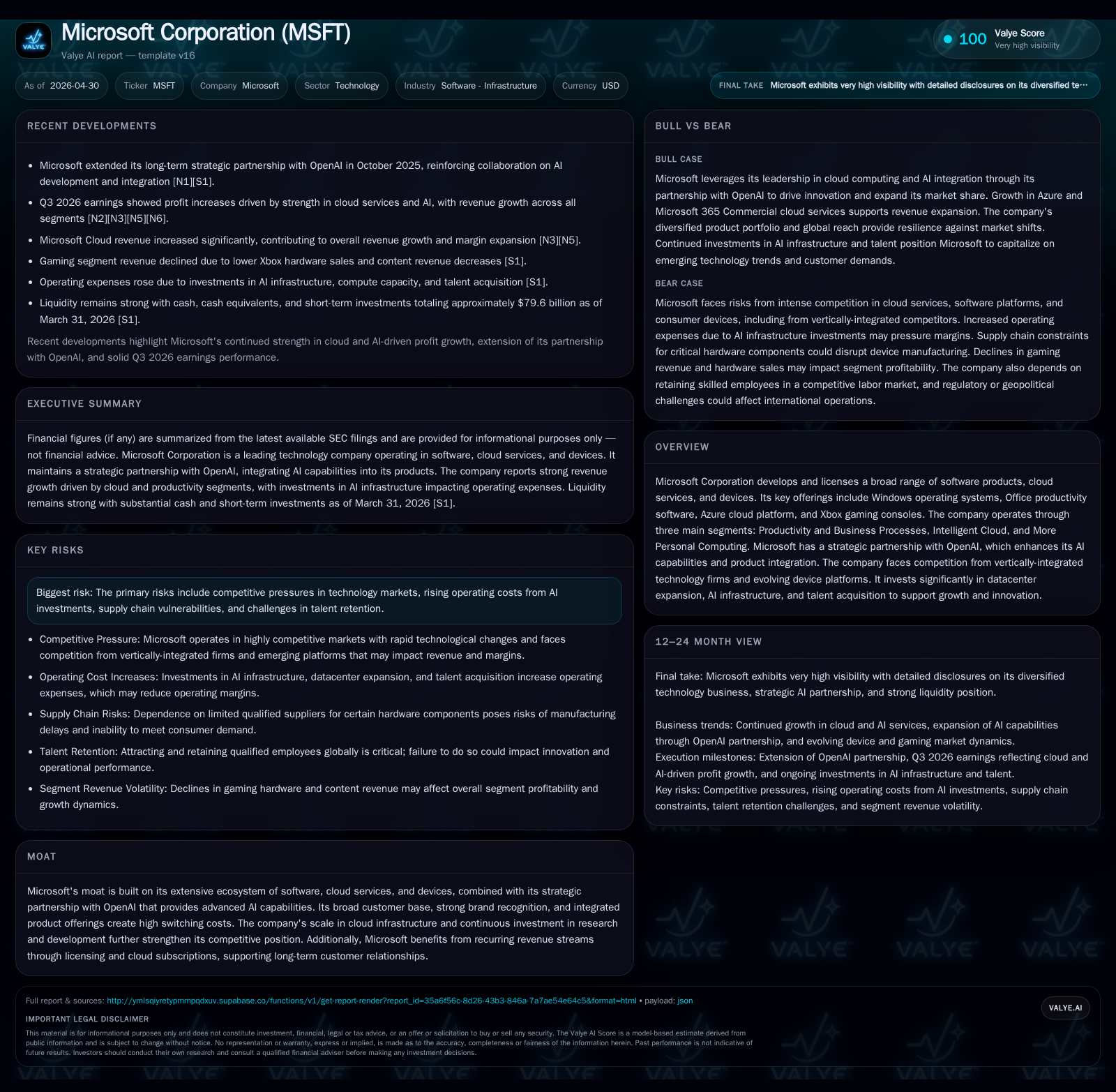
In the fiscal quarter ending March 31, 2026, Microsoft reported significant growth in its Intelligent Cloud segment driven by Azure and AI initiatives, offsetting modest declines in Gaming and hardware. Investments in AI infrastructure and compute capacity remain substantial, impacting margins but positioning Microsoft well for future growth. The company’s diversified business model spans Productivity, Cloud, and Personal Computing, supported by deep AI integration through its OpenAI partnership. Key risks include competitive pressures and escalating costs from AI scaling efforts.
Recent Operating Update: Q3 Fiscal Year 2026 Performance
Microsoft's latest quarterly filing dated April 29, 2026 ([S2], [S3]) reveals a dynamic operating environment shaped by accelerating cloud demand powered by artificial intelligence (AI) integration. Cloud revenue within the Intelligent Cloud segment surged by approximately 26% year-over-year to $51.5 billion—a clear signal that Azure's expansive portfolio continues to find strong market traction amid shifting enterprise IT priorities. Dynamics products and cloud services posted a 15% increase driven primarily by Dynamics 365 alongside robust uptake across workloads ([S2], [S13]).
However, the Gaming segment faced headwinds with a revenue decline of roughly 6%, attributable mainly to a steep drop (31%) in Xbox hardware volumes coupled with softer first-party content, partially offset by Xbox Game Pass subscription growth ([S2], [S21]). This reflects broader consumer hardware cyclical dynamics rather than structural demand loss.
Operating expenses rose notably due to heightened investment in research and development focused on compute infrastructure expansion for AI training workloads and talent acquisition—a consistent theme spanning multiple filings ([S2], [S4], [S8]). These investments underline Microsoft’s commitment to securing technological leadership amid intensifying competition.
Business Model Overview
Microsoft operates through three core segments: Productivity and Business Processes (including Office productivity suites), Intelligent Cloud (Azure, server products, cloud services), and More Personal Computing (Windows OS licensing, devices including Surface and Xbox, search advertising).
Revenue is generated primarily via licensing fees (e.g., Windows OEM), subscription-based cloud services (Azure, Microsoft 365 commercial licenses), device sales (Surface tablets/laptops; Xbox consoles), advertising sales (Bing search), and gaming content services (Xbox Game Pass). Volume growth in cloud usage drives recurring revenue expansion, while pricing dynamics are influenced by product mix shifts towards higher-margin software/services over hardware.
Margins fluctuate with scale efficiencies versus rising capital intensity—particularly as AI workloads require exponentially more data center resources. Margins in the cloud are under near-term pressure as investments in infrastructure ramp up but are expected to stabilize as economies of scale develop ([S4], [S5],[S7]).
Customer stickiness is bolstered by deep ecosystem integration across productivity tools, operating systems, cloud platforms, and intelligent applications tightly interconnected via strategic partnerships such as with OpenAI ([N1], [S1]). This multi-product approach creates high switching costs for enterprises seeking seamless interoperability.
Industry Structure and Competitive Positioning
Microsoft faces competition from vertically integrated tech giants such as Amazon (AWS) in cloud infrastructure; Google in advertising and cloud services; Apple in personal computing devices; and Sony/Nintendo in gaming content platforms. What differentiates Microsoft is its broad product spectrum combining enterprise software dominance with public cloud scale plus a growing emphasis on AI-enabled solutions.
The strategic partnership with OpenAI has provided Microsoft early access to advanced generative AI models that have been embedded into Azure offerings and productivity software like Microsoft 365—propelling incremental demand while positioning Microsoft at the forefront of commercializing AI technologies ([N1], [S1]). This partnership also represents an ‘ecosystem moat’ that rivals find hard to replicate quickly.
Datacenter capacity investments continue aggressively to meet the computational demands of AI training and inference workloads, which have become critical for sustaining competitive advantage yet increase capital intensity significantly ([S1], [S4]). Regulatory scrutiny around data privacy and antitrust concerns remains a watchpoint but has not materially slowed innovation investments thus far.
Growth Drivers
- Cloud Adoption & Azure Expansion: Continued enterprise migration to hybrid/multi-cloud solutions underpins demand for Azure platform services including AI-enhanced analytics, database offerings (SQL Server 2025 launch contributes), and developer tools ([S10], [S13]).
- AI Integration: Incorporation of OpenAI’s models into core productivity products drives upsell opportunities with existing commercial customers while attracting new clients interested in automating workflows.
- Subscription Revenue: Strong growth momentum in commercial M365 licenses alongside emerging new-use cases sustains recurring revenue reliability.
- Windows OEM Tailwinds: Elevated Windows OEM revenues from transition during Windows 10 end-of-support phase offer cyclical boost to More Personal Computing unit.
- Gaming Services Evolution: Despite console sales softness, Xbox Game Pass's strong subscriber base signals potential for content monetization leveraging cloud streaming technology.
- Advertising Revenues Increase: Search & news advertising revenues grew over 11%, assisted by long-term traffic partnerships contributing steady gains ([S16]).
Risks / Watchpoints / Growth Constraints
- Rising Operating Costs: Significant investments into AI infrastructure result in gross margin compression short term; managing cost efficiency while scaling is crucial ([S5], [S9]).
- Gaming Hardware Volatility: Semiconductor supply constraints or consumer cyclicality could further depress hardware unit sales impacting segment profitability.
- Competitive Intensity: Aggressive moves from AWS’s expanding service breadth or Google’s advancements could constrain market share gains.
- Talent Retention: High competition for specialized AI talent exposes risks in sustaining technology leadership given global scarcity.
- Supply Chain Vulnerabilities: Dependence on manufacturing partners for devices like Surface/Xbox subjects segments to geopolitical or logistic disruptions.
- Regulatory Environment: Antitrust reviews or data privacy mandates could impose operational limits or compliance costs.
What to Watch Next
Key upcoming milestones include deeper integration timelines for OpenAI-powered features across Office apps announced during calls ([N2]), monitoring Azure consumption metrics reflecting adoption velocity of new AI capabilities ([N3]), updates on Xbox Game Pass subscription growth metrics as a barometer of gaming services health ([S2]), plus capital expenditure trends spotlighting datacenter expansions supporting cloud scaling ( [S1]).
Earnings guidance comments related explicitly to AI investment pacing or customer absorption rates will be particularly telling for projecting margin trajectory going forward.
Financial Profile Snapshot End-March 2026 [F1]
Latest financial snapshot
Liquidity remains strong with current assets considerably exceeding liabilities. It does not constitute investment advice or recommendations.
Disclaimer: This is research-only, informational analysis and not investment advice. It may include AI-generated interpretation and general industry context. Always verify important details using primary sources.

Comments