
China Yuchai International's March Quarter Signals Steady Engine Demand and Governance Challenges
The latest quarterly update reflects stable operational performance at China Yuchai amid enduring governance complexities and evolving regulatory pressures.
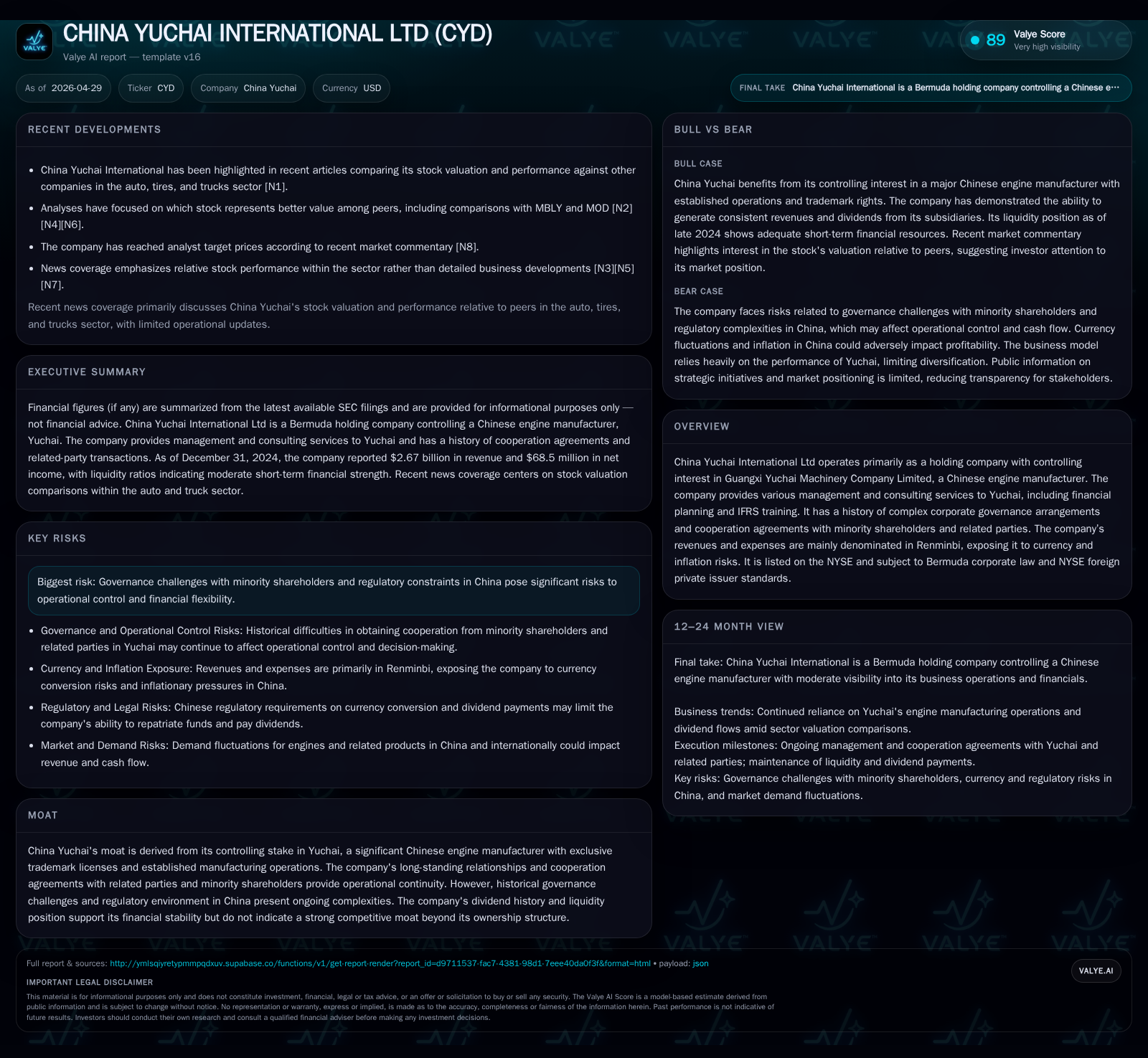
China Yuchai International Limited’s Q1 2026 interim filing demonstrates consistent engine demand driven by core manufacturing operations at Guangxi Yuchai Machinery. Despite stable dividend flows and management services revenue, the company continues to navigate long-standing governance challenges and regulatory oversight impacting strategic execution. Market demand, product innovation, and international expansion remain key growth levers, while currency risks and shareholder cooperation tensions pose ongoing operational hurdles.
Q1 2026 Interim Operating Update: Key Takeaways
China Yuchai’s latest Form 6-K filing dated March 18, 2026 confirms a continuation of stable operational performance during the first quarter of calendar year 2026 with Guangxi Yuchai Machinery ("Yuchai") maintaining engine production and delivery volumes consistent with previous periods [S2]. No significant adverse changes were reported, reinforcing the company’s established seasonal pattern characterized by slightly higher output in early-year quarters relative to later periods [S1]. Dividend payments declared by Yuchai for fiscal year 2025 were approved by its shareholders on February 27, 2026, with payment planned within one month of audited financial approval—a signal of reliable earnings distribution supporting China Yuchai’s cash flow [S10]. Management highlighted continuing seasonality variations impacted by government policies and market dynamics but indicated no material disruptions during the quarter [S22]. Meanwhile, China Yuchai maintains its annual management fee agreements with Yuchai, reflecting ongoing consulting and oversight services valued at approximately US$1 million per annum plus supplemental RMB fees [S20]. The overall operating environment reflects steady demand for emission-compliant engines supporting China's industrial vehicle markets.
Business Model Insight: Control Through Guangxi Yuchai Machinery Co.
China Yuchai International operates primarily as a holding company with decisive control over Guangxi Yuchai Machinery Company Limited—the core entity responsible for designing, producing, and selling diesel and related powertrain engines across multiple market segments including trucks, buses, construction machinery, agriculture equipment, marine propulsion, and power generation [S1,S5]. The holding company’s revenues chiefly derive from dividends declared by Guangxi Yuchai as well as service fees charged under management agreements encompassing financial planning, internal audit functions including Sarbanes-Oxley compliance support, IFRS training, and business consultancy. Management services generate a steady fee income around USD $1 million annually plus incremental annual supplemental fee adjustments tied to personnel costs [S20]. This model clearly links the parent’s financial fortunes to the manufacturing subsidiary’s operating performance and dividend policy. Shareholder controls are reinforced through exclusive trademark licenses granted to Guangxi Yuchai enabling localized branding under perpetual use rights after an initial ten-year term paid upfront [S8]. However, persistent corporate governance complexities with minority shareholders occasionally dilute operational flexibility despite China Yuchai’s controlling stake.
Product Quality, Customer Base, and Service Model
Guangxi Yuchai offers a comprehensive portfolio targeting diverse end users — from light-duty pickups to heavy-duty industrial vehicles — emphasizing reliability and compliance with evolving emissions standards. These engines enjoy established reputational strength supported by a widespread domestic distribution network directly servicing original equipment manufacturers (OEMs) as well as authorized resellers and distributors [S5]. After-sales services including parts provisioning reinforce customer retention through switching-cost barriers common in powertrain supply chains that require continuity for maintenance-intensive products. Licensing of trademarks ensures brand cohesion enabling pricing leverage particularly in China’s competitive engine manufacturing ecosystem where intellectual property protection can be fragmented. The company has also pivoted towards new energy products such as pure electric systems and fuel cells aiming to capture emerging demand linked to broader sustainability mandates domestically and internationally [S5]. This diversified product mix supports ongoing market acceptance across regulated segments where emission compliance drives procurement decisions.
Competitive Environment and Industry Structure Dynamics
Within China’s engine manufacturing industry—fragmented yet intensely competitive—Guangxi Yuchai distinguishes itself through scale advantages enabled by an integrated production footprint in Yulin city combined with proprietary technology developments nurtured over decades since its founding in 1951 [S5]. The sector faces regulatory hurdles including foreign investment restrictions under China's latest Foreign Investment Law governing Sino-foreign joint ventures like Guangxi Yuchai. Regulatory regimes impose dividend remittance controls requiring bank approvals or SAFE registrations for cross-border capital transfers limiting fluidity of funds even when operating subsidiaries generate sufficient cash [S1,S4]. Competitive pressures originate from both state-owned enterprises with preferential access to domestic infrastructure projects as well as private rivals targeting niche powertrain applications. Trademark licensing secured via exclusive contracts grants some moat protection around branded engine lines yet does not fully insulate against price competition exacerbated by raw materials cost inflation—a cyclical risk factor detailed in the company's risk disclosures [S1,S15]. Moreover, cooperation agreements with minority shareholders encapsulated in longstanding Reorganization Agreements highlight structural challenges obstructing seamless strategic governance.
Growth Drivers: Market Demand, Product Innovation, and Geographic Expansion
Growth trajectories hinge on multi-layered drivers. Structural demand stems from China’s urbanization-driven industrial vehicle fleet renewal cycles encompassing logistics trucks, public transportation buses transitioning towards low emissions profiles mandated by governmental policy incentives [N4,S5]. Innovation focuses on expanding green energy powertrain offerings including hybrid configurations, fuel cells, electric range extenders targeting nascent but rapidly expanding segments aligning with China’s carbon neutrality pledges. Geographic expansion into overseas markets leverages patent-protected technologies coupled with expanding distribution channels linking Asia-Pacific regions beyond mainland China. Monitoring key performance indicators such as booked engine sales units—reported at over 350 thousand units sold in recent full years—and after-sales service penetration provides measurable insights into demand momentum [S5]. Margin enhancement opportunities correlate directly to efficiency gains from capacity expansions funded out of operating cash flows alongside judicious capital expenditure targeting next-generation product development [S1,S6].
Risks and Constraints: Governance, Currency Exposure, and Regulatory Oversight
Despite operational steadiness there remain concentrated risks. Corporate governance challenges involving minority shareholders have periodically impeded management actions at Guangxi Yuchai reflecting deeply entrenched disagreements dating back over two decades with episodes requiring international arbitration settlements though periodically resurfacing disagreements hinting at fragile control dynamics still unresolved fully under existing Cooperation Agreements [S9,S8]. On the currency front, all substantive revenues and expenses are denominated in Renminbi exposing earnings to inflation effects inside China compounded by exchange rate fluctuations that could affect repatriated earnings especially since Renminbi conversion remains restricted under capital account controls necessitating bank reviews for cross-border dividend payments reducing predictability of foreign currency inflows [S15]. Regulatory complexity further extends into transfer pricing scrutiny given related-party transactions between China Yuchai and Guangxi subsidiaries involving sale/purchase contracts for engines and parts within affiliated groups including Hong Leong Asia affiliates adding layers of compliance costs alongside geopolitical sensitivities affecting foreign investors [S20]. An unfavorable turn in government policy or enforcement intensity could heighten operational headwinds.
Investor Watchlist: Upcoming Milestones and Market Signals
Market participants should prioritize tracking quarterly sales volume announcements at Guangxi Yuchai which provide immediate visibility into core revenue-generating activity ahead of annual reporting cycles. Dividend-related events remain critical given their role as principal cash flow sources sustaining China Yuchai’s distributable income alongside announcements related to share buyback progress which currently highlights capital return discipline with about 3.3 million shares repurchased under recent programs signaling board confidence in current valuation levels [S16,S10]. Attention to follow-up disclosures concerning progress or resolutions regarding the Cooperation Agreement implementation may materially shift governance outlooks that have persisted as a wildcard risk factor over time. Additionally monitoring macro-level indicators such as raw material price trends influencing input cost inflation should inform margin trajectory assessments.
Brief Review of Latest Financial Position and Liquidity
As of December 31, 2024 data from companyfacts reveals a solid liquidity foundation featuring cash and cash equivalents tallying approximately US$825 million alongside a current ratio of 1.55—indicative of ample working capital coverage supporting operational needs without immediate refinancing pressure [F1]. Total current assets stand near US$2.86 billion versus liabilities close to US$1.84 billion providing cushion against short-term obligations. It aims to illuminate China Yuchai International Ltd.'s business fundamentals within prevailing economic and regulatory frameworks relevant to institutional stakeholders evaluating underlying operational resilience amid nuanced governance complexities typical for Sino-foreign joint venture structures in specialized industrial manufacturing domains.
Disclaimer: This report is intended solely for informational purposes based on publicly filed documents dated up to April 29, 2026. It does not constitute investment advice or recommendations.
Disclaimer: This is research-only, informational analysis and not investment advice. It may include AI-generated interpretation and general industry context. Always verify important details using primary sources.

Comments