
NewcelX Highlights Progress in Type 1 Diabetes Collaboration and Pipeline Advancements
NewcelX advances its NCEL-101 Type 1 Diabetes program through collaboration with Eledon Pharmaceuticals, supported by recent capital raises and merger synergies.
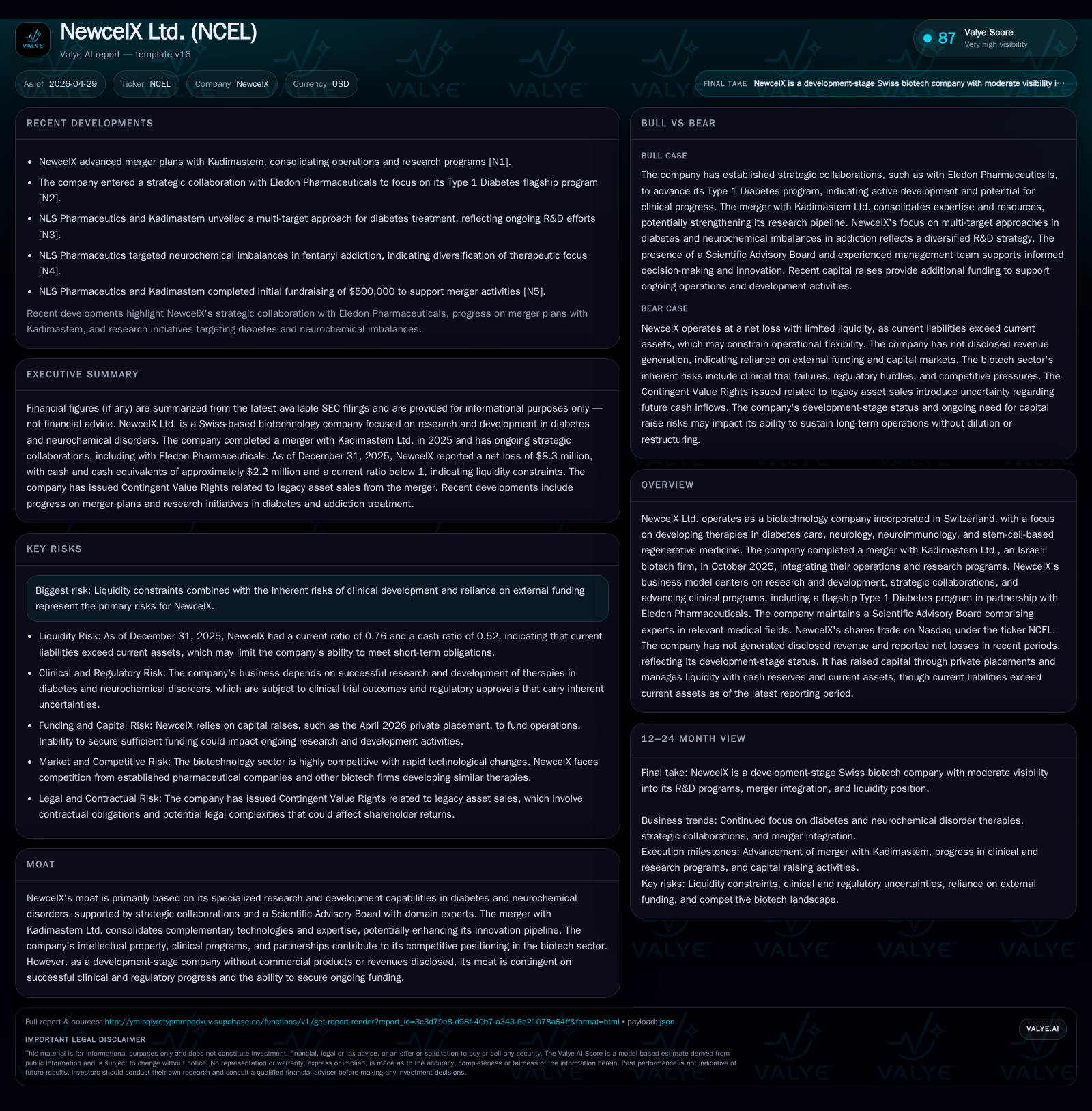
NewcelX Ltd. issued an updated corporate presentation in April 2026 emphasizing key progress in its flagship Type 1 Diabetes program, developed in partnership with Eledon Pharmaceuticals. This update follows a $1.35 million private placement and a previously announced $25 million equity line aimed at funding clinical development and general corporate needs. The integration of Kadimastem Ltd. further strengthens NewcelX's R&D pipeline and scientific expertise. While liquidity constraints persist due to development-stage operations, the company remains focused on advancing NCEL-101 clinical milestones and securing future funding.
April 2026 Quarterly Update: Strategic Collaboration and Program Focus
NewcelX Ltd.’s latest quarterly filing on April 20, 2026 ([S2]) revealed an updated corporate presentation spotlighting significant progress in its flagship Type 1 Diabetes program, NCEL-101, jointly developed with Eledon Pharmaceuticals. This update coincides with preparations for the Swiss Biotech Conference where new data is expected to be shared, underscoring the near-term importance of this collaboration and clinical momentum.
Earlier in April ([S3]), the company closed a private placement financing worth about $1.35 million gross proceeds, coupled with warrants potentially generating an additional $2.1 million upon exercise. Together with a previously announced sizable $25 million equity line commitment, this financing package is designated primarily to push forward NCEL-101 development activities as well as supporting NewcelX’s broader pipeline and general corporate expenditures.
This dual update signals an operational pivot toward intensifying clinical progress backed by tangible funding sources — a critical inflection for a company navigating the capital-intensive biotech development cycle without commercial revenues.
Business Model: R&D-Driven Innovation Amid Development-Stage Dynamics
NewcelX operates as a research-focused Swiss biotechnology firm dedicated to therapies addressing diabetes care (notably Type 1 Diabetes), neurology, neuroimmunology, alongside stem-cell-based regenerative medicine ([S1], [F1]). The October 2025 merger with Kadimastem Ltd., an Israeli biotech entity specializing in related regenerative technologies ([N1]), expanded both proprietary technologies and domain expertise within its consolidated pipeline.
Revenue generation is not yet realized given NewcelX’s developmental status; instead, the business model hinges upon advancing clinical-stage projects primarily through costly R&D efforts expensed immediately upon incurrence ([S1]). Intellectual property assets including In-Process Research and Development (IPR&D) form significant intangible valuations subject to complex management assumptions reflecting probabilities of successful technical milestones ([S1]).
Strategic collaborations such as the partnership with Eledon Pharmaceuticals provide NewcelX access to complementary resources facilitating development acceleration while preserving upfront capital — typical licensing or co-development dynamics prevalent in biotech innovation ecosystems.
Competitive Context and Industry Positioning in Diabetes and Regenerative Therapies
Within the fragmented biotechnology sector targeting diabetes interventions and regenerative therapies, NewcelX carves out a specialized niche leveraging stem cell technologies combined with immunomodulatory approaches ([S1], [N1]). The merger bolstered its platform capabilities extending beyond diabetes toward neurological disorders.
Competition is intense from large pharma companies as well as emerging biotechs focusing on chronic diseases like Type 1 Diabetes requiring complex clinical validation pathways dictated by stringent regulatory frameworks. Clinical trial failures remain a common structural risk across these sectors. Further, differentiation hinges upon proprietary biologics formulation expertise and patent-protected delivery technologies.
The company's Scientific Advisory Board comprising domain experts underpins its technical credibility; however, the moat remains contingent on successful milestone achievement translating into regulatory nods and eventual commercial rights or partnering deals.
Growth Drivers: Pipeline Advancement, Partnership Potential, and Capital Raising
Key growth vectors spotlight NCEL-101’s clinical progression underpinned by the Eledon collaboration which offers both financial support mechanisms and enhanced development capabilities ([S2], [S3]). Operational KPIs orbit near-term trial enrollment completions or data readouts supportive of advancing regulatory discussions.
Capital raising initiatives remain vital — recent private placements coupled with an active $25 million equity line enable sustained investment in internal R&D programs alongside maintaining working capital buffers necessary for ongoing operations ([S3]). Synergies arising from integrating Kadimastem’s technology portfolio can potentiate pipeline breadth ensuring diversified innovation avenues that mitigate single-program dependency risk.
Commercial partnerships may expand through further licensing or co-development arrangements leveraging the company’s growing IP estate.
Risks and Constraints: Funding Dependency and Clinical Development Challenges
Liquidity metrics paint a constrained operating environment: current assets stand at approximately $3.18 million against current liabilities of about $4.20 million at year-end 2025 ([F1]), reflecting a current ratio below unity (0.76). This signals limited near-term cushion absent successful capital injection executions or warrant exercises.
Clinical development risks predominate given the early-stage nature of most programs including NCEL-101; failure to meet endpoints or comply with regulatory expectations could derail progress entirely ([S1]). The reliance on external investors for continuous funding inflates vulnerability to market conditions impacting share issuance feasibility.
Legal contingencies are contained but should be monitored — a recent settlement resolved a dispute regarding research services payments without material impact ([S18]). Internal control weaknesses noted require remediation efforts for sustained compliance confidence ([S23]).
Upcoming Catalysts: Clinical Milestones, Financing Executions, and Investor Communication
Investors should focus closely on forthcoming NCEL-101 clinical data releases anticipated at scheduled biotech forums such as the Swiss Biotech Conference referenced in April’s presentation updates ([S2]). Parallelly, tracking full closing of private placement proceeds along with any exercise patterns of issued warrants could enhance liquidity outlooks ([S3]).
Further draws on the $25 million equity line will materially affect operational runway enabling more robust pipeline investment or opportunistic partnering maneuvers.
In addition to event-based disclosures, incremental investor communications clarifying capital management strategies or trial setbacks/successes will remain critical given inherent development volatility.
Financial Snapshot: Cash Position, Liabilities, and Capital Structure Overview
Latest financial snapshot
| Metric | Value | Period |
|---|---|---|
| Cash & equivalents | $2mm | |
| 2025-12-31 | ||
| Current assets | $3mm | |
| 2025-12-31 | ||
| Current liabilities | $4mm | |
| 2025-12-31 | ||
| Current ratio | 0.76x | |
| 2025-12-31 |
Source: SEC companyfacts cache [F1].
| Metric | Value (USD) |
|---|---|
| Cash & Equivalents | $2.20 million |
| Total Debt | $0 |
| Current Assets | $3.18 million |
| Current Liabilities | $4.20 million |
| Current Ratio | 0.76 |
As per December 31, 2025 filings([F1]), NewcelX held approximately $2.2 million in cash equivalents without outstanding debt liabilities since mid-2021 — reflecting zero traditional bank borrowings but exposing operational dependency on equity financings or shareholder loans.
The negative net working capital position reinforces urgent need for continued successful fundraises but also reflects typical balance sheet profiles observed across precommercial-stage biotechs investing heavily in pipeline expansion ([F1]). Net losses demonstrated historically include heavy R&D expense loads consistent with early product development cycles ([F1]).
Disclaimer
This analysis is based exclusively on disclosed SEC filings and publicly available documents up to April 29, 2026. It does not constitute investment advice or recommendations but provides an informed perspective suited for industry professionals examining NewcelX Ltd.’s operational progress within the biotechnology sector.
Disclaimer: This is research-only, informational analysis and not investment advice. It may include AI-generated interpretation and general industry context. Always verify important details using primary sources.

Comments