
Nordic American Tankers Strengthens Financial Flexibility Amid Stable Suezmax Market Fundamentals
NAT’s latest quarterly update highlights dividend continuity alongside refinancing that supports fleet expansion and operational stability.
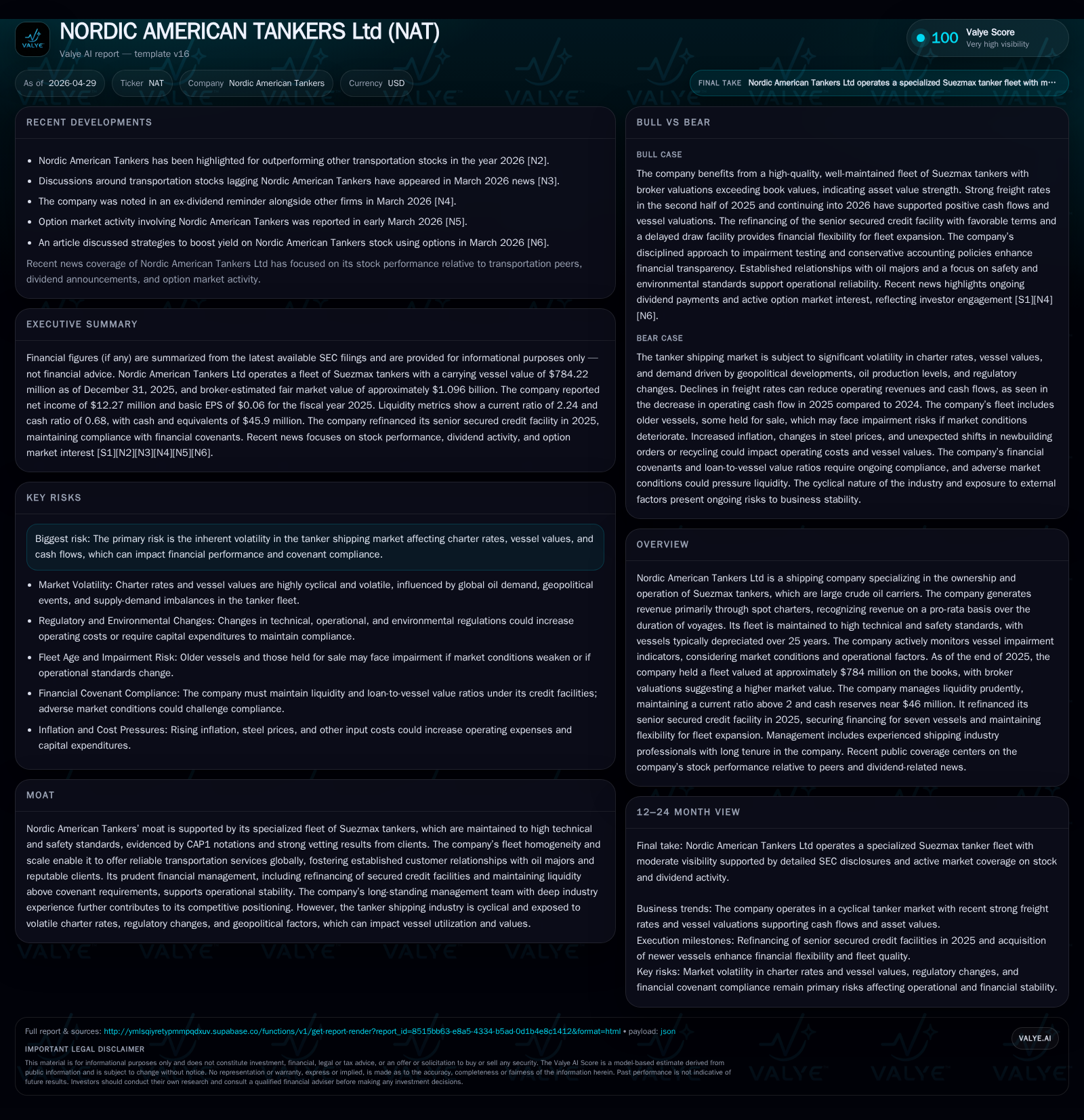
In its latest quarterly filing, Nordic American Tankers Ltd (NAT) reported stable operations with an ongoing focus on liquidity and debt management amid a volatile tanker market. The company renewed its senior secured credit facility in early 2025, extending debt maturities and incorporating a delayed draw option to support fleet growth. NAT’s business model centers on operating a homogenous Suezmax tanker fleet primarily under spot charters, benefitting from elevated freight rates and restrained newbuild supply. Competitive advantages include its fleet standardization, solid vessel maintenance standards, and strong client vetting credentials. Key risks remain the cyclical nature of the tanker market, freight rate volatility, and regulatory pressures. Going forward, the company's financial health and adaptability to market conditions will be pivotal for capital deployment and dividend sustainability.
Recent Operating Update
Nordic American Tankers Ltd’s most recent quarterly filing for Q4 2025 confirms the continuation of its dividend payments, declared at $0.17 per share and paid in March 2026 [S2]. This payout underscores management’s confidence in operational cash flow despite inherent cyclicality in the tanker markets. The report also reflects strong adherence to covenants following a strategic refinancing implemented in February 2025. This replaced the earlier 2019 Senior Secured Credit Facility—originally collateralized by fourteen vessels—with a more streamlined $150 million facility secured against seven Suezmax vessels [S3].
Critically, this amended loan extends maturity to early 2029 and adds a delayed draw option worth $100 million designed for future fleet expansion opportunities at conservative leverage metrics (50% loan-to-value ratio) [S3]. As of December 31, 2025, NAT had drawn down $142.8 million under this facility while repaying $8.2 million over that year. Subsequent repayments of $2.5 million further strengthened the balance sheet by early 2026 [S3]. Maintained liquidity levels remain robust with cash reserves near $46 million as year-end [F1], along with a current ratio above 2x indicating solid short-term financial health.
The company emphasizes no impairment indicators on its vessels after considering improved freight rates emerging since mid-2025 and sustained broker forecasts projecting above-average charter earnings—support factors critical in light of observable declines in certain vessel values during the period that nevertheless remain above impairment thresholds under GAAP [S15,S22].
Business Model
Nordic American Tankers operates exclusively within the Suezmax tanker segment—ships capable of transporting approximately one million barrels of crude oil through the Suez Canal or similar maritime routes. Its business hinges predominantly on spot chartering model contracts where revenue is recognized on an accrual basis proportional to voyage duration from loading to discharge ports as per ASC 606 accounting standards [S1]. This revenue recognition approach ensures alignment with actual vessel utilization but also creates exposure to daily spot rate fluctuations.
Voyage expenses including incremental costs directly attributable to securing contracts are capitalized then amortized over voyage duration providing clear visibility into contribution margins per journey. The homogeneity of their fleet simplifies operations and maintenance schedules while enabling NAT to meet stringent vetting protocols required by major oil companies—effectively establishing high-quality customer relationships built on reliability and safety norms highlighted by CAP1 certification status [S1].
Fleet assets are depreciated straight-line over an estimated economic life of 25 years from delivery date less residual value assumptions. Given cyclicality affecting second-hand vessel prices driven by supply-demand imbalances globally, management performs regular impairment tests using undiscounted future cash flow estimates based on broker forward curves for charter rates, utilization assumptions factoring expected drydock periods and capital expenditures necessary for upkeep and regulatory compliance [S1,S22].
Industry Structure and Competitive Position
The international tanker shipping industry remains highly cyclical with intensity driven primarily by crude oil production volumes, inventory cycles at major storage hubs, geopolitical shifts impacting export routes (e.g., Middle East tensions), and regulatory climate changes particularly related to environmental standards governing emissions.
Within the sectoral landscape Nordic American Tankers distinguishes itself via a focused fleet of modernized Suezmax vessels standardized around key build years predominantly post-2003 models including two newbuild deliveries in recent years (2016 builds acquired in late 2023). This selective scale enables efficient technical upkeep while attracting premium charters accessible only through certified performance reliability metrics verified during third-party client vettings [S1].
Spot charter predominance offers upside potential compared to longer-term time charters given current tanker asset scarcity juxtaposed against muted newbuilding order books stemming from steel price inflation and limited shipyard capacity—a dynamic that bolsters used-asset valuations underpinning NAT’s equity base valued at approximately $784 million book value at end-2025 with broker marks above that level yet tangible realizations dependent on prevailing market conditions [S1,F1].
Additionally geopolitical disruptions can reroute crude traffic abruptly affecting traditional trading lanes where NAT’s vessels operate.
Residual Value Declines: Despite supportive market conditions vessel values may experience downward shocks if oversupply recurs or if secondhand asset preferences shift towards alternative fuel technologies ahead of wider adoption timelines placing pressure on depreciation assumptions and potential impairment events.
Financial Covenant Compliance: Continuing adherence to minimum liquidity requirements ($20 million) alongside loan-to-vessel value ceiling (70%) demands vigilant balance sheet management especially when interest rates fluctuate as floating-rate debt instruments expose interest expenses directly correlating with benchmarks such as SOFR plus margin spreads currently averaging near mid-4% range [S3].
What to Watch Next
- Freight Rate Developments: Monitoring quarterly time charter equivalent rates relative to broker forecasts aids visibility into upcoming operating income variations.[S15]
- Fleet Utilization & Off-Hire Days: Tracking scheduled maintenance or drydocking impacts influencing availability critical for revenue estimation during volatile cycles.[S22]
- Refinancing Milestones: Updates concerning planned financing arrangements for two newbuild vessels scheduled for delivery in 2028 will reveal management’s execution effectiveness.[S3]
- Dividend Policy Adjustments: Any modifications tied to earnings fluctuations or cash flow pressures would highlight shifting capital allocation priorities.[S2]
- Regulatory Changes: Maritime emission control zones expansions or carbon taxation implementations can alter cost structures abruptly requiring adaptive strategies.
Financial Profile Summary (As of December 31, 2025)
Latest financial snapshot
This snapshot indicates controlled leverage balanced against liquid assets adequate for meeting near-term obligations while supporting incremental investments tied to present refinancing terms. NAT’s total debt stood at approximately $424 million with net debt near $378 million, supported by cash and equivalents of about $46 million. The current ratio was a healthy 2.24, reflecting solid short-term liquidity [F1].
This analysis synthesizes Nordic American Tankers’ disclosure to present an updated view into operational positioning against macro tanker industry dynamics without expressing investment counsel or recommendations.
Disclaimer: This is research-only, informational analysis and not investment advice. It may include AI-generated interpretation and general industry context. Always verify important details using primary sources.

Comments