
Blackbaud Expands AI-Driven Cloud Solutions Amid Strong Customer Contract Renewals in Q1 2026
Blackbaud’s Q1 2026 results show ongoing AI integration and robust multi-year customer contracts driving growth and visibility.
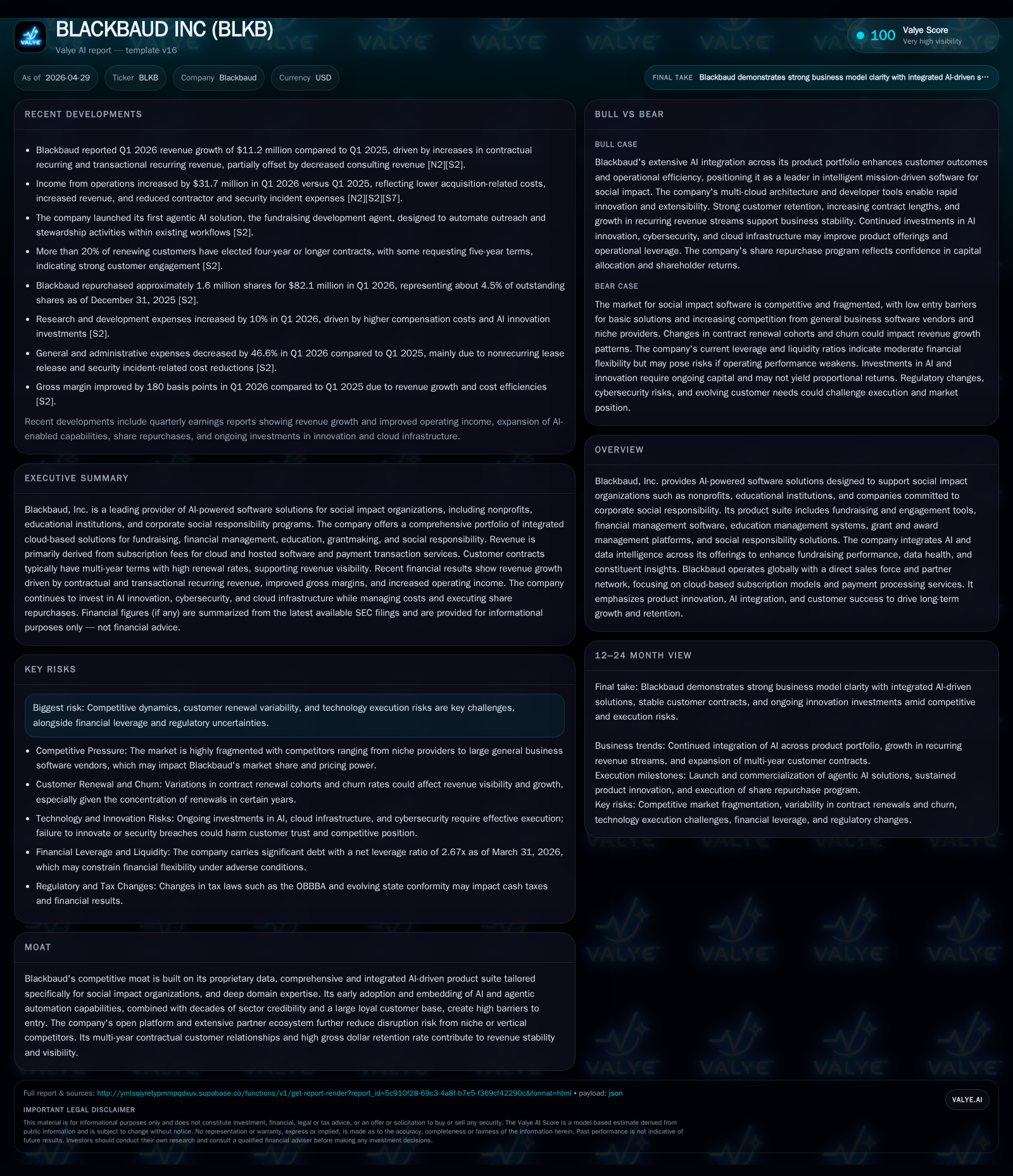
In its latest quarter ending March 31, 2026, Blackbaud continued to advance its AI-powered solutions for social impact organizations, launching the Blackbaud fundraising development agent under subscription pricing and expanding AI features across its portfolio. The business benefits from a customer base with majority three-year contracts, over 20% extending beyond four years, supporting revenue visibility and retention stability. Ongoing investments in R&D and stock repurchases reflect confidence in long-term growth driven by innovation and strong gross dollar retention near 92%. Risks include technology execution and competitive pressures, but Blackbaud’s proprietary data, integrated product suite, and sector expertise underpin a durable competitive moat.
Recent Operating Update
Blackbaud’s first quarter of fiscal 2026 saw steady progression in executing its strategy to embed AI capabilities deeply across its cloud-based social impact software offerings. Revenue trends improved with increased adoption of AI-driven features such as machine learning for donor prospecting within Raiser's Edge NXT. Notably, the company launched the Blackbaud fundraising development agent — an agentic AI solution designed to automate fundraising outreach and stewardship workflows — now generally available under a subscription pricing model that scales with customer size.
Shareholder returns remain a priority as evidenced by a substantial $82.1 million stock repurchase during Q1 representing about 4.5% of shares outstanding at the end of 2025. Approximately $878.5 million remains available in the buyback program, reflecting strong capital allocation discipline.
Contractually recurring revenue is underpinned by multi-year agreements predominantly spanning three years at inception with options for renewal or extension. More than one-fifth of renewal customers have elected terms exceeding four years in this cycle, marking a trend toward longer commitments that promote revenue visibility and customer engagement longevity.
Internally, investment in R&D increased modestly to support AI innovation alongside enhancements to engineering productivity via generative AI development tools. These internal efficiency gains contribute to accelerated feature delivery cycles.
Business Model: Revenue Mechanics & Strategic Position
Blackbaud generates revenue primarily through cloud subscription fees for its suite of software solutions aimed at nonprofits, educational institutions, corporate social responsibility efforts, and individual change makers. Additional revenues stem from payment processing services tied to these platforms.
Customers pay recurring fees based on contract size and length; typical contracts last three years with annual price escalations embedded to ensure predictable revenue growth. Revenue recognition follows a ratable pattern over contract terms supporting stable income streams.
The strategic strength lies in Blackbaud’s ability to offer an integrated AI-powered ecosystem that spans fundraising automation (e.g., prospect identification), financial management, grantmaking administration, education management systems, and CSR reporting. This holistic approach reduces fragmentation risk and switching costs for customers who prefer a unified platform optimized for social impact.
Moreover, Blackbaud leverages exclusive philanthropic datasets combined with licensed external data through its Intelligence for Good® initiative to deliver predictive insights driving more effective fundraising campaigns—features not easily replicated by general business software vendors.
Sales efforts combine specialized direct sales teams focused on new customer acquisition alongside expansion teams that cross-sell/up-sell emerging capabilities such as agentic AI assistants. Partner programs further extend reach through referrals and technical integrations.
Industry Structure & Competitive Position
Blackbaud operates at the intersection of nonprofit software solutions and enterprise SaaS infused with advanced analytics. Its primary competitors fall into four buckets: niche point solutions serving specific verticals; vertical-specific suites targeting particular segments; broad-based enterprise software providers like Salesforce or Oracle moving into social good segments; and emerging cloud startups.
Blackbaud’s moat rests on:
- Proprietary data troves accumulated over decades,
- Integrated product suites embedding AI-driven automation,
- Deep domain expertise tailored explicitly for social impact organizations,
- Large installed base fostering network effects,
- Multi-year contractual relationships ensuring revenue stability.
The company mitigates disruption risks by maintaining an open platform allowing integration with best-of-breed niche applications while continuing aggressive innovation via its Agents for Good™ line.
Growth Drivers
Growth is fueled by multiple vectors:
- Land-and-expand sales motions penetrate existing accounts with new AI-powered modules targeting fundraising efficacy improvements.
- New logo acquisition driven by rising demand for digital transformation among nonprofits pushing more aggressive social investment agendas.
- Extended contract durations up from three years to often five-year terms enhance customer lifetime value visibility.
- Product innovation delivering autonomous agent capabilities anticipated to reduce administrative overheads helping justify premium pricing.
- Increasing adoption of payment processing services linked to fundraising transactions adds incremental fee revenue.
- Expansion into international markets via localized cloud deployments supports geographic diversification.
Management targets mid-single-digit top-line growth backed by renewal rates around 92% gross dollar retention sustained through continuous innovation and deepening client relationships.
Risks / Watchpoints / Growth Constraints
Key risks include:
- Variability in customer renewals due to economic or organizational changes that could alter spending priorities,
- Competitive pressure from both specialized startups offering cheaper point solutions and tech giants gradually expanding philanthropic solution sets,
- Execution risk related to integrating complex AI technologies smoothly without disrupting existing workflows or alienating users,
- Financial leverage constraints given approximately $1.19 billion total debt against about $34 million cash on hand at quarter-end leading to net debt near $1.16 billion [F1][S2], which limits flexibility if market conditions worsen,
- Regulatory risks involving cybersecurity standards and data privacy given sensitive constituent information handled.
Monitoring adoption rates of newly launched agents such as the fundraising development agent will be critical to validate commercial viability beyond pilot phases.
What to Watch Next
Upcoming milestones include ongoing evaluation of:
- Customer uptake metrics for agentic AI subscriptions across fundraising teams,
- Renewal cohort behavior especially the proportion opting for extended-term agreements (≥5 years),
- Ramp-up pace of R&D spend directed at generative AI integration monitoring both costs and productivity outcomes,
- Quarterly updates on gross dollar retention rates providing insight into customer satisfaction,
- Impact of macroeconomic conditions on nonprofit budgets which ultimately influence contract renewals,
- Progress on leveraging partnerships to extend distribution footprint internationally,
- Further share repurchase activity reflecting management’s confidence level in future cash flows.
Financial Profile (Snapshot)
Latest financial snapshot
Disclaimer: This analysis is based exclusively on public SEC filings and verified news sources as of April 29, 2026. It does not constitute investment advice.
Disclaimer: This is research-only, informational analysis and not investment advice. It may include AI-generated interpretation and general industry context. Always verify important details using primary sources.

Comments