
Creative Media & Community Trust Corp Transforms Portfolio Focus With Strategic Corporate Actions
CMCT refocuses on core multifamily and creative office assets, executing reverse stock splits and Nasdaq listing changes to stabilize market presence.
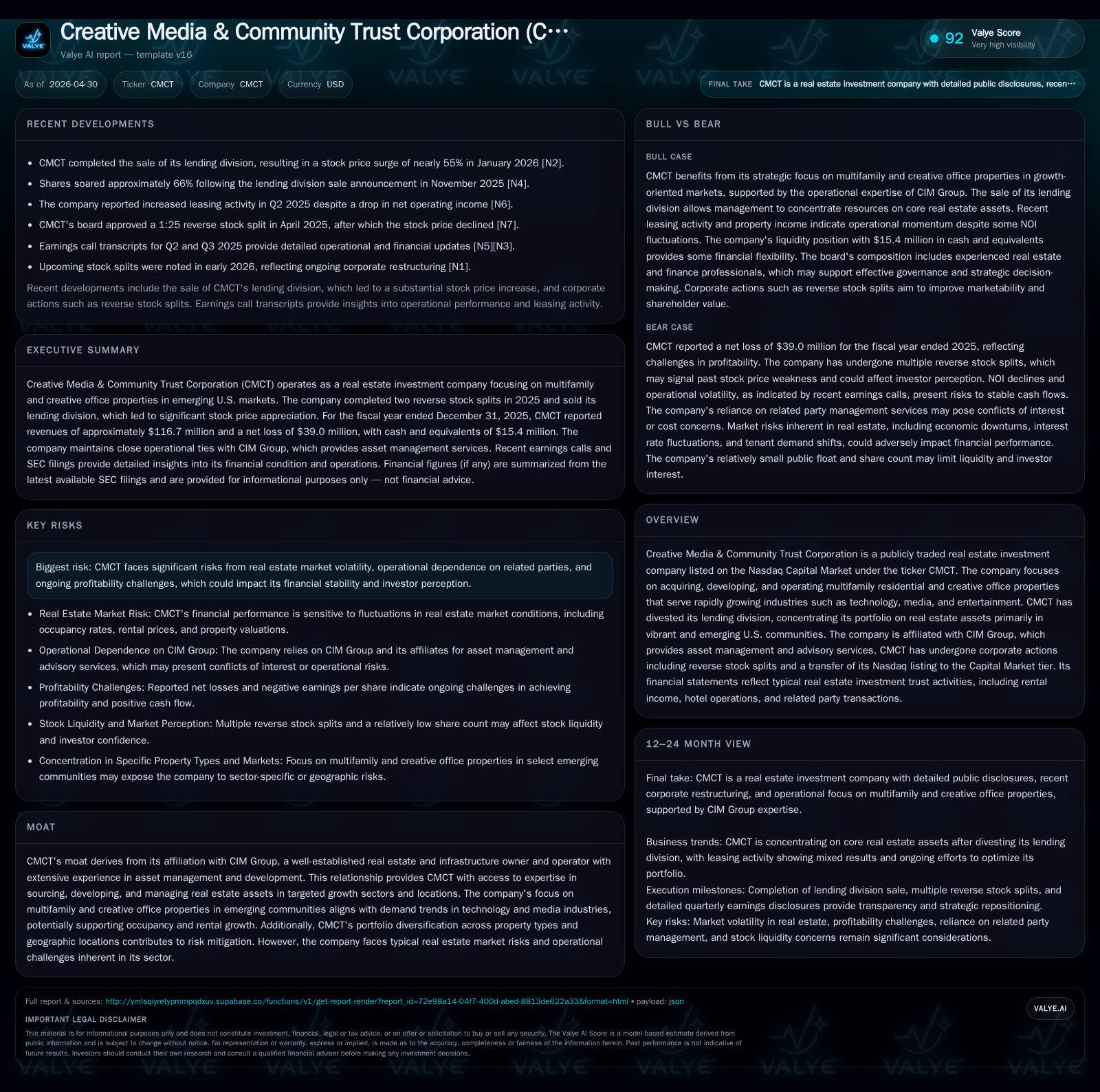
Creative Media & Community Trust Corporation (CMCT) has undertaken a series of strategic corporate maneuvers in late 2025 and early 2026, including multiple reverse stock splits and a transfer of its Nasdaq listing to the Capital Market tier. These moves coincide with the company’s divestiture of its lending division and sharpened focus on multifamily residential and creative office properties aligned with growth industries like technology and media. Affiliated with CIM Group, CMCT leverages related-party expertise to manage and develop its portfolio concentrated in vibrant U.S. communities. Despite pressure from real estate market volatility and operating losses, CMCT’s repositioning attempts to balance risk with structural demand drivers in niche real estate sectors.
Recent Operational Shifts: Q3 2025 Filing Highlights
Creative Media & Community Trust Corporation (CMCT) reported key corporate actions in its November 14, 2025 quarterly filing that set a new operational tone. In early 2025, CMCT implemented two reverse stock splits—initially a one-for-ten split in January followed by an additional one-for-25 split in April—resulting in substantial consolidation of outstanding shares. These maneuvers aimed to uplift the per-share trading price, thereby supporting continued Nasdaq listing compliance.
Subsequently on April 17, 2025, CMCT transitioned its common stock listing from the Nasdaq Global Market to the Nasdaq Capital Market tier. While both markets operate similarly with continuous trading platforms, the Capital Market is tailored toward companies seeking less rigorous listing standards amid challenges such as lower share prices or market capitalization. This transfer reflects CMCT's recalibration to maintain regulatory standing while it navigates portfolio adjustments.
A consequential strategic event occurred in January 2026 when CMCT completed the sale of its lending division subsidiary First Western SBLC LLC for approximately $44.9 million gross proceeds (about $31.2 million net after expenses and debt payoffs). This divestiture denotes a clear pivot from broader financial services exposure toward a concentrated real estate investment focus [S2],[S3],[S4].
These developments are not isolated but represent deliberate recalibrations combining corporate governance tactics with portfolio streamlining initiatives aimed at repositioning CMCT for stability and focused growth.
Business Model Overview: Multifamily and Creative Office Real Estate
CMCT operates as a publicly traded real estate investment trust (REIT) specializing predominantly in multifamily residential properties alongside 'creative office' assets that cater specifically to rapidly expanding sectors such as technology, media, and entertainment. Its property footprint is concentrated within vibrant and emerging U.S. communities characterized by strong business dynamism.
The company’s revenue model is anchored chiefly on rental income streams derived from these multifamily units and office leases. Additionally, CMCT operates a hotel asset located in Northern California that contributes hotel income revenue. Historically it also included SBA-backed lending under the Small Business Administration's 7(a) loan program; however, this lending segment was divested as part of recent strategy refinement.
A critical strength lies in CMCT’s affiliation with CIM Group—a seasoned real estate owner-operator and developer known for its asset management expertise. CIM Group both manages assets on behalf of CMCT and provides advisory services that facilitate property acquisitions, development projects, leasing management, and operational oversight.
This relationship grants CMCT an operational edge enabling access to targeted niche assets often underserved by larger broad-spectrum REIT peers. The focused product mix seeking Class A multifamily units along with creative office environments—defined by flexible workspace features attractive to innovative sector tenants—is structurally aligned with contemporary demand themes.
Overall, CMCT monetizes through lease revenue contracts whose volume depends on occupancy rates influenced by tenant sector health; pricing power manifests through rental rate adjustments reflective of local market competitiveness. Operating margins are subject to fluctuations based on property maintenance costs, leasing commissions (notable for creative office spaces requiring build-to-suit modifications), and general real estate cycle effects [S1],[S2].
Competitive Landscape and Industry Positioning
Within the REIT sector landscape, CMCT occupies a niche segment targeting multifamily housing combined with creative office assets predominantly leased to technology/media/entertainment tenants. This differentiates it from broad-market residential REITs or traditional office-focused trusts.
The affiliation with CIM Group confers a moat primarily via operational expertise across real estate development cycles—helping mitigate acquisition risks through deep local knowledge—and offering scale benefits through shared management resources.
However, like many mid-cap REITs in specialized categories, CMCT contends with thin profit margins highlighted by recent operating losses (-$39 million net loss for fiscal year 2025) reflecting transitional costs related to portfolio shifts plus market headwinds [F1],[S1]. Its substantial leverage position amplifies sensitivity to interest rate movements affecting financing costs.
From an industry perspective, Creative Office space is an emerging sub-sector responding to demand for adaptable office configurations driven by tech/media firms’ evolving workspace needs—a factor that could enable occupancy resilience versus conventional office products exposed to COVID-related structural devaluation risks.
Multifamily residential remains one of the more stable real estate asset classes underpinned by sustained demographic tailwinds favoring renting over home ownership among younger cohorts. However, geographic diversification exposes CMCT to variances in local economic conditions affecting rent growth potential.
Hence competitive positioning benefits from relative product differentiation but is tempered by macroeconomic cyclicality impacting aggregate tenant demand.
Growth Drivers: Targeting Rapidly Expanding Sectors and Communities
CMCT’s growth thesis centers around several structural demand vectors:
Demographic trends: Continued migration towards urban centers supports sustained demand for multifamily rentals; especially among workforce populations employed in high-growth industries where housing affordability or lifestyle preferences favor rentals over ownership.
Creative Office adoption: Technology, media, and entertainment companies increasingly seek integrated work-live-play environments that prioritize flexible floor plans conducive to collaboration—spaces that CMCT actively develops within its office portfolio.
Geographic focus: Concentrating investments in vibrant emerging U.S. communities allows capitalizing on improving local labor markets which can drive stronger lease renewals and upward pressure on rents.
Portfolio optimization: The divestiture of non-core lending operations sharpens capital deployment towards higher-return CRE assets potentially improving operational cash flow generation over time [S1],[S2].
KPIs reflecting these drivers include occupancy rates across multifamily properties (historically stable above regional averages) and lease renewal spreads within the creative office segment. Further evidence resides in hotel income trends linked to California tourism recovery dynamics as a supplemental cash flow source.
Risks and Constraints: Market Volatility and Operational Dependencies
CMCT faces ongoing challenges typical of REIT operators navigating volatile commercial real estate markets:
High leverage: With net debt approximating $499 million as of December 31, 2025 against relatively modest cash balances (~$15 million), leverage amplifies exposure to rising interest costs or liquidity tightening episodes [F1].
Negative profitability: The sizable operating losses underscore pressures during portfolio repositioning phases causing constraints on internal cash generation capacity [F1],[S1].
Related-party reliance: Significant dependence on CIM Group for asset management injects operational risk tied to service continuity or conflicts arising from affiliated transactions.
Market cyclicality: Rental income streams depend heavily on occupancy rates that can fluctuate due to macroeconomic downturns or localized oversupply scenarios especially affecting office sector fundamentals.
Regulatory risks: Shifts in tax policies affecting REIT structures or regional zoning changes may constrain development flexibility or operating cost baselines.
Collectively these factors call for vigilant capital structure management alongside proactive leasing strategies ensuring tenant mix stability during economic cycles.
Near-Term Watchpoints: Milestones and Market Signals
In assessing CMCT’s forthcoming performance trajectory several indicators merit close monitoring:
Upcoming quarterly earnings: Post-April 2026 results will reveal impact from recently closed lending division sale proceeds deployment plus early performance indicators within multifamily/creative office portfolios [S3],[S2].
Occupancy metrics: Release cadence around lease renewal rates across core asset classes will signal tenant retention efficacy amidst competitive leasing markets.
Debt refinancing activity: Given significant near-term maturities implicit in secured borrowings disclosed at quarter-end September 2025, successful refinancing execution without excessive cost escalation remains critical [F1].[S2]
Asset optimization initiatives: Progress reports on redevelopment projects or acquired property integration will indicate capital allocation quality driving future income expansion.
Tracking these milestones illuminates whether current strategy solidifies CMCT’s positioning or whether marketplace headwinds persistently impair outcomes.
Financial Snapshot: Balance Sheet, Debt Structure, and Liquidity
Latest financial snapshot
| Metric | Value | Period |
|---|---|---|
| Cash & equivalents | $15mm | |
| 2025-12-31 | ||
| Total debt | $514mm | |
| 2025-12-31 | ||
| Net debt | $499mm | |
| 2025-12-31 |
Source: SEC companyfacts cache [F1].
| Metric | Value (USD million) |
|---|---|
| Cash & Equivalents | $15.4 |
| Total Debt | $514.5 |
| Net Debt | $499.0 |
| Net Loss (FY 2025) | ($39.0) |
As per the latest available data through December 31, 2025 ([F1]), CMCT maintains a balance sheet marked by considerable leverage with total debt just above $514 million offset slightly by limited cash reserves near $15 million yielding net debt close to $499 million. The company recorded a substantial net loss approaching $39 million during fiscal year 2025 evidencing ongoing operating challenges likely related to portfolio rebalancing costs plus market-driven rent pressures.
Liquidity management appears tight given scale of obligations relative to operating cash inflows observed; this underscores importance of maintaining steady leasing momentum along with prudent interest expense control vital for medium-term financial sustainability.[S2]
This analysis is based solely on disclosed SEC filings as well as validated financial data dated through April 30, 2026. It does not constitute investment advice or recommendations.
Disclaimer: This is research-only, informational analysis and not investment advice. It may include AI-generated interpretation and general industry context. Always verify important details using primary sources.

Comments