
PicS N.V. Advances Digital Payment Integration with Banco Original Collaboration
Recent contractual updates between PicS and Banco Original redefine operational collaboration, enhancing strategic integration within Brazil’s evolving fintech landscape.
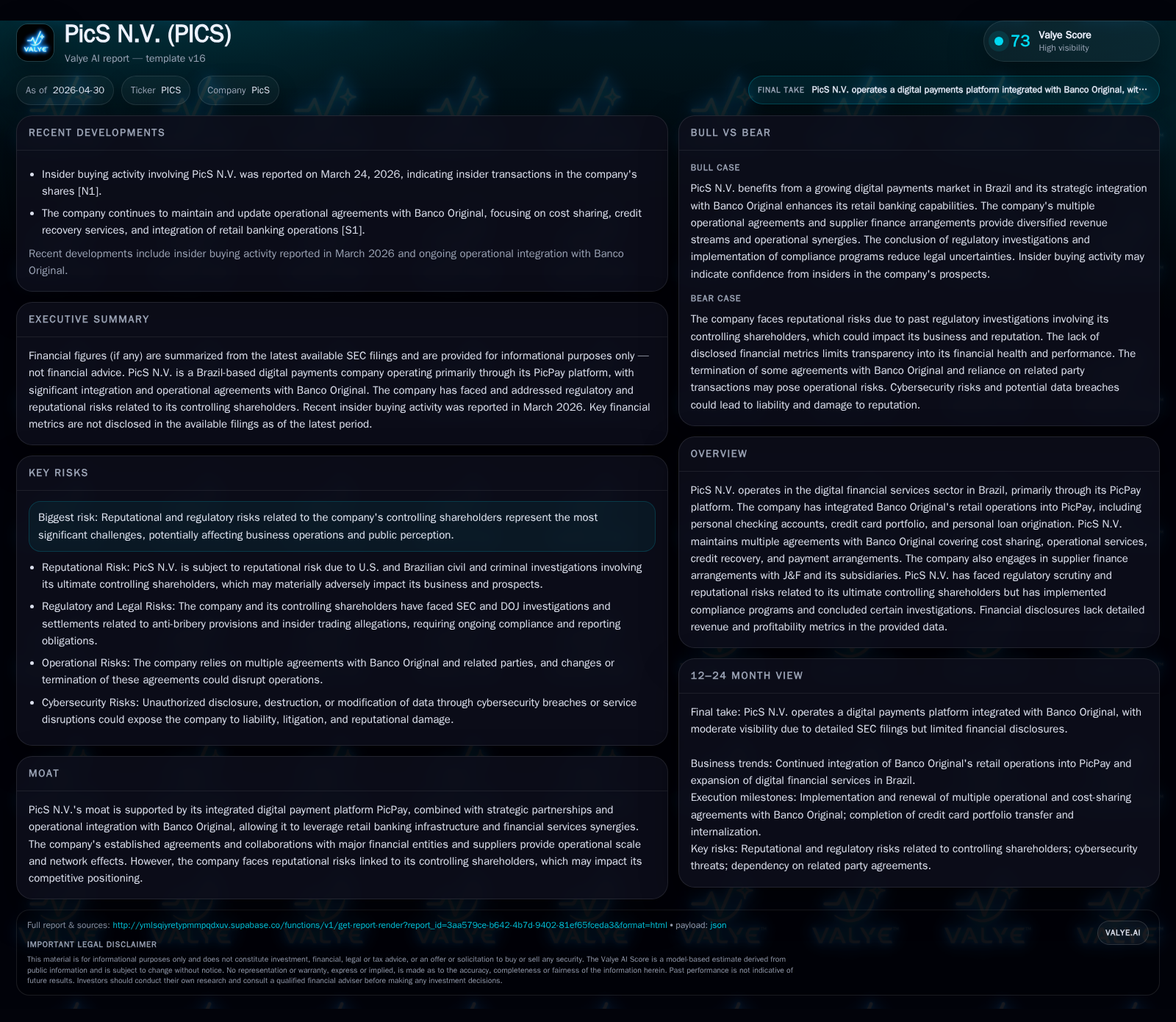
PicS N.V.'s March 2026 quarterly filing reveals important adjustments in its agreements with Banco Original, including new cost-sharing arrangements and credit services collaboration that underpin the growing integration of retail financial products into PicPay’s digital platform. These updates reflect a strategic pivot towards tighter operational synergy, leveraging shared infrastructure and data intelligence to deepen customer engagement in Brazil's competitive digital payments market. Despite inherent reputational risks linked to controlling shareholders, PicS continues to solidify its business model through innovative API usage, credit portfolio acquisitions, and supplier financing solutions. The company’s growth trajectory will depend on successful execution of ongoing contractual terms and regulatory compliance.
Latest Operating Developments from Q1 2026 Filing
PicS N.V.’s latest quarterly disclosure dated March 19, 2026 ([S2]) surfaces critical contractual realignments with Banco Original that materially affect near-term operations. Key updates include:
A Cost Sharing Agreement entered on January 10, 2024 between PicPay Bank (its banking subsidiary) and Banco Original governs the joint provisioning of support services and cost reimbursements for suppliers delivering shared products or services. This indefinite agreement is terminable by either party on thirty days’ notice.
PicPay Brazil similarly established a Cost Sharing Agreement with Banco Original on November 16, 2023 focused on back-office cost allocations including technology vendor expenses. This arrangement remains valid indefinitely.
An ongoing Recovering of Credit Services Agreement initiated January 18, 2024 tasking PicPay Bank with credit collection for defaulted borrowers of Banco Original under a two-year term with flexible termination clauses augments control over delinquency workflows.
Termination settlements finalized earlier in 2024 closed out previous Rights Assignment Agreements transferring Banco Original’s credit card portfolios and cashback-related operational arrangements to PicPay Bank as part of their strategic consolidation ([S4]).
These developments illustrate an accelerated migration of Banco Original’s retail financial operations onto PicPay’s platform ecosystem while formalizing mechanisms for joint cost governance.
PicS Business Model and Platform Ecosystem
PicS operates predominantly through the PicPay platform—a digitally native financial services provider rooted in Brazil’s fast-growing fintech sector ([S1]). The company's model integrates:
Retail banking assets migrated from Banco Original including personal checking accounts (transferred mid-2023), credit card portfolios (transferred early 2024), and recently launched personal loan origination (/2023), effectively internalizing loan underwriting functions.
Payment capabilities licensed via multi-phase API integrations initially covering bank slip payments, taxes, utility bills, automatic debit registrations ([S1]), later expanding into QR code-enabled ATM cash withdrawals interoperable across the widespread 24Horas network.
A closed-loop digital wallet offering seamless transactional experiences blending direct deposits, credit line utilization via PicPay credit cards issued under partnership with Banco Original, utility payments, transfers, and point-of-sale financing.
Revenue stems from fees associated with transaction processing, lending interest margins on originated loans and credit cards, interchange commissions from card schemes like Mastercard (per strategic alliance agreements [S15]), as well as interest income from supplier finance programs.
This integrated approach leverages shared infrastructures to optimize unit economics while expanding user engagement through cross-product bundling.
Integration and Synergies with Banco Original
The operational alliance between PicS and Banco Original is structured around a complex web of agreements enabling synergies at multiple touchpoints ([S1],[S4]):
Cooperation agreements enable reciprocal sharing of customer data to enhance risk models and tailor financial product offerings while jointly complying with anti-money laundering (AML) regulations.
Cost-sharing contracts spread technology development expenses and administrative overheads efficiently across both entities reducing duplication.
Recovery service contracts delegate collections management to PicPay Bank incentivizing streamlined delinquency handling without fixed commitments.
Endorsement agreements allow PicPay Bank to securitize bank credit notes originated by Banco Original without co-obligation increasing capital flexibility ([S11]).
Collectively these linkages embed scale advantages that are difficult for standalone fintech entrants to replicate due to the deep entanglement of legacy banking systems combined with agile digital delivery capabilities.
Industry Environment and Competitive Dynamics in Brazilian Digital Finance
Brazil hosts a highly competitive digital payments ecosystem comprising legacy banks expanding their digital footprint; pure-play fintechs targeting underbanked populations; global card networks innovating transaction value capture; alongside emergent mobile wallets transforming user payment behavior.
PicS occupies a niche enabled by its ownership ties to J&F – Brazil's diversified conglomerate controlling JBS S.A. – facilitating large-scale asset transfers from Banco Original’s retail arm into a modern fintech wrapper. This hybrid positioning confers differentiated scale but exposes the firm to heightened scrutiny given the controlling shareholders’ checkered regulatory past:
The SEC issued cease-and-desist orders related to illicit payments tied to prior dealings involving the controlling shareholders; recent termination letters in early 2024 suggest closure but not elimination of reputational risks ([S14]).
Brazilian securities regulator CVM imposed fines following investigations into insider trading allegations against the same ultimate owners with some fines settled recently but maintaining a watchful oversight posture.
Regulatory compliance programs have been enhanced accordingly; however, potential adverse public perception remains an overhang affecting client acquisition dynamics especially among younger demographics sensitive to ethical considerations.
Digital wallets also benefit from strong network effects; user stickiness is driven by integrated product suites combining payment convenience with embedded financial services supported by proprietary data analytics bolstered by cooperation agreements ([S1]). Yet rivals like Nubank or PagSeguro leverage alternative distribution models emphasizing expansive credit underwriting algorithms or merchant-oriented POS systems creating a dynamic contest for market share.
Key Growth Drivers: Technology, Partnerships, and Market Expansion
Several vectors underpin PicS’s forward growth potential:
Incremental API rollouts continue expanding service capabilities—from earlier bank slip payments to recent QR code ATM withdrawal functionalities—enhancing user value propositions across physical-digital payment touchpoints ([S1]).
Strategic acquisitions of credit portfolios from Banco Original internalize more lending revenue streams allowing improved margin control alongside diversified consumer finance products ranging from personal loans to credit cards which scaled substantially post-transfer in early 2024 ([S4]).
Data intelligence sharing agreed under repeated cooperation frameworks sharpens risk assessment models enabling better underwriting decisions while also strengthening compliance monitoring effectiveness particularly relevant amid tighter AML enforcement ([S1]).
Supplier financing mechanisms introduced through receivables sales arrangements involving J&F-affiliated subsidiaries provide cash flow optimization benefits reducing working capital costs directly impacting profitability ( [S16]).
Maintaining robust compliance safeguards around regulatory mandates further bolsters durable growth prospects helping secure trust among institutional partners.
Risk Factors: Regulatory, Reputational, and Compliance Challenges
The predominant concern revolves around residual reputational risks tightly coupled with the company’s controlling shareholders – namely J&F Participa0es S.A. These risks manifest as:
Historical SEC orders relating to illicit payments requiring ongoing disclosures covering anti-bribery enhancements plus monitoring undertakings that concluded only recently but remain sensitivities in public markets ([S14]).
Brazilian CVM investigations into alleged insider trading activities although largely resolved still indicate systemic governance scrutiny particularly in large conglomerate-linked entities ([S22],[S23]).
Criminal proceedings against key individuals among controlling shareholders impose reputational vigilance even if no direct impact on day-to-day operators currently documented.
Additional operational risks include cybersecurity threats acknowledged publicly due to high dependence on digital transaction infrastructure which could cause service disruptions or data breaches undermining client retention ([S6]). Also possible contract terminations envisaged under certain service agreements may influence revenue stability hence exact execution penalties merit monitoring closely.
Catalysts to Monitor: Upcoming Milestones and Execution Triggers
Looking ahead several factors warrant close observation:
Renewal or termination decisions related to key Cost Sharing Agreements signed since late 2023 will reveal the sustainability of cross-company operational synergies given their terminable nature at short notice ([S4],[S8],[S12]).
Technological innovation pace especially deployment of advanced APIs offering new payment modes such as real-time cross-platform fund transfers could materially alter user engagement metrics.
Regulatory filings documenting compliance program enhancements or any unexpected enforcement actions would profoundly influence investor confidence due to legacy shareholder associations.
Insider buying activity spotted shortly after the Q1 filing might signal management optimism regarding forthcoming execution performance [N1].
Progress tracking around incremental integration milestones related to loan origination volumes or credit portfolio expansions provides measurable demand-side indicators supporting growth assumptions.
Disclaimer: This analysis is solely for informational purposes based on publicly available SEC filings as of April 30, 2026. It does not constitute investment advice or recommendations regarding securities of PicS N.V. Readers should perform independent due diligence before any decision-making.
Disclaimer: This is research-only, informational analysis and not investment advice. It may include AI-generated interpretation and general industry context. Always verify important details using primary sources.

Comments