
Powell Max Ltd Upgrades Capital Structure and Pursues Strategic Expansion
The company’s recent share reorganization and acquisition pursuits strategically position Powell Max amid competitive pressures in Hong Kong’s financial communications sector.
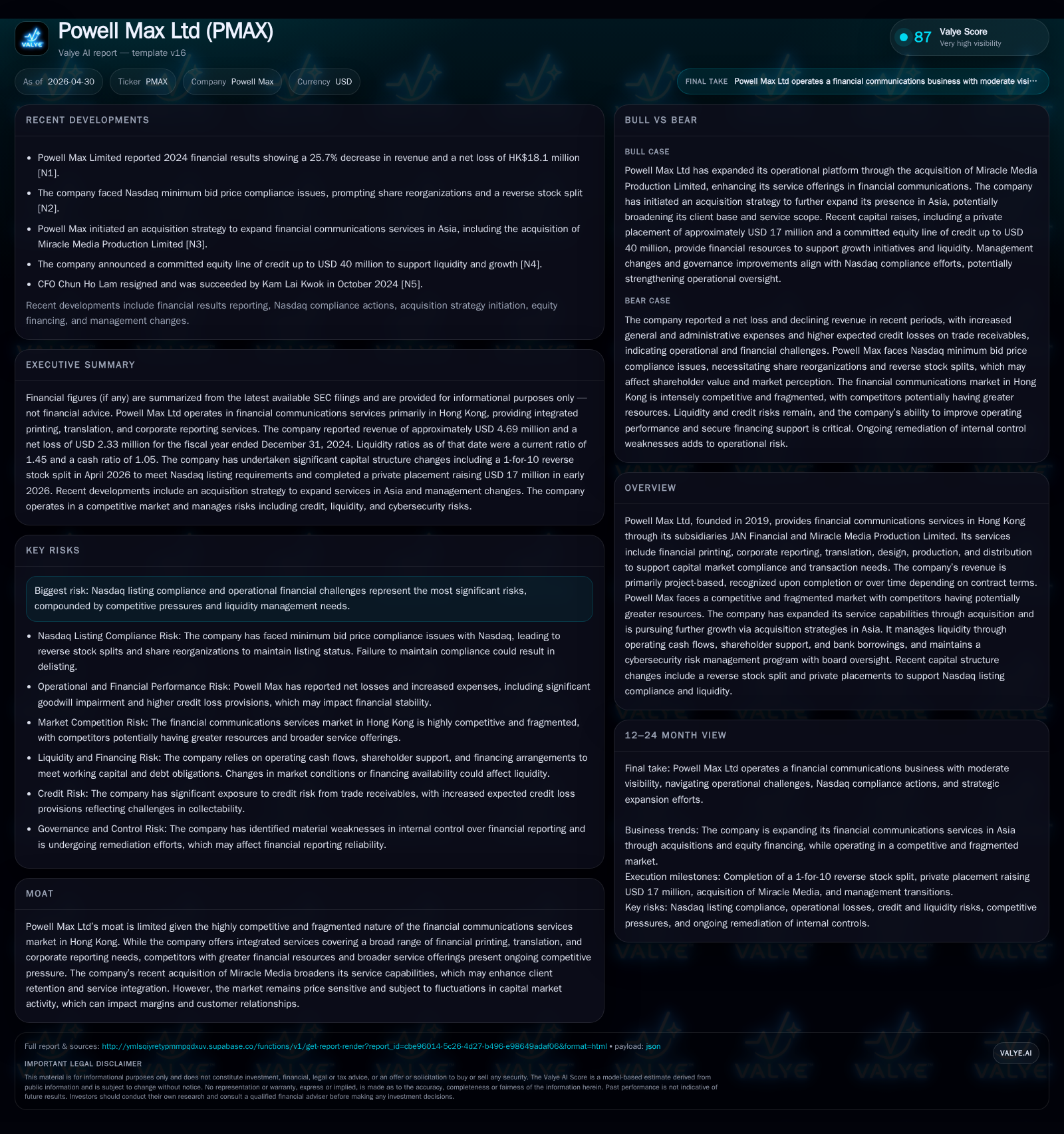
Powell Max executed a 1-for-10 reverse stock split in April 2026 to meet Nasdaq's minimum bid price compliance, restructuring its capital without shareholder approval under BVI authority. The firm operates integrated financial communications services, recently expanded by acquiring Miracle Media, enhancing offerings but facing a fragmented and resource-intensive competitive landscape in Hong Kong. Growth initiatives center on strategic acquisitions such as the pending intent to acquire Boston Solar Company, aiming to diversify service mix. Market sensitivity and Nasdaq listing obligations remain key risks. Financially, Powell Max maintains moderate liquidity with a current ratio of 1.45 and manages capital structure changes aligned with market access goals.
Recent Capital Structure Transformation: Nasdaq Compliance and Share Reorganization
In the first quarter of 2026, Powell Max Ltd undertook significant capital structure actions to maintain its listing on the Nasdaq Capital Market. On March 27, 2026, the Board exercised its authority under the British Virgin Islands (BVI) Business Companies Act to approve a series of share combinations—culminating in a net effective 1-for-10 reverse stock split across all classes of ordinary shares without requiring shareholder approval [S2]. This move followed an initial 1-for-8 combination combined with an 8-for-1 subdivision designed solely to comply with BVI registration protocols.
The reverse stock split became effective April 17, 2026. This strategic maneuver was aimed explicitly at increasing the per-share trading price above Nasdaq’s $1 minimum bid price requirement, ensuring continued public market eligibility [S2]. Such restructuring also provided Powell Max more flexibility in optimizing its capital structure post-January private placement and retirement of certain shares via buyback from Bliss On Limited. The cumulative effect materially altered the shareholder composition and voting profile while recalibrating the potential dilution pathway from issued warrants and convertible securities [S6]. This governance approach highlights an active response to regulatory listing challenges via legally streamlined capital management.
Business Model Overview: Integrated Financial Communications Services in Hong Kong
Founded in 2019, Powell Max operates primarily within Hong Kong through operating subsidiaries JAN Financial and Miracle Media Production Limited. Its core business provides comprehensive financial communications services essential for capital market compliance and transaction facilitation. These services encompass financial printing, corporate reporting, typesetting, proofreading, bilingual translation, design, electronic dissemination, newspaper placement, distribution, production maintenance services, and client support facilities [S1].
Revenue is largely project-based with recognition either at contract completion or progressively over service milestones when benefits are simultaneously received by clients. Contracts blend tightly integrated deliverables spanning multiple components like printing combined with translation or electronic publishing—all critical under Hong Kong Stock Exchange (HKSE) reporting mandates [S1]. Clients mostly comprise HKSE-listed companies or IPO applicants seeking disclosure fulfillment per HK Listing Rules and Securities & Futures Ordinance requirements.
The acquisition of Miracle Media in February 2025 expanded Powell Max’s platform breadth beyond JAN Financial alone [S1]. This move added complementary translation and production offerings but introduced complexity by overlapping service lines. The firm's model relies on managing these synergies carefully to maintain client retention amid tight pricing conditions prevalent in this niche segment.
Competitive Environment: Fragmented Market Dynamics and Resource Pressures
Powell Max operates in an intensely competitive and fragmented Hong Kong financial communications market with many players delivering overlapping print, translation, communication support, and compliance-related services [S1][S24]. Competitors often boast larger financial resources, broader geographic footprints or longer-established brand recognition which imposes pricing pressure risks for Powell Max.
The market exhibits pronounced pricing sensitivity especially during periods of subdued capital markets activity which directly impacts volume demand for reporting services [S1]. Margins can compress if competitors pursue aggressive discounting or bundled offerings with higher switching costs—though Powell Max aims to leverage its integrated service suite as a differentiation angle [S1]. Capacity constraints in specialized printing or language expertise further shape competition dynamics since delivery speed and quality remain critical for capital markets deadlines.
Growth Initiatives: Acquisitions and Expansion into Adjacent Service Markets
Powell Max's growth strategy prominently features acquisitions to augment scale and diversify offerings. The February 2025 purchase of Miracle Media expanded its service range into additional printing and language domains within Hong Kong [S1]. This acquisition broadened cross-selling opportunities but increased integration complexity potentially pressuring margins.
Further emphasizing expansion ambitions is the March 2026 signing of a non-binding letter of intent to acquire The Boston Solar Company—a transaction envisaging up to $9 million consideration plus assumption of significant debt totaling up to $7 million alongside a potential working capital facility [S3][S6][S10].
This deal signals Powell Max’s intent to penetrate adjacent sectors possibly outside traditional financial communications—potentially offering new growth levers while introducing operational diversification. However, completion remains uncertain pending customary conditions including financing diligence [S3]. The strategy reflects an appetite for vertical integration effects or scale-driven efficiencies amid an otherwise mature core business base.
Risks and Headwinds: Market Sensitivity, Nasdaq Listing Challenges, and Cybersecurity
A primary risk emerges from the cyclical nature of capital market activities influencing new issuance volumes and compliance workloads—directly impacting demand elasticity for Powell Max’s services [S1][S24]. Declines in IPOs or public market transactions reduce fee-paying project volumes leading to revenue variability.
Nasdaq compliance requirements have imposed governance restructuring costs including leadership changes in late 2025/early 2026 together with share reorganizations aimed at maintaining listing eligibility [S6][S18]. Continued regulatory pressures could necessitate further equity refinancings dilutive to existing shareholders.
Cybersecurity represents a material operational risk given reliance on IT systems managing sensitive corporate disclosures. The board maintains oversight through audit committees regularly reviewing risk management programs; management-led initiatives ensure ongoing assessment though inherent threat potentials persist [S1]. No material cybersecurity incidents have been reported thus far.
What to Watch Next: Acquisition Outcomes and Market Activity Indicators
Investors should monitor progress toward consummating the Boston Solar Company acquisition including definitive agreement execution and financing arrangements given its transformational implications for the company's revenue profile [S3][S6][S10]. Market conditions in Hong Kong’s capital markets remain relevant demand indicators—for instance new IPO pipelines or regulatory changes could shift project flow fundamentals.
Post-reverse split share price behavior will be telling regarding retail/institutional acceptance after structural dilution events triggered by prior private placements alongside warrant conversions [S2][S6]. Watch developments around integration effectiveness following Miracle Media acquisition as well as sales/marketing initiatives targeting client retention amidst strong competition.
Financial Profile Summary: Liquidity, Cash Flow, and Capital Structure
As of December 31, 2024, Powell Max held cash & equivalents approximating $5.4 million USD complemented by current assets totaling roughly $7.5 million USD against current liabilities near $5.2 million USD—translating into a current ratio around 1.45 indicating moderate short-term liquidity coverage [F1].
Operating cash flows were negative HK$8.7 million (~$1.1 million USD) for full-year 2025 reflecting ongoing investment outlays including the Miracle Media purchase valued near HK$28 million cash outflow plus operational losses linked to competitive pressures [S4][S15]. Equity financings raised about $17 million gross from private placements partially alleviated liquidity constraints in early 2026 alongside share repurchases altering ownership structure materially [S6].
No significant new debt issuances have been reported subsequent to refinancing efforts completed by year-end 2025 where prior bank borrowings were settled alongside convertible promissory notes elimination improving the liability profile [S4][F1].
This analysis represents a detailed synthesis grounded exclusively within disclosed SEC filings without offering investment advice or specific price expectations. It incorporates primary source evidence through April 15-30, 2026 filings reflecting Powell Max’s strategic responses amidst regulatory demands and competitive industry context.
Disclaimer: This is research-only, informational analysis and not investment advice. It may include AI-generated interpretation and general industry context. Always verify important details using primary sources.

Comments