
BRBI BR Partners Advances Diversified Advisory Amid Brazilian Market Shifts
BRBI sustains its leadership in Brazil’s investment banking by adapting its integrated advisory platform to challenging macroeconomic conditions.
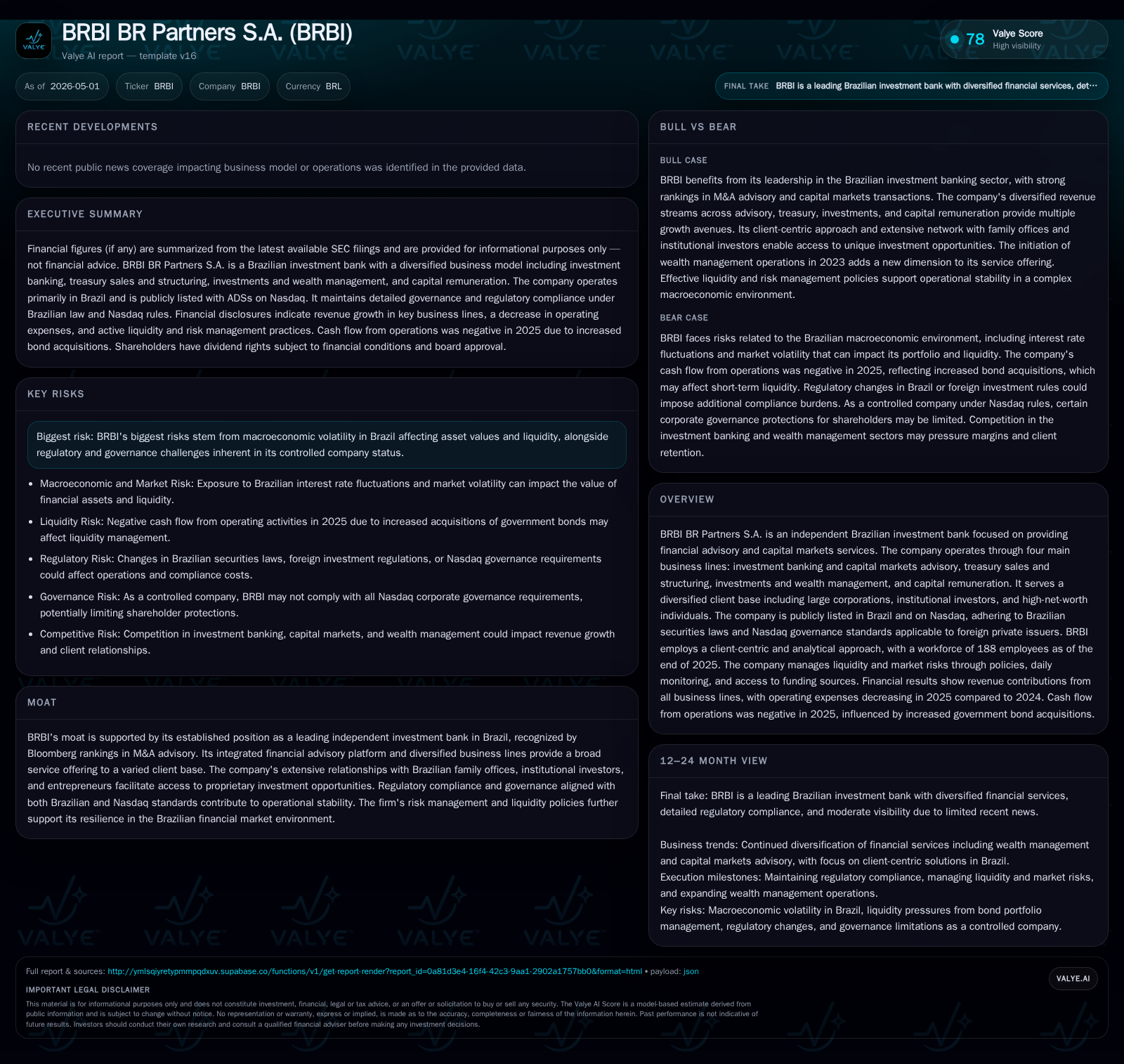
In its latest quarterly filing dated March 30, 2026, BRBI BR Partners reaffirmed compliance and governance continuity with no material operational changes, underscoring steady execution amid a tough Brazilian macroeconomic backdrop. The company’s diversified business lines spanning investment banking advisory, treasury structuring, wealth management, and capital remuneration underpin resilience despite M&A headwinds caused by rising SELIC rates. BRBI leverages an established client base including corporates, institutional investors, and high-net-worth individuals (HNWIs) through a client-centric and analytical service model. With wealth management newly launched in late 2023, growth avenues are emerging alongside steady debt capital markets activity that partially offsets softer M&A volumes. Key risks center on macro-economic volatility and regulatory complexities in Brazil’s dual market framework.
Latest Quarterly Update: Key Developments and Immediate Implications
BRBI BR Partners’ most recent report filed on March 30, 2026 [S2] along with the complementary March 19 filing [S3] essentially reaffirm ongoing regulatory compliance under the U.S. Securities Exchange Act without reporting any material change to operations or corporate strategy. These filings serve as confirmation of disciplined governance adherence amidst an evolving political-economic setting in Brazil.
While no headline-altering event emerged this quarter, these routine disclosures are critical for foreign-listed companies like BRBI maintaining investor transparency under Nasdaq listing rules. From an operating perspective, this signals steady-state execution across its business lines with readiness to adapt incrementally as market dynamics unfold.
Integrated Business Model: Services, Clientele, and Competitive Differentiation
BRBI’s revenue streams stem from four interrelated business pillars: (1) investment banking and capital markets advisory; (2) treasury sales and structuring; (3) investments and wealth management; and (4) capital remuneration [S1]. This diversification allows the firm to service a wide spectrum of clients dominated by large corporations requiring complex M&A advisory solutions, institutional investors seeking tailored structuring, and HNWIs benefiting from newer wealth management offerings introduced in September 2023.
The firm's analytical approach combined with sector knowledge facilitates differentiated advice that goes beyond typical transactional support. Employing roughly 188 professionals at end-2025 [S1], BRBI emphasizes a client-centric culture that fosters deep engagement across its regional footprint.
Unlike some competitors reliant on singular revenue sources vulnerable to cyclicality—particularly M&A fees—BRBI’s balanced model cushions against volatility by integrating treasury sales targeting fixed income products favored during high interest rate cycles. Early traction in wealth management opens cross-selling synergies to embed clients deeper into the platform.
Industry Context and Competitive Dynamics in Brazilian Investment Banking
Within Brazil’s financial advisory space BRBI stands out as a leading independent investment bank consistently ranked among top five M&A advisors by Bloomberg since 2017. Its standing reflects not just deal count but impactful volume execution track record [S1]. The competitive landscape is shaped by tiered domestic banks versus independents like BRBI who carve niche expertise especially servicing family offices and entrepreneur-owned businesses.
Rising SELIC rates—which averaged approximately 15% in 2025—have injected pricing pressure into M&A transactions as higher discount rates dampen asset valuations and elongate deal timelines. This environment constrains fee generation directly linked to deal closings but catalyzes demand for complementary offerings such as restructuring advice and fairness opinions where fees are lower but more stable [S1].
Brazilian securities market regulation is multi-layered involving CMN, CVM, Central Bank oversight alongside Nasdaq governance requirements inherent to foreign private issuers. While adding complexity for compliance teams,[S1] this dual regime helps maintain operational discipline serving as a moat against less rigorous rivals.
Local ties underpin much of BRBI's moat including extensive relationships with institutional investors controlling meaningful capital pools alongside wealthy families whose strategic mandates extend beyond transactional objectives toward long-term partnership.
Growth Drivers: Capital Markets Activity, Wealth Management Expansion, and Client Relationships
Although M&A activity softened due largely to macroeconomic headwinds from a higher cost of capital environment driven by SELIC increments,[S1] BRBI strategically offset this through strengthened Debt Capital Markets activities where investor appetite for fixed income rose notably throughout 2025. Treasury sales and structuring effectively monetize these trends by packaging attractive fixed-income-linked solutions meeting demand from cautious investors focused on yield preservation.
Wealth management presents a compelling nascent growth vector following its late-2023 launch allowing BRBI access to Brazil’s growing segment of affluent individuals seeking sophisticated portfolio construction beyond traditional bank offerings. This segment provides recurring fee potential less correlated with cyclical deal flows.
Underlying all growth is the firm’s ability to leverage proprietary deal flow stemming from well-established networks within entrepreneurial circles combined with bespoke product innovation adapting continuously as clients face shifting economic realities.[S1]
Operational Risks and External Constraints: Macroeconomics and Regulatory Landscape
Risk exposure centers prominently on Brazil's macroenvironmental volatility manifesting as fluctuations in GDP growth rates, inflation indexes such as IPCA/IGP-M used for contractual adjustments,[S1] and benchmark interest rates influencing transaction economics directly affecting investment banking deal timing and volume.
Moreover, operating inside the Brazilian regulatory ecosystem imposes challenges given rules enforced by CVM (securities regulator), CMN (national monetary council), Central Bank (monetary authority), compounded with Nasdaq’s oversight for foreign issuers.[S1]
BRBI’s controlled company status suggests additional governance scrutiny which may impose limits on certain corporate actions or require enhanced disclosure routines imposing added administrative costs.[S1]
Liquidity risk is managed via comprehensive daily monitoring tools overseen by the assets & liabilities committee ensuring high liquidity buffers alongside ready access to multiple financial institutions capable of providing funding if stress scenarios arise.[S7][S21]
Sensitivity analyses performed internally account for possible adverse movements in interest rates impacting portfolios tied to Brazilian government bonds that also integrate derivative instruments like inflation swaps.[S7]
Credit risk assessments follow a staged model whereby receivables are classified according to delinquency grades informing provisioning strategies designed to minimize financial impact.[S1]
Looking Ahead: Milestones and Market Signals to Monitor
Investors should closely monitor upcoming quarterly filings for indicators such as evolution in transaction pipeline composition especially shifts across M&A versus restructuring engagements reflecting changing market confidence levels.[S2][S3]
Progress metrics related to wealth management client acquisition will be key signals indicating successful entry into this less traditional but expanding segment helping smooth revenue cyclicality over time.
Regulatory updates impacting foreign private issuers or controlled company governance requirements may signal shifts in compliance burden or strategic realignments.
Also critical is observing how prevailing high SELIC rates evolve since any reduction could potentially unlock previously delayed M&A activity restoring fee growth momentum.[S2][S3]
Lastly, maintenance of operational discipline around liquidity management will remain vital given the sensitivity of their financial assets portfolio dominated by government bonds susceptible to real interest rate spikes.[S7]
DISCLAIMER: This analysis is purely informational based on disclosed regulatory filings without offering investment advice or forecasts regarding company performance or stock valuation.
Disclaimer: This is research-only, informational analysis and not investment advice. It may include AI-generated interpretation and general industry context. Always verify important details using primary sources.

Comments