
Oppenheimer Holdings Advances Wealth Management and Tech Investments in Q1 2026
Q1 2026 updates show Oppenheimer’s compliance readiness and strategic growth focus in wealth management and technology.
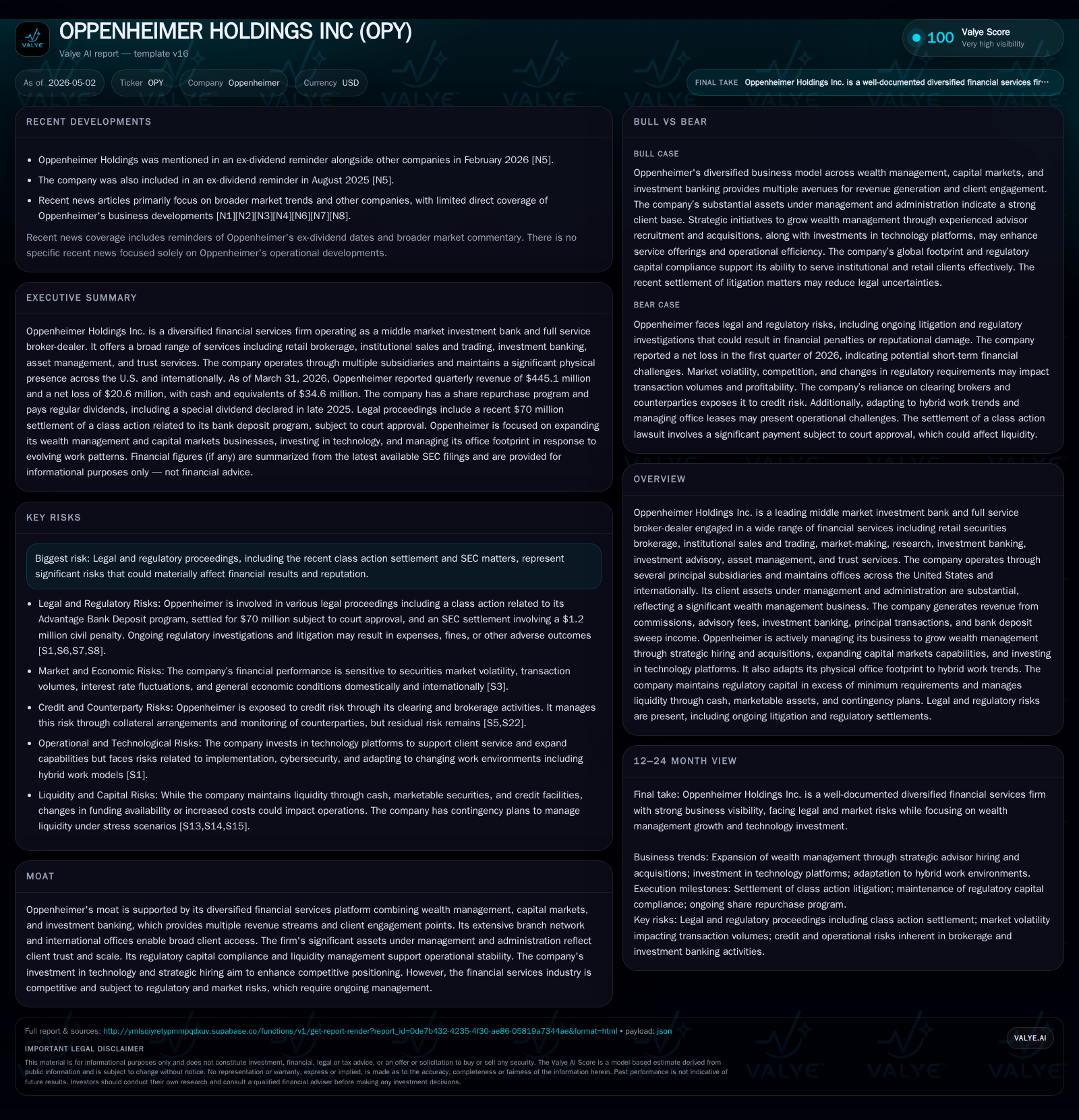
Oppenheimer Holdings’ May 2026 quarterly filing highlights operational preparedness for new SEC customer protection rules and ongoing investment in strategic hires and technology aimed at expanding its wealth management business. The firm maintains solid regulatory capital buffers and operational stability, while navigating complex legal settlements and evolving tax regulations. Its diversified financial services model, combining retail brokerage, institutional trading, investment banking, and asset management across a geographic footprint stretching from the U.S. to Europe and Asia, underpins a resilient competitive moat. Growth is driven chiefly by targeted hiring, acquisitions, and technology upgrades enhancing client experience and operational efficiency.
Q1 2026 Operating Update: Key Developments and Implications
Oppenheimer Holdings' latest quarterly disclosure dated May 1, 2026 [S2] demonstrates significant progress toward compliance with upcoming regulatory requirements notably the SEC's amended Rule 15c3-3. This amendment mandates broker-dealers with customer credits over $500 million to perform daily (rather than weekly) net cash owed computations starting June 30, 2026. Oppenheimer confirms readiness for this shift within its broker-dealer subsidiary operations, underscoring proactive risk management aligned with intensified customer protection standards. Such preparedness reduces potential operational disruptions while stabilizing trust with investors and regulators.
Alongside compliance measures, the filing underscores ongoing execution of strategic initiatives: expanding wealth management through targeted recruiting and acquisitions as well as ramping up technology investments. These moves aim to reinforce revenue streams amid competitive pressures.
Integrated Business Model: Comprehensive Financial Services Platform
Oppenheimer operates a diversified financial services model encompassing retail securities brokerage commissions, institutional sales & trading revenues, investment banking fees derived from underwriting and advisory engagements, asset management fees on client assets under administration (AUA) or management (AUM), and trust services income [S1]. This multi-pronged revenue structure mitigates reliance on cyclical capital markets activity while facilitating cross-selling across client segments.
Geographically, the company’s footprint spans major U.S. financial markets with offices headquartered at 85 Broad Street in New York complemented by regional branches nationwide. International presence includes London, Geneva, Tel Aviv, Hong Kong, and Jersey [S1]. This dispersion enhances access to global capital flows and diversified client pools.
Operationally, Oppenheimer is assessing real estate needs in light of hybrid work trends impacting branch utilization—balancing cost control against the necessity of client-facing teams stationed regionally. Data processing centralization remains anchored in New York headquarters supporting trading platforms and backend infrastructure [S1].
Competitive Strengths within Wealth Management and Capital Markets
Valye report excerpts identify Oppenheimer's strength rooted in its combination of substantial AUM/AUA underpinning wealth management scale with complementary capital markets activities including middle-market investment banking. This integrated approach delivers multiple client touchpoints that help raise switching costs by embedding clients into several advisory or transactional relationships.
The firm’s market-making capabilities combined with robust institutional sales & trading desks provide diversification beyond pure brokerage commissions—a critical buffer during periods of equity market volatility [S1]. Strategic efforts to enhance technology platforms also contribute to maintaining a differentiated client experience.
By focusing on mid-market deal flow rather than top-tier mega deals dominated by bulge bracket banks, Oppenheimer occupies a defensible niche offering personalized advisory coupled with competitive execution capabilities. The scale of its branch network further supports retail brokerage reach where personalized advisor relationships remain valued.
Growth Drivers: Strategic Hiring, Acquisitions, and Technology Investment
Growth momentum is anchored around three key levers. First is strategic hiring focused primarily on expanding wealth advisors in target geographic areas—a channel pivotal for growing AUM/AUA which drives recurring advisory fees [S2]. Acquisitions complement organic headcount growth by bringing specialist practices or territories into the fold.
Second is enhancement of capital markets capabilities through recruiting experienced bankers capable of sourcing middle-market deal mandates—leveraging established industry relationships to build deal pipelines [S1] [S2].
Third is sustained investment in front-to-back technology platforms facilitating digital onboarding, portfolio reporting, compliance monitoring (especially post-SEC rule amendments), and trade execution efficiencies [S2]. This tech upgrade agenda responds both to increasing regulatory complexity as well as elevated client expectations for digital interactions.
These growth vectors are supported by KPIs referenced indirectly such as rising client assets under management/administration (though exact figures were not disclosed this quarter), steady advisor recruitment pace noted previously in annual reports [S1], and ongoing capital commitment to systems modernization. While direct bookings or retention metrics are not specified therein, the nature of recurring fee revenues suggests durable client relationships benefitting from these investments.
Risk Factors: Regulatory Landscape and Legal Contingencies
Ongoing regulatory scrutiny presents material risk layers for Oppenheimer. The firm remains fully compliant on net capital requirements with all domestic/international subsidiaries exceeding minimum thresholds as of March 31, 2026 [S2]. However, it faces legal contingencies including a recently settled class action litigation involving a $70 million payment subject to court approval expected within months [S9]. This settlement follows a protracted dispute without admission of liability but represents a notable expense.
Further legal exposure stems from SEC investigations linked to municipal securities disclosure compliance settled via a $1.2 million civil penalty agreement finalized late 2025 [S11] [S15]. These proceedings illustrate enforcement intensity prevalent across broker-dealer operations nationally.
Tax regulation changes effective from January 1, 2027 expand limits on deductibility of certain executive compensation under Section 162(m), potentially increasing Oppenheimer’s effective tax rate given its executive compensation mix [S2]. The firm acknowledges some uncertainty regarding how this may affect future operating results based on personnel decisions but is preparing accordingly.
Beyond quantifiable impacts are reputational risks inherent in litigation/settlement contexts which could affect client confidence or employee morale if recurring.
Outlook: Key Milestones and Market Catalysts to Monitor
Looking ahead over the remainder of calendar 2026 key operational markers include:
- Successful transition to daily customer reserve computations mandated by SEC Rule 15c3-3 amendments by June 30 deadline—tracking readiness offers insight into compliance process robustness.
- Execution pace for further strategic hiring within wealth management aimed at maintaining or accelerating asset inflows.
- Integration effectiveness of recent acquisitions contributing incremental AUM/AUA or advisory talent pool expansions.
- Technology platform deployment milestones that facilitate increased automation or reduce overhead costs while enhancing client service quality.
- Legal developments including District Court approval timing for the $70 million class action settlement alongside ongoing motions affecting litigation outcomes.[S9]
- Monitoring impacts from the One Big Beautiful Bill Act (OBBBA) provisions introduced mid-2025 shaping expense deductions extending through 2026 without material immediate financial effect but laying groundwork for future fiscal dynamics.[S2]
Attention to these factors will underscore whether strategic initiatives translate into sustainable revenue growth amidst sector-wide competitive pressures.
Financial Snapshot: Supporting Context from Latest Quarter
As of March 31, 2026, Oppenheimer reported cash and equivalents totaling $34.6 million according to companyfacts data [F1], providing near-term liquidity cushion supporting operational needs during volatile market cycles. Although explicit details about current total debt were last marked approximately $149 million from mid-2020 levels [F1], no recent filings indicate significant new debt issuance nor refinancing activities altering leverage materially since then.
The firm's ability to maintain net capital requirements above minimums across subsidiaries at quarter-end signals continued financial stability bolstered by internally generated funds supplemented through flexible uncommitted bank borrowing facilities referenced historically [S5] [S13]. Share repurchase programs announced previously underpin disciplined capital allocation though activity levels remain calibrated based on prevailing market conditions.[S4][S6]
Overall, the financial profile complements the operational strategy emphasizing measured expansion funded largely through cash flow while preserving agility amid regulatory evolution.
This analysis synthesizes information solely derived from Oppenheimer Holdings Inc.'s official SEC filings up to May 1st, 2026 ([S1], [S2], [S3], etc.) together with validated companyfacts statistics ([F1]) without conjecture beyond disclosed data points. It reflects current company positioning as a diversified middle-market investment banking firm prudently managing growth opportunities alongside regulatory challenges within competitive wealth management ecosystems.
Disclaimer: This is research-only, informational analysis and not investment advice. It may include AI-generated interpretation and general industry context. Always verify important details using primary sources.

Comments