
Cboe Global Markets Strengthens Profitability and Focus with Strategic Realignment in Q1 2026
Cboe’s first quarter results reflect operational resilience through strategic workforce reductions and raised revenue guidance amid competitive exchange industry dynamics.
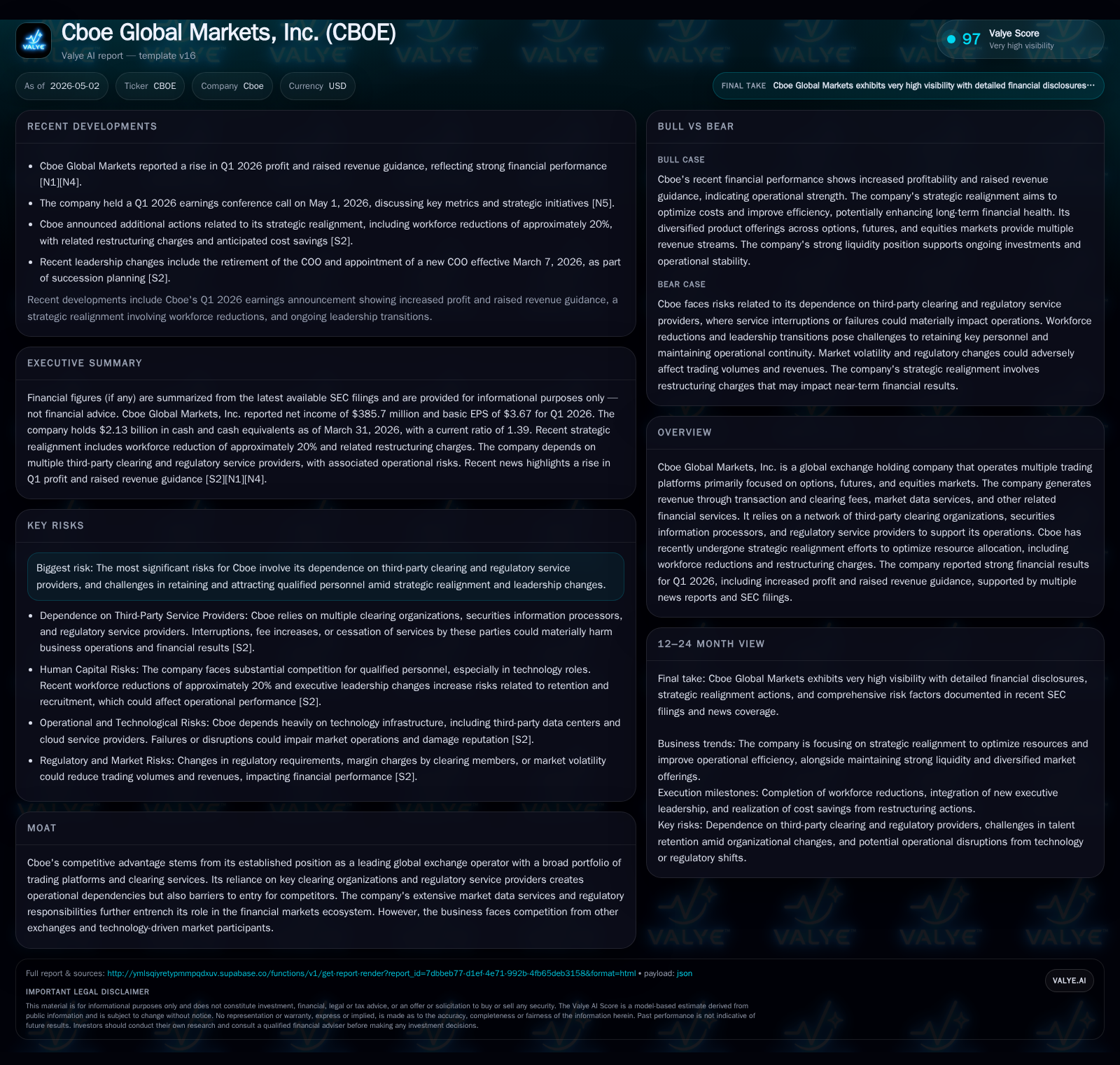
In Q1 2026, Cboe Global Markets reported earnings surpassing estimates with notable margin improvements driven by a substantial strategic realignment that includes a projected 20% workforce reduction. The company’s diversified revenue streams, centered on transaction and clearing fees across options, futures, and equities markets, underpin its robust market position despite operational dependencies on third-party clearinghouses and regulatory bodies. While restructuring-related costs will impact near-term expenses, anticipated annualized savings of $40-50 million aim to enhance cost efficiency. Key risks include employee retention challenges during this transition and reliance on critical external service providers. Monitoring execution of the realignment actions and subsequent quarterly results will be essential to gauge sustained growth momentum.
First Quarter 2026 Operating Highlights
Cboe Global Markets delivered a solid operational performance in the first quarter ended March 31, 2026, beating analyst earnings estimates and raising revenue guidance for the full year [S2], [S3], [N1], [N3]. This upside was supported by improving profit margins despite the ongoing impacts of strategic realignment initiatives. The company announced additional restructuring efforts expected to reduce its workforce by roughly 20%, resulting in pre-tax restructuring charges projected between $36 million to $46 million primarily for severance and related expenses [S2], [S4], [S5]. These charges will be mostly incurred from Q2 through Q4 of 2026.
Importantly, these realignment actions follow a comprehensive review carried out in late 2025 aimed at sharpening Cboe's strategic focus and reallocating resources more efficiently across global operations [S5]. The company anticipates annualized cost savings ranging from $40 million to $50 million attributable to these initiatives beginning in 2026, with $20 million to $25 million expected this year alone [S5]. Despite near-term restructuring costs, the combined benefit of earlier business optimization moves enhances operational leverage going forward.
Core Business Model and Product Offerings
Cboe operates as a global exchange holding entity managing multiple trading platforms focused predominantly on options, futures, and equities markets. Revenue generation is anchored primarily in transaction fees collected per trade executed across its exchanges as well as clearing fees associated with post-trade processing services facilitated through Cboe-owned clearing subsidiaries such as Cboe Clear U.S. and Cboe Clear Europe [S1].
Additionallly, significant income derives from market data services which provide real-time consolidated tape data, quotations, and last-sale reports — indispensable for trading participants — alongside other financial services including risk management tools and regulatory compliance oversight functions [S1], [S2].
This recurring fee structure fosters stable revenues where volume-driven demand elasticity partially influences top-line fluctuations but benefits from structural stickiness due to limited alternative venues of comparable scale. Regulatory licenses granted by federal authorities also present high barriers to entry for competitors attempting to establish new exchanges or clearing facilities [S1]. However, this model holds operational complexities given the company’s reliance on key third-party organizations like the Options Clearing Corporation (OCC), FINRA for regulatory services, several securities information processors (CTA / UTP), as well as technology vendors supporting critical infrastructure [S6], [S9].
Industry Structure and Competitive Dynamics
The securities exchange industry is characterized by oligopolistic competition among large operators possessing multifaceted portfolio offerings capturing diverse asset classes globally. Cboe competes directly with other established exchanges such as Intercontinental Exchange (ICE), Nasdaq OMX Group, CME Group, and various regional platforms.
Cboe's niche strength remains pronounced in the U.S. options market where it holds among the largest share of volume. This segment commands premium pricing power given participant demand for liquidity pools and extensive contract varieties including proprietary products like SPX options [S1],. However, evolving technological advancements enable new entrants such as electronic trading firms deploying smart order routing algorithms, potentially exerting pricing pressure on traditional fee structures.
Regulatory oversight further shapes competitive boundaries: Cboe's collaboration with FINRA and OCC secures operational legitimacy but simultaneously embeds risk stemming from potential service disruptions or regulatory shifts that can materially affect market access or fee collectability [S9]. Capacity constraints at clearing agencies or data dissemination networks occasionally limit scalability absent significant infrastructure investment.
Drivers of Growth: Strategic Realignment and Market Position
Cboe’s declared strategic realignment aims to optimize its cost base through workforce reductions estimated at roughly one-fifth of its employee base while concentrating investment on higher-returning core businesses [S2], [S5]. This initiative is expected to realize annualized pre-tax savings up to $50 million starting full-scale in late 2026.
Beyond cost discipline, growth prospects depend on leveraging product innovation within existing asset classes—such as expanding derivatives offerings—and enhancing platform technology to improve latency, order routing efficiency, and user experience. Incremental expansion into emerging markets or underserved segments could supplement volume-driven revenue increases but requires calibrated capital deployment amidst heightened competition.
Historical challenges retaining technical talent amid reorganization heighten importance on human capital management programs designed to sustain innovation capacity given that financial systems outages bear disproportionate reputational risks [S2], [S20].
Risks and Constraints: Third-Party Dependencies and Workforce Challenges
Despite strengths documented above, Cboe faces tangible risks primarily tied to its dependency on third-party service providers essential for clearing (OCC etc.), market data consolidation (CTA/UTP), regulatory services (FINRA), plus communication infrastructure vendors subject to operational failures or fee escalations impacting cost or continuity of operations [S6], [S9],. Disruptions here could constrain transaction volumes or result in regulatory sanctions.
Workforce retention amid strategic realignments embodies another prominent constraint. The announced ~20% headcount reduction may impair team cohesion or institutional knowledge transfer if poorly managed; competitive labor markets for senior executives particularly expose execution risks during ongoing leadership transitions recently replacing CEO, COO, and senior managers [S24], [S28], [S29]. Negative perceptions around human capital strategies may exacerbate attrition or attract litigation risk which bears downstream operational strain impacts [S2], [S20].
Financially material uncertain outcomes remain regarding timing of full cost savings recognition versus upfront restructuring charges creating near-term margin volatility.
Near-Term Milestones and What to Monitor
Key execution milestones include completing the announced workforce reductions substantially by year-end 2026 while mitigating disruption risks inherent in this scale down effort. Subsequent quarterly earnings reports should clarify the trajectory towards realizing targeted cost savings ($40-$50 million annualized) including partial run-rate contributions recognized in late 2026 [S5].
Observing employee retention rates especially among technology personnel will be critical alongside monitoring hiring in strategic growth areas such as derivatives product development or market data innovation.
Market activity trends across options volumes—particularly around flagship products like SPX options—will serve as proxies for revenue stability amid rising clearing costs imposed by OCC’s Intraday Risk Charge initiative referenced previously known to pressure volumes indirectly via increased transactional clearing expenses [S9]. Additionally, regulatory relationships warrant monitoring for shifts affecting indirect operating costs or market conduct liabilities.
Latest Financial Snapshot
Latest financial snapshot
| Metric | Value | Period |
|---|---|---|
| Cash & equivalents | $2.1bn | |
| 2026-03-31 | ||
| Total debt | $1450mm | |
| 2026-03-31 | ||
| Net debt | $-684mm | |
| 2026-03-31 | ||
| Current assets | $6.2bn | |
| 2026-03-31 | ||
| Current liabilities | $4.5bn | |
| 2026-03-31 | ||
| Current ratio | 1.39x | |
| 2026-03-31 |
Source: SEC companyfacts cache [F1].
| Metric | Value (USD) |
|---|---|
| Cash & Equivalents | 2.13B |
| Total Debt | 1.45B |
| Net Debt | -0.68B |
| Current Assets | 6.22B |
| Current Liabilities | 4.49B |
| Current Ratio | 1.39 |
As of March 31, 2026, Cboe sustains a strong liquidity position evidenced by over $2 billion in cash equivalents against manageable debt levels culminating in a net cash stance approximating negative $684 million net debt [F1]. The current ratio above 1.3 reflects adequate short-term asset coverage versus liabilities supporting operational resilience during ongoing restructuring activities.
This analysis leverages the latest publicly available regulatory filings issued May 1, 2026 ([S2],[S3],[S4],[S5]), validated news reports ([N1],[N3]), historical business disclosures ([S1]), risk factors ([S6],[S9],[S20]), alongside current balance sheet metrics ([F1]). No predictive or investment guidance is provided herein; readers should consider this an independent assessment grounded strictly on disclosed corporate reporting.
Disclaimer: This is research-only, informational analysis and not investment advice. It may include AI-generated interpretation and general industry context. Always verify important details using primary sources.

Comments