
Davion Healthcare Reshapes Revenue Timeline with NeuRX Licensing Alignment
A recent amendment delays payment commencement under Davion’s sole license agreement, signaling a recalibration of near-term revenue expectations ahead of its 2026 market entry.
In January 2026, Davion Healthcare announced an addendum to its global licensing agreement with NeuRX Health Inc., postponing payment commencement from December 2025 to July 2026. This deferral reorients revenue recognition timelines as the company transitions from R&D to commercialization of its flagship BreastCheck home test, expected to launch in H2 2026. Operating under a wholly licensing-driven model, Davion retains intellectual property ownership while relying on NeuRX for regulatory approvals, manufacturing, and sales — a dependency that balances capital efficiency with execution risk. With four thermographically based non-invasive home test products completed, Davion’s growth depends critically on NeuRX’s commercialization effectiveness and regulatory milestones across key markets including the U.S. and Europe.
Recent Licensing Update and Commercial Implications
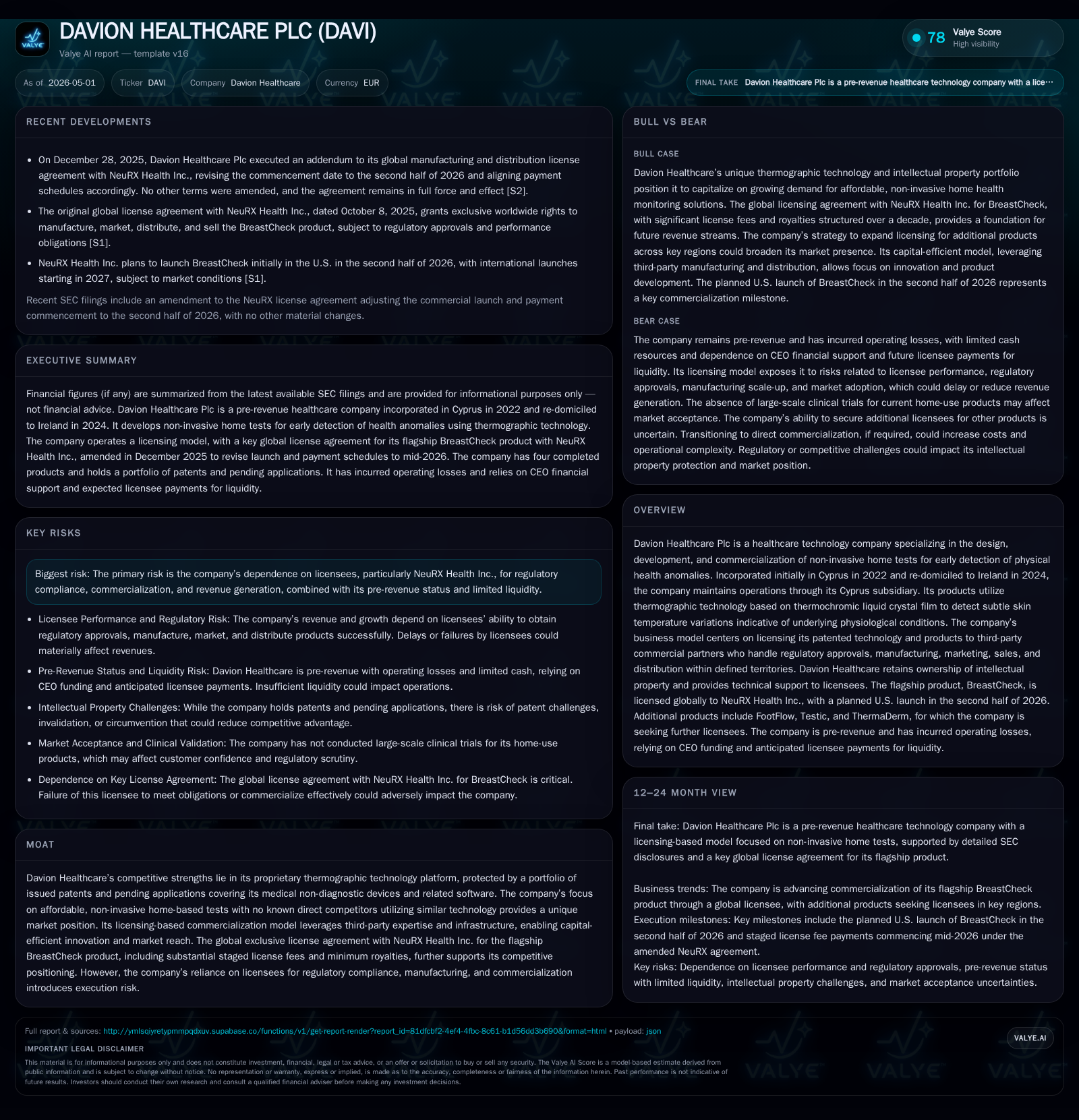
Davion Healthcare Plc’s latest operating update filed in early January 2026 centers on an administrative amendment to its existing Global Manufacturing and Distribution License Agreement with NeuRX Health Inc. The addendum pushes the commencement of scheduled license fee payments — initially anticipated for December 2025 — back to July 2026. This timing revision reflects a recalibration aligning payment inflows with the delayed commercial launch window for the BreastCheck product, now targeted for the second half of 2026 [S2].
No other terms of the agreement were altered, confirming that the structure remains intact including staged license fees totaling $120 million payable over ten years plus minimum guaranteed royalties of $10 million annually throughout the initial term. The deferred payment timeline resets near-term revenue expectations while preserving anticipated long-term contractual economics fundamentally tied to NeuRX’s commercialization efforts.
This shift signals a critical phase transition for Davion: moving the company off its extended R&D trajectory toward early commercialization and revenue generation. It underscores how the company’s cash flow realization is tightly coupled to NeuRX managing regulatory approvals, manufacturing scale-up, distribution networks, and market acceptance milestones within agreed territories.
Business Model Centered on Intellectual Property and Licensing
Davion Healthcare has constructed its business architecture around owning a proprietary portfolio of patented non-invasive home test technologies and selectively monetizing these innovations through exclusive or regional licensing agreements. The company holds intellectual property rights firmly while delegating regulatory compliance, manufacturing, marketing, warranty administration, and end-customer engagement downstream to licensees.
This asset-light licensing model enables Davion to remain capital efficient — reinvesting primarily in product development and intellectual property protection rather than burdening itself with labor-intensive manufacturing or distribution costs. However, such dependence inherently concentrates commercial execution risk externally.
Following its re-domiciliation from Cyprus to Ireland in late 2024 to better access EU markets and streamline corporate structure, Davion maintains operations through its Cyprus subsidiary while focusing international licensing strategy centrally from Ireland [S1][S10].
The financial inflows are predominantly tied to upfront license fees paid by partners like NeuRX upon contract milestones plus royalty streams dependent on product sales volumes within licensed territories. The company actively monitors licensee performance and retains rights to reassume direct commercialization duties if a partner fails regulatory responsibilities or market delivery targets—moving in-house would substantially increase costs but might unlock higher margin potential [S1][S12].
Proprietary Thermographic Technology and Product Portfolio Overview
Davion's core technological innovation lies in a distinct thermographic platform utilizing thermochromic liquid crystal film applied directly on skin surfaces which visibly changes color reflecting variations in cutaneous temperature. These subtle thermal patterns can be indicative of physiological anomalies such as abnormal tissue growth or impaired blood flow.
Complemented by sophisticated AI-powered image analysis apps directing smartphone cameras, Davion delivers standardized thermal mapping enabling consumers a safe, scalable way to monitor potential health issues at home without invasive procedures or specialized equipment [S1][S4].
Currently completed products include:
- BreastCheck: The flagship device aimed at early detection of breast anomalies.
- FootFlow: Designed to assess circulatory health in extremities by detecting temperature asymmetries related to vascular issues.
- Testic: For monitoring testicular abnormalities potentially linked to cancers or inflammation.
- ThermaDerm: Focused on skin health detection including lesions or infections.
These devices are classified as Class I medical devices requiring registration rather than extensive FDA premarket clearances—lowering some regulatory barriers but still demanding compliance with stringent quality standards [S13]. This unique product suite offers preventive screening possibilities absent direct competition employing similar liquid crystal technology methods [S1].
Competitive Positioning and Industry Dynamics
Within the broader healthcare diagnostics sector pivoting toward decentralized patient-centric solutions, Davion stakes out a specialized niche targeting affordable non-invasive home screening leveraging patented thermochromic sensing integrated with AI-driven diagnostic support tools.
Unlike conventional imaging modalities requiring clinical environments—such as mammography or Doppler ultrasound—Davion’s products offer consumer-friendly early warning options potentially capable of prompting timely clinical follow-ups reducing late-stage disease burdens.
The lack of direct competitors deploying like-technologies confers a distinctive technological moat protected by patents encompassing device hardware designs and associated machine learning software frameworks [S1][S13]. Nonetheless, indirect competition arises from alternative home testing kits involving biosensors or wearable trackers addressing overlapping markets.
Importantly, all commercialization relies on licensees navigating complex medical device regulations across multiple jurisdictions (U.S., Europe, U.K.). Consequently, regulatory approval processes impose gatekeeping dynamics shaping product launch cadence and geographic expansion speed [S13].
Pathways to Growth: Market Launch and Licensee Performance
Davion’s primary revenue driver will be NeuRX Health Inc.’s successful execution of its BreastCheck launch planned for the U.S. in H2-2026 followed by incremental international rollouts beginning in 2027 subject to market readiness. The global license specifies staged license fee payments amounting to $120 million over ten years plus minimum annual royalties designed to underpin predictable cash flows post-commercialization [S3][S24].
Additional products FootFlow, Testic, and ThermaDerm are poised for later licensing but remain unlicensed currently [S3]. These represent potential future avenues for top-line expansion either through new partnerships or internal commercial shifts if deemed strategically favorable.
Davion’s ability to translate its R&D efforts into commercial gains hinges heavily on NeuRX achieving regulatory authorizations and market penetration targets within prescribed timelines. Delays or underperformance could compress cash flow realization windows adversely impacting operational stability given current reliance on external funding sources including CEO advances during pre-revenue phases [S3][S8].
Furthermore, infrastructure investments such as an ongoing software development contract secured in late 2025 aims at building regulatory-compliant customer data portals integral for sustained product deployment over the decade-long partnership period [S3]. Successful completion is critical for compliance assurance and user experience consistency.
Risk Factors: Licensee Dependence and Execution Challenges
The company explicitly identifies significant risks emanating from its dependence on NeuRX for both regulatory navigation and revenue generation. Any material failure by NeuRX concerning payments or commercial delivery could materially impair Davion’s business model viability given limited internal operational scale at present [S13].
Moreover, as a pre-revenue entity through fiscal year-end 2025 with minimal cash reserves constrained liquidity requires continued CEO financial support—a factor recently reaffirmed during capital raise processes completed in early 2026 via convertible notes and term loans carrying attendant repayment obligations secured against intellectual property assets [S3][S5][S18][S19].
Additional risk layers relate to potential shifts necessitating Davion assuming direct commercialization roles if licensee performance falters—a maneuver that would steeply increase capital intensity altering cost structures away from lean licensing architecture [S1][S12]. Regulatory uncertainties persist despite Class I product categorization due to stringent quality system regulations enforced by agencies such as the FDA across differing geographies adding complexity to timely launches.
Key Upcoming Milestones and Performance Indicators
Strategic focus points looking forward center first on attaining full market clearance across core target regions—U.S., Europe, U.K.—where regulatory registrations remain principal gating steps before commercial availability is legally permissible [S13].
NeuRX’s planned product launch schedule beginning H2-2026 represents an inflection point marking Davion’s anticipated revenue start date aligned now with revised payment initiation set for July 2026 per latest license amendment [S2][S3]. Monitoring actual royalty payments beginning post-launch will serve as tangible demand markers alongside reported sales uptake metrics from licensees.
Concurrently progress towards completing mandated database software underpinning customer data management is essential for ongoing compliance enforcement throughout the license term supporting longevity of recurring revenues [S3]. Finally, watch for developments regarding additional licensing agreements potentially covering other products in Davion's pipeline or strategic pivots toward direct commercialization that could reshape future growth trajectories [S1][S4].
Disclaimer: This analysis is based solely on publicly available filings as detailed by SEC documents dated through April 30th, 2026 ([S1–25]) without insight into confidential data or forward-looking statements beyond disclosed information. No investment advice or price predictions are offered herein.
Disclaimer: This is research-only, informational analysis and not investment advice. It may include AI-generated interpretation and general industry context. Always verify important details using primary sources.

Comments