
Jowell Global Advances Supply Chain Efficiency with Shift to Affordable Supplements
Jowell Global's latest quarterly filing reveals a strategic pivot toward affordable health supplements that is reshaping product mix, operational efficiency, and margin dynamics.
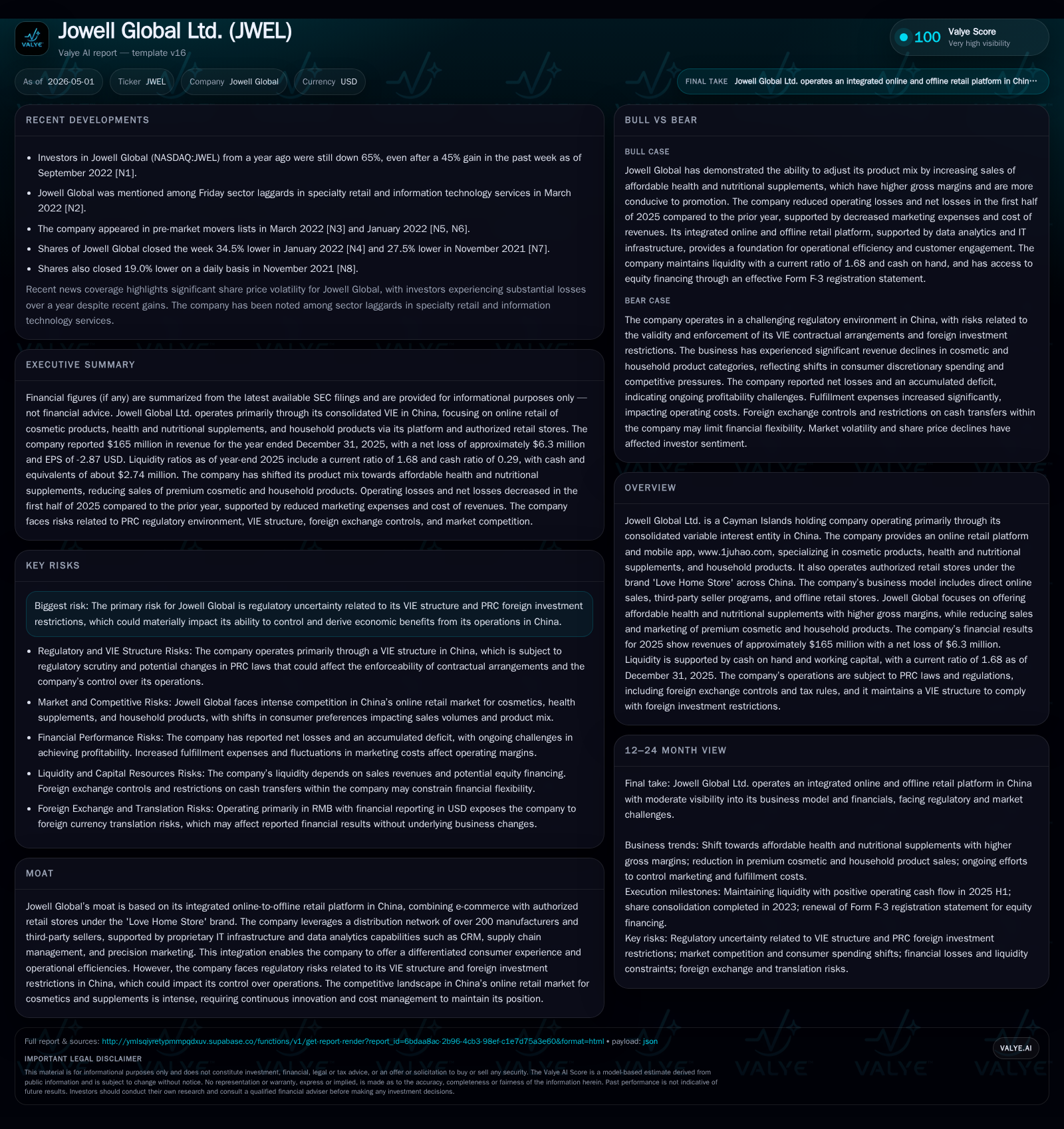
Jowell Global's H1 2025 results demonstrate a significant reorientation of its product portfolio, with health and nutritional supplements revenues surging by over 240%, offsetting steep declines in cosmetics and household product lines. This shift reflects deliberate management actions to align with changing consumer preferences toward low-cost, necessity products amid economic pressures in China. The company's integrated online-to-offline platform and improved supply chain efficiencies underpin this transition, though regulatory risks related to the VIE structure remain a material concern. Liquidity remains adequate for near-term operations supported by cash on hand and prudent cost management.
Latest Quarterly Operating Update Shaping Strategy
The first half of 2025 marked a pivotal juncture for Jowell Global as revealed in its December 30, 2025 Form 6-K filing [S2]. Total revenues declined by 11.1% year-over-year to $76.2 million, primarily reflecting pronounced downturns in cosmetic products (-36.4%) and household products (-91.3%) sales volumes. These shifts anchor on a strategic reallocation by management aiming to reduce sales efforts on low-margin premium cosmetic and household items burdened by high promotional costs.
Concurrently, health and nutritional supplements surged by over 245%, or approximately $42.2 million increase in revenue compared to H1 2024 [S2]. This dramatic rise stems from an expanded portfolio of affordable supplements coupled with aggressive promotional discounts targeting a consumer base increasingly oriented toward necessity goods amidst cautious discretionary spending.
Notably, weighted average unit prices plunged from $5.16 to $2.59 over the year-earlier comparable period (-49.9%), illustrating the volume-driven nature of sales growth rooted in low-price points preferred by customers during economic tightening [S2]. Reductions in unit costs—$2.47 to $1.7 for cosmetics and $8.11 to $1.13 for household goods—further underscore this mix shift away from premium brands toward cost-efficient alternatives favored by consumers facing inflationary pressures [S2].
Management’s deliberate strategy cut promotional outlays on cosmetics and household goods starting H2 2023, effectively reducing cash consumption from marketing activities while channeling resources into higher gross margin supplements more amenable to scaled promotion [S2]. Operating loss narrowed substantially during H1 2025 with net loss down to $1.3 million versus $3.8 million in the prior year quarter, aided largely by these cost discipline measures.
Business Model and Product Portfolio Dynamics
Jowell Global operates through an integrated online-to-offline (O2O) retail ecosystem centering on its flagship platform www.1juhao.com along with its mobile app and authorized physical outlets branded as 'Love Home Store' across China [S1]. The company’s core offering spans three primary categories: cosmetics, health & nutritional supplements, and household products.
The business model comprises direct online sales backed by proprietary e-commerce infrastructure supporting logistics coordination, supply chain management, CRM capabilities, and precision-targeted marketing analytics [S1]. It additionally offers third-party seller programs enabling partner brands to leverage Jowell’s digital storefronts, broadening product assortment while sharing transaction revenue.
Recent portfolio adjustments reflect heightened emphasis on health and nutritional supplements—products characterized by relatively higher gross margins compared to traditionally lower-margin cosmetics and household segments which historically demanded intensive promotional investments [S1][S2]. This pivot aligns profitability objectives with consumer purchasing patterns skewed toward value-focused wellness goods amid increasing economic conservatism.
Operationally, Jowell’s IT infrastructure underpins fulfillment efficiencies crossing both e-commerce channels and offline retail stores—a dual-channel strategy designed to reduce customer acquisition costs while enhancing retention via seamless omnichannel engagements [S1]. The supply chain network integrates over 200 manufacturers and third-party sellers ensuring breadth of inventory combined with agility in response to fluctuating demand signals.
Competitive Position and Market Structure in China’s Retail Sector
China’s online retail market segment catering to cosmetics and nutritional supplements is intensely competitive with numerous large platforms alongside niche players vying for share within a rapidly evolving consumer landscape [S1]. Amid stiff rivalry, Jowell seeks differentiation through its hybrid O2O presence leveraging data-driven precision marketing and supply chain synergies unattainable by pure-play digital competitors alone.
However, regulatory environments present material hurdles given Jowell's variable interest entity (VIE) structure required for foreign investment restriction circumvention in China [S1]. While current contractual frameworks afford operational control per PRC counsel opinion, uncertainties persist relative to future government interpretation which may impose restructuring or operational constraints potentially impacting consolidation ability or economic benefit capture.
Pricing power within premium segments appears eroding because of intensified sensitivity among consumers reducing discretionary expenditures on non-essential luxury goods; this dynamic propels demand toward necessity-oriented low-price offerings reinforcing Jowell’s strategic shift toward affordable supplements offering stronger margin profiles under mass market conditions.
Under such structural industry pressures, maintaining operational efficiency through advanced IT-enabled logistics plus continuous product innovation remain critical competitive parameters—areas where Jowell holds tangible edge supported by proprietary CRM platforms that optimize inventory turnover rates aligned with real-time data insights [S1].
Growth Drivers from Health and Nutritional Supplements Focus
The surge in affordable health supplement sales in H1 2025 lays foundation for incremental revenue growth backed by measurable KPIs such as volumes sold and pricing metrics showing stable profitability expansion despite unit price deflation [S2]. Promotional strategies centered around discounts have accelerated market penetration while reinforcing brand loyalty within price-sensitive demographics increasingly focused on wellness maintenance.
Additionally, the ongoing expansion of the third-party seller ecosystem diversifies product assortments accessible through Jowell’s platform without commensurate inventory risk—providing leverage effects on top-line expansion while containing fixed cost escalation within distribution channels [S1][S2]. This amplifies scalability potential particularly if complemented by continued enhancements in supply chain automation reducing weighted average unit costs further.
Investment in IT infrastructure improvement including CRM system upgrades supports precision marketing campaigns enhancing conversion rates thus magnifying returns on promotional spend—a key operational KPI informing ongoing resource prioritization decisions.
In sum, these dynamics collectively form the growth levers underpinning Jowell’s path forward: category mix optimization towards high-margin affordable health supplements coupled with scalable multi-channel distribution powered by data analytics entrenched supply chain processes.
Risks from Regulatory Environment and Consumer Spending Trends
The most salient risk remains regulatory uncertainty surrounding the VIE contractual arrangements enabling foreign control over Jowell's Chinese operations—a structural element vulnerable to PRC policy reinterpretation or enforcement variations exposing potential deconsolidation or other adverse outcomes if deemed non-compliant [S1]. Stakeholders must monitor developments around regulatory clarifications impacting foreign investment restrictions closely.
From a demand perspective, macroeconomic headwinds manifesting as cautious discretionary spending curtails volumes especially for premium cosmetic and household segments—product lines that historically delivered supplementary revenue but suffered steep declines recently as management scaled back efforts accordingly [S2][S1]. Such consumption pattern shifts necessitate ongoing portfolio realignments which while strategically sound impose execution risk if consumer preferences evolve unpredictably.
Furthermore, inflationary pressures elevate personnel expenses overhead overhead costs which may squeeze gross margins if pricing adjustments lag behind rising input costs; although not yet materially impactful historically at current scale levels management flags vigilance given possibility of sustained high inflation scenarios constraining resilience [S1].
Key Milestones and Next Steps for Investors
Going forward monitoring key metrics revolving around ongoing conversion uplift from supplement promotions constitutes near-term performance barometer providing clarity on sustainability of recent growth acceleration reported in H1 2025 filings [S2][S1]. Refinement of marketing initiatives aimed at further penetrating mid-tier consumer segments presents actionable milestone informing resource allocation efficacy.
Regulatory developments linked directly to interpretation of VIE structures represent critical uncertainty domain; any official communications or enforcement changes could materially alter operational viability—thus tracking updates from authoritative PRC bodies remains essential.
Operational efficiencies realized via enhanced supply chain capabilities including logistics automation milestones should be reported as indicators of underlying margin improvement potential reinforcing defensive positioning amidst pricing volatility challenges.
Additional markers such as expansion pace of third-party seller participation rate alongside product SKU roll-out cadence within supplements category will provide concrete visibility into scaling traction beyond legacy product sets.
Financial Snapshot Reflecting Liquidity and Capital Structure
Latest financial snapshot
| Metric | Value | Period |
|---|---|---|
| Cash & equivalents | $2.74mm | |
| 2025-12-31 | ||
| Total debt | $6,381 | |
| 2025-12-31 | ||
| Net debt | $-2.73mm | |
| 2025-12-31 | ||
| Current assets | $16.0mm | |
| 2025-12-31 | ||
| Current liabilities | $9.55mm | |
| 2025-12-31 | ||
| Current ratio | 1.68x | |
| 2025-12-31 |
Source: SEC companyfacts cache [F1].
Financially, as per the annual report filed April 30, 2026 gleaned from both SEC filing data sets and companyfacts repository ([F1], [S2]), Jowell ended FY2025 with revenues totaling approximately $165 million against a net loss of about $6.3 million attributable largely to transitional operating dynamics within its revamped portfolio mix.
Cash & equivalents stood at roughly $2.74 million at year-end complemented by minimal total debt of $6,381 indicating a very low leverage posture bolstering balance sheet flexibility.
Notwithstanding reported operating cash outflows during the full fiscal period contrasted against positive inflows earlier noted intra-year reflecting phased promotion expense timing differences—the overall liquidity outlook remains sufficient for next twelve months based upon existing plans supported by ongoing sales revenues [S2].
Collectively these financials underscore a cautiously managed capital structure facilitating continued execution on repositioned strategy while maintaining financial discipline requisite given prevailing sectoral uncertainties.
Disclaimer: This analysis does not constitute investment advice or recommendation but aims to provide an informed perspective grounded solely in available SEC disclosures and validated numeric data.
Disclaimer: This is research-only, informational analysis and not investment advice. It may include AI-generated interpretation and general industry context. Always verify important details using primary sources.

Comments