
Q/C Technologies Advances Photonic Computing Amid Strategic Shift
Recent SEC filings highlight Q/C Technologies’ pivot to laser-based blockchain and AI hardware underpinned by proprietary photonic technology.
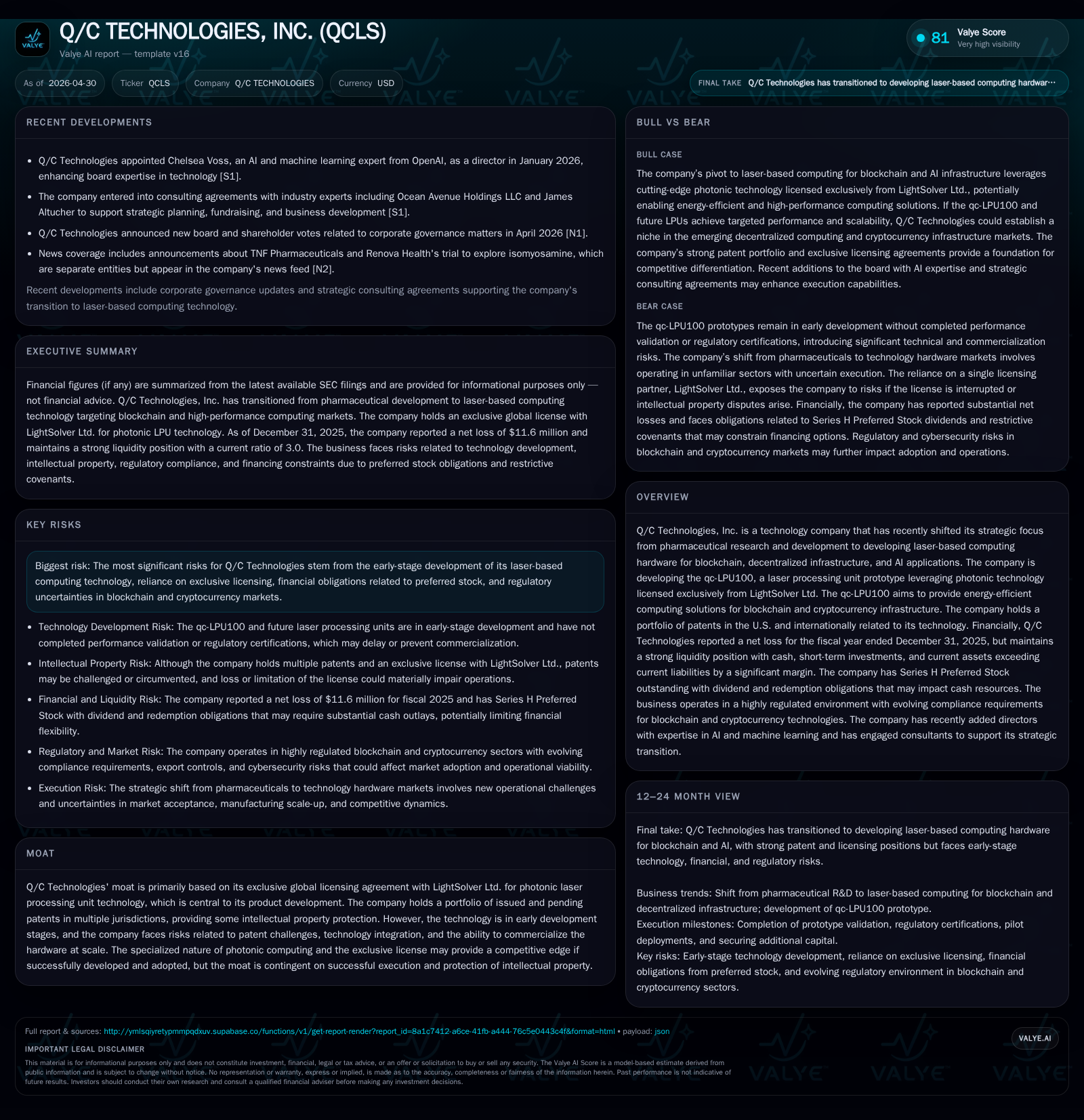
Q/C Technologies, Inc. has pivoted from pharmaceutical R&D to the development of energy-efficient photonic computing hardware targeting blockchain infrastructure and AI applications. The latest quarterly and event filings detail early-stage prototype progress and underscore reliance on an exclusive global license with LightSolver Ltd., supported by a broad patent portfolio. While the technology offers potential competitive advantage in an emerging market, execution risks and financial obligations linked to preferred stock remain key constraints.
Latest Operating Update Reflects Early-Stage Progress
The November 2025 quarterly report (Form 10-Q) captures Q/C Technologies’ ongoing transition toward laser-based computing hardware targeting blockchain infrastructure. The company continues developing the qc-LPU100 prototype—a photonic laser processing unit licensed exclusively from LightSolver Ltd.—which remains in early stages without completed performance validation or regulatory certification [S2]. R&D expenses dominate operating outlays as the company invests in prototype refinement over commercial sales. Notably, the March 2026 Form 8-K discloses the dismissal of the independent auditor Stephano Slack LLC amidst no unresolved accounting disagreements or reportable events during their tenure. This governance update suggests stable internal controls despite ongoing operational transformation [S3].
The absence of revenue progression aligns with the nascent state of product development. Together these filings establish a near-term narrative centered on technical proof-of-concept activities rather than commercialization.
Business Model and Proprietary Technology Overview
Q/C Technologies has repositioned itself from pharmaceutical research toward developing specialized computing hardware leveraging photonic technology to serve blockchain networks, decentralized infrastructure (DePin tokens), and artificial intelligence workloads [S1]. The cornerstone is an exclusive global license agreement with LightSolver Ltd., which grants access to unique laser processing unit (LPU) methodologies central to its product roadmap [S1].
The flagship qc-LPU100 aims to deliver markedly better energy efficiency compared to conventional electronic processors by harnessing optical signal processing—crucial for energy-intensive blockchain operations. The company’s business model thus combines product development of hardware units with potential future intellectual property licensing streams derived from its broad patent portfolio spanning multiple jurisdictions (19 issued U.S. patents plus about 70 foreign patents and pending applications expiring between 2036-2041) [S19].
This dual avenue reflects both direct sales motivation for LPUs and longer-term monetization through patent rights enforcement or sublicensing.
Competitive Position Within Emerging Photonic Computing
Photonic computing represents a frontier segment within semiconductor alternatives aimed at solving power and speed bottlenecks inherent in traditional silicon architectures. Q/C Technologies’ moat primarily derives from its exclusive global license agreement with LightSolver Ltd., providing access to proprietary designs that competitors cannot easily duplicate without infringing highly specific laser-based photonics patents.
Currently, the competitive landscape is sparse as photonic processing units are mostly experimental or conceptual outside large research labs. However, significant execution risks exist in integrating LightSolver’s methods into commercially viable hardware platforms at scale.
If successfully commercialized, Q/C Technologies could address energy consumption pressures faced by blockchain validators and AI data centers—a growing pain point given rising regulatory scrutiny over cryptocurrency mining energy usage. Strong switching costs might develop if the qc-LPU100 achieves superior throughput per watt metrics relative to incumbent GPU/ASIC offerings.
Growth Drivers: Technology Development, Blockchain Adoption, and IP Licensing
Key growth levers for Q/C Technologies hinge on advancing qc-LPU100 prototypes into validated demonstrators capable of attracting blockchain miners, DePin ecosystem participants, or AI compute entities aiming to reduce operational costs through improved photonics efficiency. Milestone deliveries such as performance benchmarks, scalability proofs, or regulatory clearances will be principal KPIs.
Further revenue expansion may arise from licensing new patents or enhancements of existing technology under LightSolver collaboration agreements. These licensing revenues would scale with adoption but remain highly contingent on patent enforceability and market acceptance.
Broad industry trends favor decentralized blockchain networks seeking sustainability solutions amid increasing energy regulation—providing structural tailwinds rather than cyclicality for Q/C’s offering [S1, S2]. Demand growth is tied closely to broader acceptance of novel computing paradigms beyond electron-based semiconductors.
Key Risks: Development Uncertainty, Licensing Dependence, and Regulatory Factors
The ambition to pioneer laser-based computing for blockchain faces substantial hurdles including the immature state of prototype platforms lacking proven speed or scalability [S2]. Delays or underperformance in delivering expected performance targets materially impair commercial prospects.
Dependence on the exclusive LightSolver Ltd. license constitutes a single point of failure—any restrictions on this agreement's continuation or disputes over intellectual property rights could halt product development or commercialization entirely [S2]. Enforcement of patents across diverse jurisdictions remains uncertain given challenges in international patent law and potential design-arounds.
Regulatory uncertainties affecting blockchain infrastructure adoption—such as tightening energy consumption policies or crypto asset regulations—could limit addressable markets or impose compliance costs reducing demand for Q/C’s energy-saving LPUs [S21].
Upcoming Milestones and Execution Watchpoints
Critical near-term events include:
- Demonstration or beta testing phases showcasing qc-LPU100 prototype capabilities addressing speed and energy metrics required by target customers.
- Patent portfolio developments including new filings/extensions or oppositions challenging current protections.
- Corporate governance signals following auditor transition reflecting internal control robustness or strategic clarity after the March 2026 dismissal of Stephano Slack LLC [S3].
- Management disclosures within future SEC filings clarifying timelines for commercialization or technology validation progress.
- Capital raising activities linked to funding ongoing R&D amid restrictive covenants associated with Series H preferred financing agreements limiting dilution or securities issuance capabilities [S14].
Tracking these milestones will provide clearer evidence whether Q/C can convert technological promise into scalable market success.
Financial Snapshot: Liquidity and Capital Structure
Q/C Technologies maintains a solid liquidity position with cash and equivalents of approximately $987,000 and current assets totaling about $17 million against current liabilities near $6 million, resulting in a current ratio of roughly 3x as of December 31, 2025, indicating good short-term solvency [F1]. However, the most recent available total debt figure dates back to 2013 and may not reflect current leverage levels, so caution is warranted in assessing the company’s current debt profile [F1].
Ongoing net losses reflect substantial R&D investment prior to revenue generation. Investors should monitor cash flow commitments related to Series H Preferred Stock dividends, which may impact operational funding needs going forward.
*Note: Total debt figure corresponds to a best-effort dated back number from late 2013; absence of newer figures may indicate low additional borrowings but warrants caution regarding updated leverage analysis.[F1]
This report is prepared solely for informational purposes based on SEC filings and publicly available data as of April 2026. It does not constitute investment advice or recommendations. Readers should conduct independent analysis before forming opinions on the company’s prospects.
Disclaimer: This is research-only, informational analysis and not investment advice. It may include AI-generated interpretation and general industry context. Always verify important details using primary sources.

Comments