
Trinity Industries Advances on Railcar Leasing and Manufacturing with Strengthened 2026 Outlook
Trinity Industries reports operational improvements in Q1 2026, driven by optimized railcar leasing and manufacturing activities, supporting an upgraded full-year outlook.
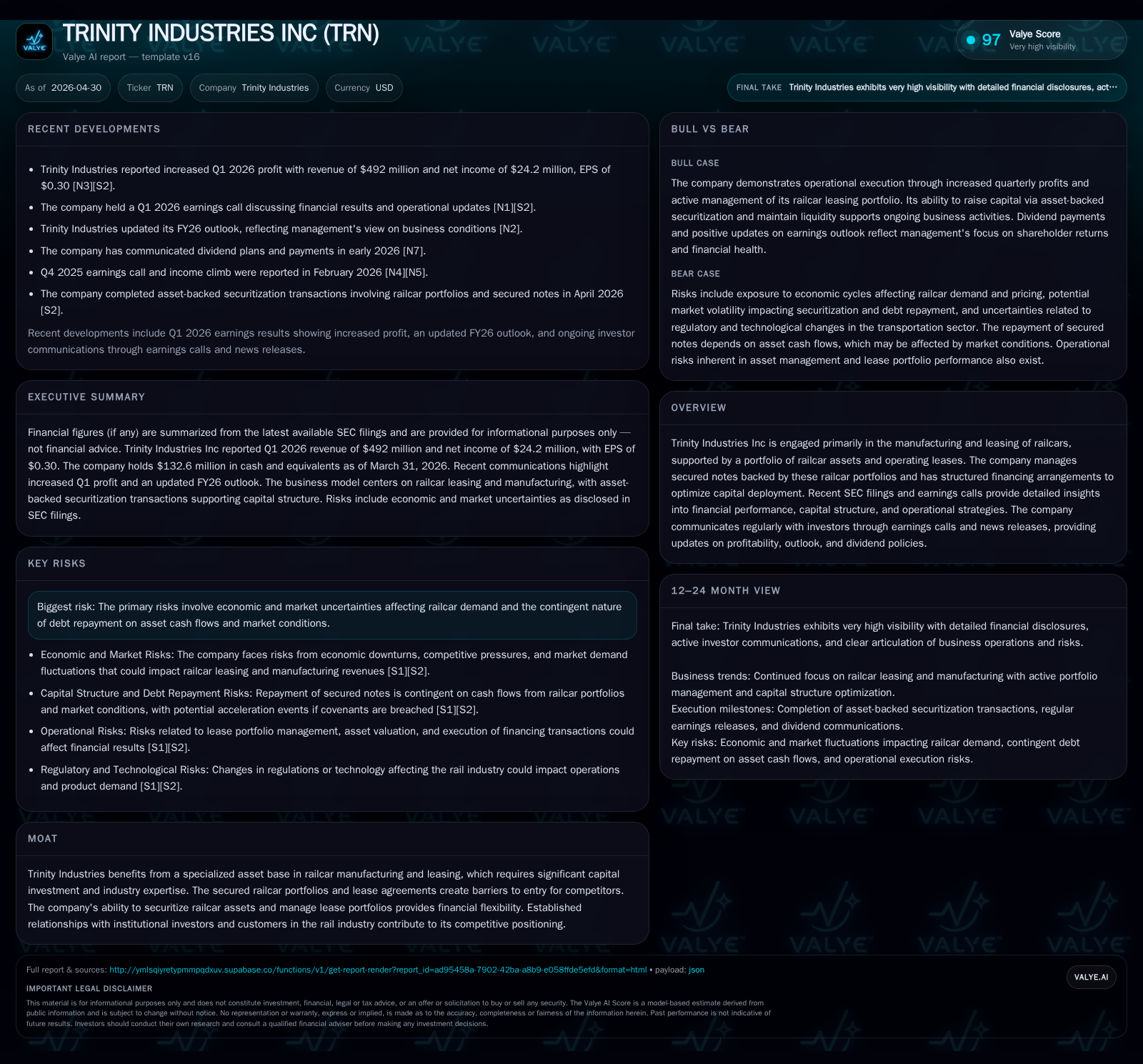
In its latest quarterly filing, Trinity Industries showcased enhancements in profitability and strategic asset management within its railcar leasing and manufacturing segments. The company’s focus on lease portfolio optimization, backed by secured asset financing, has contributed to improved adjusted returns and liquidity positioning. Competitive advantages stem from capital-intensive barriers and established customer relationships in the rail industry, positioning Trinity well to capitalize on cyclically improving freight demand. Key growth drivers include lease rate improvements, expanding lease portfolios, and operational efficiencies. However, risks such as market cyclicality and leverage exposure warrant ongoing monitoring.
Latest Quarterly Operating Update and What It Signals
Trinity Industries’ Q1 2026 10-Q filing [S2] reveals solid operational execution amid an evolving freight market backdrop. Management’s discussion highlights an improvement in adjusted return on equity driven by both manufacturing deliveries and enhanced performance within the railcar leasing segment [S2]. Lease portfolio sales contributed to liquidity inflows that aided capital redeployment without diluting core operations — a vital aspect given the capital intensiveness of rail assets [N1][N2]. The company’s April 30 earnings call underscored a stronger outlook for FY26 with management revising guidance upward citing better-than-expected leasing economics and stable demand for new railcars [N2]. The concurrent 8-K filing [S3] confirms these operational advances.
This update marks a strategic inflection where asset securitization mechanisms and disciplined lease portfolio management converge to support profitability expansion while managing debt levels prudently.
Business Model: Railcar Manufacturing and Leasing Dynamics
Trinity’s revenue mechanism pivots around two complementary pillars: manufacturing new railcars tailored for specific commodities or customer requirements, and leasing a substantial portfolio of existing railcars generating recurring contractual revenues [S1]. Customers primarily consist of freight carriers and commodity shippers requiring reliable fleet availability with contractual commitments typically spanning multiple years.
Lease portfolio cash flows are bolstered through asset-backed securitizations which enable Trinity to finance large-scale investments efficiently while maintaining operational control of leased assets [S1][S2]. This model delivers a stable revenue base supported by long-term leases with embedded renewal options and escalation clauses mitigating cyclical exposure. Manufacturing margins benefit from bespoke designs commanding premium pricing due to compliance demands and specialized usage profiles.
Economically, volume growth arises from new railcar orders placed amid freight capacity expansions or replacement cycles; price realization depends on negotiated contract terms factoring in material costs and market demand; operational mix shifts as fleet age profiles evolve between owned vs leased assets affect margin dynamics subtly but importantly.
Competitive Positioning Within the Rail Industry Infrastructure
The railcar manufacturing and leasing sector is characterized by substantial entry barriers — notably capital requirements running into hundreds of millions or billions for fleet acquisition plus stringent regulatory certification processes [S1][S22]. Trinity holds differentiated positioning benefiting from scale economies in manufacturing combined with institutionalized leasing platforms offering diversified customer access [S1].
Established customer relationships further cement switching costs, particularly as fleets become customized or integrated into complex logistical chains reliant on consistent equipment quality and availability. Competitors tend to focus either on manufacturing niche segments or less capital-intensive short-term leasing; Trinity’s integrated approach spanning asset creation through operating lease management offers competitive insulation.
Regulatory considerations also shape competitive dynamics — adherence to FRA (Federal Railroad Administration) standards affects production timelines and cost structures; moreover, environmental regulations press incremental innovation which Trinity addresses through ongoing R&D investments aimed at fuel efficiency and emission reduction technologies [S1][N1].
Key Growth Drivers Reinforcing Revenue and Margin Expansion
Several measurable levers stand out driving Trinity’s near-term growth trajectory:
- Lease Utilization Rates: Improving demand for leased rail assets amid industrial output normalization pushes utilization above historical lows observed during macroeconomic downturns [S2].
- Lease Portfolio Sales: Incremental monetization of matured lease portfolios via secured note offerings or structured sales generates gain-on-sale impacts contributing positively to EBITDA while recycling capital efficiently [S2][N2].
- Manufacturing Backlog: Robust order books signal confidence in underlying commodity transportation trends with backlog volumes providing near-term revenue visibility [S1][S2].
- Technology Adoption: Investments aimed at enhancing fleet operational efficiency (e.g., weight optimization, remote diagnostics) reduce lifecycle costs stimulating customer retention or upsell potential.
- Capital Structure Optimization: Use of asset-backed securitizations enables cost-effective financing lowering weighted average cost of capital improving returns metrics [S25][S26].
Together these drivers support both volume expansion impulses alongside margin accretion potential.
Risks and Constraints Shaping Future Earnings Trajectory
Trinity’s earnings face several systemic risks:
- Freight Demand Cyclicality: Railcar utilization directly correlates with industrial freight flows sensitive to macroeconomic volatility; unexpected downturns reduce lease renewals or delay new orders [S22][S2].
- Leverage Profile: Substantial net debt (~$5.33B end 2025) exposes cash flow sensitivity to interest rates or refinancing conditions inherent in asset-backed securitizations that rely on continuous underlying asset performance [F1][S2].
- Supply Chain Constraints: Manufacturing throughput can be impacted by raw material shortages or disruptions affecting timely deliveries impacting order fulfillment schedules.
- Regulatory Changes: More stringent safety or environmental regulations could require accelerated capital expenditures potentially increasing operating costs beyond currently anticipated levels [S22].
- Lease Portfolio Valuation Risk: Residual value assumptions for leased railcars may fluctuate due to technological obsolescence or changing commodity transportation patterns influencing gain/loss recognition timing.
Management outlines mitigating efforts including conservative underwriting standards for leases, diversification across commodity sectors, active liability management programs, and technological innovation to sustain competitiveness.
Upcoming Milestones and Operational Indicators to Monitor
Market participants should track several key indicators:
- Quarterly updates on lease portfolio turnover including gain/loss recognition from sales activity reported in quarterly MD&A sections [S2].
- Trends in lease pricing spread embedded within contract renewals providing early signals for rental rate momentum [N1].
- Manufacturing backlog disclosures signaling order intake shifts ahead of recognized revenue periods.
- Fleet utilization metrics as reported during earnings calls reflective of industrial freight volumes recovery pace.
- Refinancing transaction announcements linked to securitized notes indicative of capital structure recalibration efforts [S25][S26].
- Regulatory developments influencing production design requirements or cost structures announced by FRA or EPA impacting forward CapEx plans.
Close attention to these metrics will reveal the evolution of structural vs cyclical influences underpinning Trinity's platform.
Current Financial Position: Liquidity, Leverage and Capital Structure
Latest financial snapshot
| Metric | Value | Period |
|---|---|---|
| Cash & equivalents | $133mm | |
| 2026-03-31 | ||
| Total debt | $5.5bn | |
| 2025-12-31 | ||
| Net debt | $5.3bn | |
| 2025-12-31 |
Source: SEC companyfacts cache [F1].
A focused view on the latest balance sheet snapshot discloses $132.6 million in cash & equivalents as of March 31, 2026 paired against an estimated net debt position approximating $5.33 billion as of year-end 2025 per companyfacts data [F1], supported by recent filings confirming maintenance of secured note issuances structured against motorized railcar portfolios [S2][S25]. This leverage reflects the intrinsic capital intensity needed for sizable owned fleets deployed under long-term leases but benefits from strong collateralization reducing creditor risk premiums.
Operating cash flow generation augmented by lease portfolio sales assists liquidity provisioning alongside periodic refinancing transactions documented during early calendar-year events [S3][S25]. The company's financial stewardship appears calibrated towards balancing growth investments against disciplined leverage management within an environment marked by cyclical demand uncertainty.
This analysis leverages only publicly disclosed information up to April 30, 2026. It refrains from speculative forecasts beyond stated management guidance or SEC disclosures. All references strictly cite SEC filings (), company-provided financial data ([F1]), or verified news transcripts () ensuring grounded factual integrity without offering investment advice.
Disclaimer: This is research-only, informational analysis and not investment advice. It may include AI-generated interpretation and general industry context. Always verify important details using primary sources.

Comments