
Choice Hotels Balances Franchise Expansion and Owned Asset Strategy in Q1 2026
Q1 2026 results reflect steady franchising growth amid ongoing investment in owned hotels to fuel brand development.
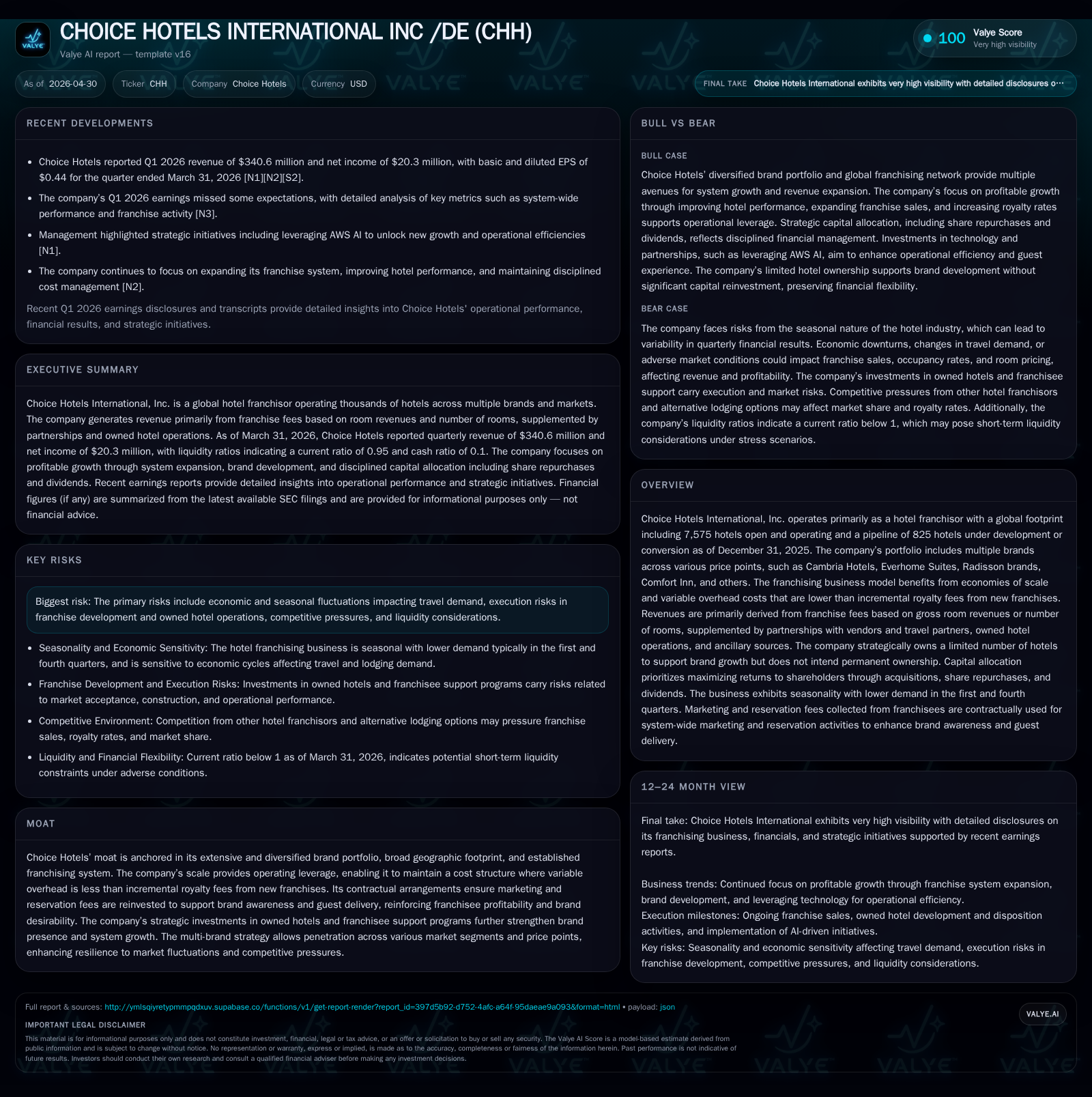
Choice Hotels International’s latest quarterly filing reveals continued expansion in franchise fees alongside stable owned hotel operations. The company maintains a multi-brand, franchising-focused business model with selective ownership of properties to support strategic brand growth, especially for Cambria Hotels and Everhome Suites. The competitive advantage hinges on scale, diversified brand portfolio, and franchising system efficiencies. Going forward, growth drivers include new franchise development supported by investment programs and ownership incentives, while risks entail travel demand cyclicality and execution in owned assets. Financially, the balance sheet shows modest liquidity with a leveraged but manageable debt profile, supporting ongoing capital allocation toward franchise incentives and share repurchases.
Recent Operating Update
Choice Hotels International's first quarter ended March 31, 2026, disclosed in the April 30, 2026 10-Q filing [S2], reinforces its position as a predominantly franchising-focused operator with incremental owned-hotel involvement designed to underpin brand development. The company reported consistent growth in its core franchise fees segment complemented by an increase in partnership services revenues. No material changes to risk factors were noted since the prior year-end [S2]. A concurrent event filing (8-K) reiterated these updates without additional major operational announcements [S3].
The firm’s consolidated financials reveal that although cash balances are modest at approximately $43.9 million as of Q1-end [F1], total debt stands near $1.9 billion (net debt around $1.86 billion), reflecting ongoing use of leverage to support capital-intensive franchise development strategies [F1]. Current assets are slightly below current liabilities with a current ratio of approximately 0.95 as of March 31, 2026 [F1].
Business Model
Choice Hotels primarily operates as a hotel franchisor with an extensive network spanning over 7,500 active hotels globally and a robust pipeline exceeding 800 developments or conversions as of December 31, 2025 [S1]. Its diversified multi-brand portfolio — including Cambria Hotels, Everhome Suites, Radisson-affiliated properties, Comfort Inn, among others — supports penetration across different market segments.
The core revenue streams stem from royalty-based franchise fees derived as percentages of gross room revenues or fixed per-room charges under long-term contracts with franchisees. This fee structure generates scalable income tied directly to room nights sold by affiliated hotels without substantial incremental operating expenses for Choice. Complementary revenues include partnership services from vendor alliances and ancillary income from managed or owned properties [S1].
Strategic minority ownership of select hotel properties—mainly Cambria Hotels and Everhome Suites—operates both to boost brand visibility and accelerate adoption where direct franchising might progress slowly otherwise [S1]. These holdings are typically temporary investments intended for resale to franchisees under long-term agreements after proving successful market traction for the brand.
Cost management is emphasized via outsourcing hotel operations on owned assets to third-party management firms rather than direct employment (except for four properties), allowing Choice to control capital deployment while leveraging external operating expertise [S1]. A portion of the company’s capital is also allocated to incentivize franchise development through investments such as guaranty supports and franchise acquisition costs that help lower entry barriers for potential franchisees [S20].
Industry Structure and Competitive Position
Choice Hotels occupies a unique niche within the lodging industry largely characterized by three broad segments: pure franchisors (like Choice), asset-light operators focusing on management contracts, and fully owned hotel chains.
By leaning heavily on franchising—coupled with selective asset ownership—Choice minimizes fixed operational costs compared with asset-heavy models while maintaining sufficient control over brand standards via contractual obligations tied to marketing fee reinvestments and reservation system operations [S1]. This distinctive strategy leverages economies of scale where variable overhead grows more slowly than royalty fees from new franchises do.
Its broad geographic diversification paired with a multi-brand approach hedges against region-specific economic cycles or segment saturation risks while appealing to a wide range of consumer demographics across price points. Portfolio brands like Cambria cater to upper-midscale customers seeking boutique experiences whereas Comfort Inn targets value-conscious travelers, diversifying demand sources.
The company’s contractual requirement that marketing fees collected must be reinvested into national advertising preserves brand prominence — reinforcing franchisee profitability and reducing susceptibility to competitor poaching [S1]. Furthermore, technologically integrated central reservations systems enhance guest convenience enhancing overall brand equity.
Growth Drivers
Franchise expansion remains the primary engine for revenue growth. New franchise awards depend heavily on market acceptance of Choice’s brands supported by strategic investments including direct ownership in greenfield projects or conversions under the Cambria Hotels and Everhome Suites banners. These owned hotels act as brand showcases accelerating credibility among potential franchisees [S1][S20].
Additionally, deployment of guaranty support programs backed by the board approval (up to $1.2 billion cap) indicates aggressive incentivization of franchise deals especially in strategically important markets [S20]. These incentives help overcome local financing hurdles faced by developers thereby expediting supply additions aligned with demand forecasts.
Revenue per available room (RevPAR) dynamics indirectly influence royalty fee income yet are mediated through the franchisees’ pricing capability tied into broader economic conditions affecting travel frequency [S22]. Moderate inflation typically correlates with increases in room rates benefitting Choice via proportional royalty uplift; however, macroeconomic turbulence could dampen discretionary travel spending temporarily [S1][S22].
Choice’s growing partnerships with vendors and travel services offer incremental income opportunities beyond traditional royalties lending further resilience amid industry shifts towards digital platforms.
Risks / Watchpoints / Growth Constraints
Economic cyclicality poses inherent risk given hospitality’s sensitivity to consumer discretionary budgets impacting occupancy rates which directly affect royalty revenues. Seasonal fluctuations amplify this effect necessitating effective cost control during lower demand periods [S1][S2].
Execution risk exists around owned hotel operations where maintaining profitable margins depends on third-party managers meeting performance targets without direct employment oversight by Choice—a tradeoff aimed at capital efficiency but less operational control [S1]. Delays or cost overruns in new hotel developments may affect expected returns from these strategic investments.
Competitive pressures persist not only from traditional hotel chains like Marriott or Hilton but increasingly from alternative accommodation platforms such as Airbnb altering guest expectations around service models.
Liquidity management remains important given current assets slightly trailing current liabilities implying stricter working capital discipline is necessary in near term [F1].
Regulatory considerations including cybersecurity risks are proactively managed by dedicated teams chaired by experienced CISOs ensuring that emerging threats do not materially disrupt operations or data safety impacting customer trust [S1].
What To Watch Next
Key milestones include measuring unit growth rates among key brands especially newly promoted ones like Cambria; backlog changes indicating pipeline health; renewal rates of existing franchises reflecting long-term system stability; trends in royalty margin expansion tied to RevPAR gains; updates regarding the pace and success of investment-backed development initiatives; details about refinancing activities or debt reduction efforts providing financial flexibility signals; monitoring dividend declarations or share repurchase activity signaling confidence; macroeconomic indicators that could alter travel patterns; any shifts in marketing spend efficiency influencing competitive positioning.
Formal guidance updates would be explicitly referenced if issued but as yet no fresh forecast adjustments appear outside routine disclosures [S2][N2][N3].
Financial Profile Summary
Latest financial snapshot
| Metric | Value | Period |
|---|---|---|
| Cash & equivalents | $44mm | |
| 2026-03-31 | ||
| Total debt | $1906mm | |
| 2025-12-31 | ||
| Net debt | $1862mm | |
| 2025-12-31 | ||
| Current assets | $411mm | |
| 2026-03-31 | ||
| Current liabilities | $434mm | |
| 2026-03-31 | ||
| Current ratio | 0.95x | |
| 2026-03-31 |
Source: SEC companyfacts cache [F1].
FY 2025 |
Choice maintains disciplined capital allocation favoring recycling of investments within target horizons (~five years), balancing shareholder returns through dividends ($53.5M paid in 2025) plus active share repurchases under authorized programs totaling over $125 million spent during last year [F1][S10][S13][S20]. Debt maturities extend comfortably into late decade supported by solid credit ratings allowing relatively low interest cost under revolver agreements extended through mid-2029 plus unsecured notes maturing between 2029–2034 providing liquidity stability [S4][S5][S6][S8][S12][S14].
This analysis is based purely on publicly available SEC filings and verified financial data up to Q1 2026 with no predictive commentary or investment advice intended.
Disclaimer: This is research-only, informational analysis and not investment advice. It may include AI-generated interpretation and general industry context. Always verify important details using primary sources.

Comments