
Axalta Coating Systems Faces Profit Pressure While Pursuing AkzoNobel Merger
Q1 2026 earnings show revenue resilience but margin and profit declines amid ongoing merger integration risks.
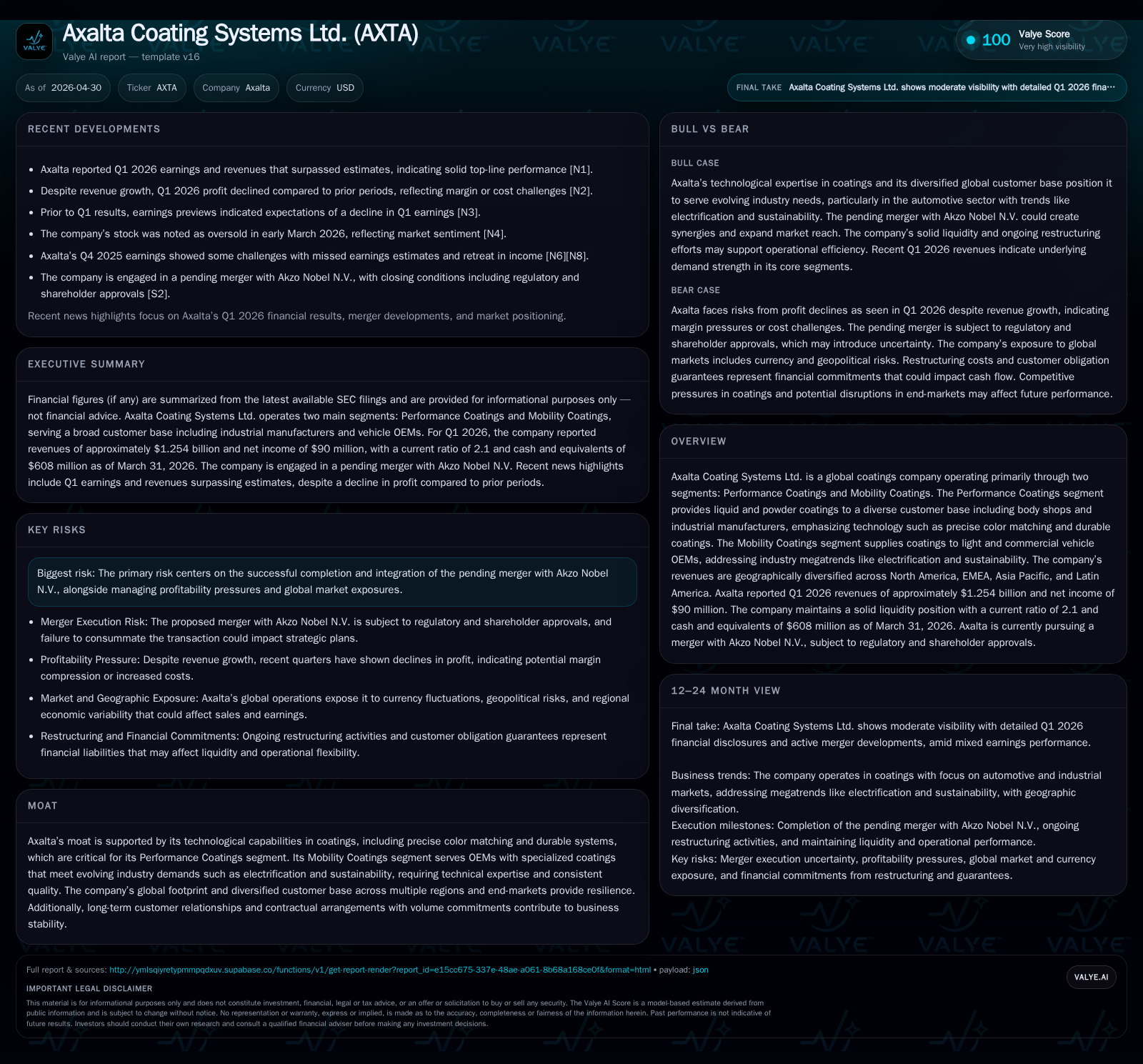
Axalta Coating Systems reported Q1 2026 revenues of approximately $1.254 billion, beating consensus expectations. However, net income declined to $90 million, reflecting margin pressures in its core Performance and Mobility Coatings segments. The company is progressing toward a pending merger with AkzoNobel expected by late 2026 or early 2027, which poses integration and regulatory execution risks. Axalta’s business model centers on technologically advanced coatings for automotive OEMs and industrial clients, sustained by strong global customer relationships. Growth depends on vehicle production trends, sustainability-driven innovation, and merger synergies, while leverage and profitability challenges remain near-term concerns.
Recent Operating Update
Axalta Coating Systems Ltd. reported first-quarter 2026 results that underscore both resilience in sales traction and ongoing profit challenges amid a complex operating environment. Revenue reached approximately $1.254 billion for the quarter ended March 31, 2026, surpassing estimates by a modest margin due to steady demand in the key Mobility Coatings segment alongside stable Performance Coatings volumes [S2][N2]. However, net income declined notably to $90 million from prior year levels as the company faced margin contraction driven by elevated raw material prices and competitive pricing pressures [S2][N1]. This decline in profitability signals continuing pressures despite revenue growth.
Importantly, management disclosed progress toward a definitive all-stock merger agreement with Akzo Nobel N.V., targeting completion in late 2026 or early 2027 pending regulatory approvals and shareholder votes [S11]. The merger represents a significant strategic inflection point that could reshape the combined coatings industry positioning but also introduces near-term execution risk. The deal’s "change of control" provisions have prompted discussions of refinancing Axalta’s existing term loans ahead of closing to optimize capital structure [S4].
Business Model Overview
Axalta operates primarily through two segments: Performance Coatings and Mobility Coatings. The Performance Coatings segment supplies liquid and powder coatings to body shops, industrial manufacturers, automotive refinishers, and other customers requiring precision color matching technology coupled with durable coating systems. This segment’s strength lies in its proprietary color matching technologies that reduce repaint cycles and material waste for customers.
The Mobility Coatings segment focuses on light vehicle OEMs as well as commercial vehicle manufacturers. Here the product offering aligns closely with megatrends such as automobile electrification and sustainability mandates, requiring cutting-edge coatings that provide corrosion resistance, durability under electric drivetrain heat profiles, and environmentally compliant formulations. This segment benefits from long-term contractual relationships driven by stringent OEM specifications and product lifecycle demands.
Revenue derives largely from direct sales to industrial customers who pay for coatings volumes typically under contractual commitments or recurring purchase agreements. Pricing dynamics are influenced by raw material cost fluctuations (notably pigments and resins), competitive forces within automotive supply chains, and regulatory compliance costs related to volatile organic compounds (VOC) emissions standards. Volume growth is primarily linked to end-market production trends—particularly global light vehicle build rates—and operational mix shifts favoring higher-value sustainable coatings.
Margins benefit from technological differentiation but face cyclical pressures tied to automotive production cycles as well as raw material inflation episodes. Operational efficiency improvements help offset cost headwinds but remain a focus area given stiff pricing competition.
Industry Structure and Competitive Position
The global coatings industry comprises several large players competing across multiple segments: automotive OEM coatings, refinish coatings, architectural paints, and industrial coatings. Axalta is positioned strongly within automotive-related coatings through a technology-enabled product suite focused on precision color matching and formulation tailored for EVs and commercial vehicles.
The company’s moat rests on its technical expertise in coating chemistries that deliver durability while meeting evolving environmental regulations across regions such as North America, EMEA, Asia Pacific, and Latin America—all markets where Axalta holds diversified revenue streams [S8]. Strong customer relationships anchored in long-term contracts with major OEMs underpin business stability despite cyclicality inherent in automotive production.
Competition arises from multinational chemical companies including PPG Industries and Sherwin-Williams (via Valspar), each possessing broad portfolios but often lacking Axalta’s specialized mobility coatings technology footprint. Emerging sustainability trends elevate the importance of innovation cycles—companies able to anticipate regulatory shifts toward low-VOC or powder-based coatings will capture outsized growth.
Growth Drivers
Several vectors fuel Axalta's growth outlook:
- Automotive Production Recovery: Global light vehicle production continues recovering from pandemic-related disruptions with increased electrification penetration whose unique coating needs align well with Axalta's product toolkit [N1][S1].
- Sustainability Innovation: Rising OEM demand for environmentally friendly coatings formulas (powder coatings, waterborne technologies) offers incremental volume upside backed by regulatory drivers globally.
- Merger Synergies: The pending combination with Akzo Nobel introduces potential cross-selling opportunities, platform expansion across complementary geographic footprints, product innovation acceleration via combined R&D capabilities, and cost rationalization benefits leading to margin improvement post-integration.
- Industrial End Markets: Performance Coatings’ penetration into non-automotive industrial sectors provides structural diversification beyond cyclicality tied exclusively to autos.
Milestones to watch include clearance of antitrust reviews on the merger by regulators (expected late 2026), progress updates on integration planning disclosed by management through earnings commentary, backlog growth rates for key OEM customers especially around EV programs, price realizations vis-à-vis raw material inflation pass-through success rate, and any adjustments in capital expenditures supporting new plant capacity or technology capabilities.
Risks / Watchpoints / Growth Constraints
Risks predominantly orbit around:
- Merger Execution: Integration complexity spanning systems harmonization, culture alignment between diverse corporate headquarters (Amsterdam/Philadelphia), retention of critical talent pools including R&D personnel directly affecting innovation trajectories [S11].
- Profitability Pressures: Persistent raw materials volatility coupled with competitive pricing can compress margins if operational efficiencies fall short or pricing power erodes.
- Leverage Load: As of March 31, 2026 total borrowings stood at approximately $3.17 billion against cash reserves of $608 million yielding a net debt position near $2.56 billion; servicing this debt amid economic cyclicality remains a focal vigilance point until refined under new ownership structure [F1][S4].
- Market Cyclicality: Automotive sector sensitivity to macroeconomic downturns or geopolitical disruptions (trade conflicts or sanctions impacting supply chains) could depress volumes abruptly.
- Regulatory Compliance: Increasingly stringent environmental rules across jurisdictions may necessitate unforeseen R&D spending or adaptation costs.
What To Watch Next
Key upcoming indicators informing Axalta's trajectory include:
- Final regulatory approval status for the Akzo Nobel merger expected during late 2026 quarter disclosures.
- Quarterly backlog trends for Mobility Coatings reflecting automotive OEM order books related to EV launches.
- Earnings commentary regarding margin evolution driven by raw material cost pass-through effectiveness versus inflationary input pricing pressure.[N1]
- Refinancing developments related to term loan repayment ahead of merger close per credit facility covenants [S4].
- New product announcements highlighting proprietary sustainability-focused coating innovations aligned with regulatory tailwinds.
Financial Profile Snapshot
Latest financial snapshot
| Metric | Value | Period |
|---|---|---|
| Cash & equivalents | $608mm | |
| 2026-03-31 | ||
| Total debt | $3.2bn | |
| 2026-03-31 | ||
| Net debt | $2.6bn | |
| 2026-03-31 | ||
| Current assets | $2.8bn | |
| 2026-03-31 | ||
| Current liabilities | $1348mm | |
| 2026-03-31 | ||
| Current ratio | 2.1x | |
| 2026-03-31 |
Source: SEC companyfacts cache [F1].
As of March 31, 2026 (latest available) [F1][S2]:
The company maintains liquidity buffers adequate for near-term obligations though leverage remains elevated given acquisition financing needs pending merger consummation. Depreciation expense was consistent at $33 million quarterly reflecting stable asset base utilization [S2]. Interest expenses incorporate hedging instruments managing interest rate exposure under credit facilities maturing through 2031 [S4], relevant for refinancing timing considerations.
Disclaimer
This analysis is based solely on publicly available SEC filings dated through April 30, 2026, supplemented by reporting as noted in citations. It does not constitute investment advice or recommendations regarding any securities mentioned herein.
Disclaimer: This is research-only, informational analysis and not investment advice. It may include AI-generated interpretation and general industry context. Always verify important details using primary sources.

Comments