
Intercure Ltd.’s Strategic Response to Production Disruptions and Market Listing Risks
Intercure confronts pressing Nasdaq listing challenges while advancing facility recovery and strengthening global partnerships in medical cannabis.
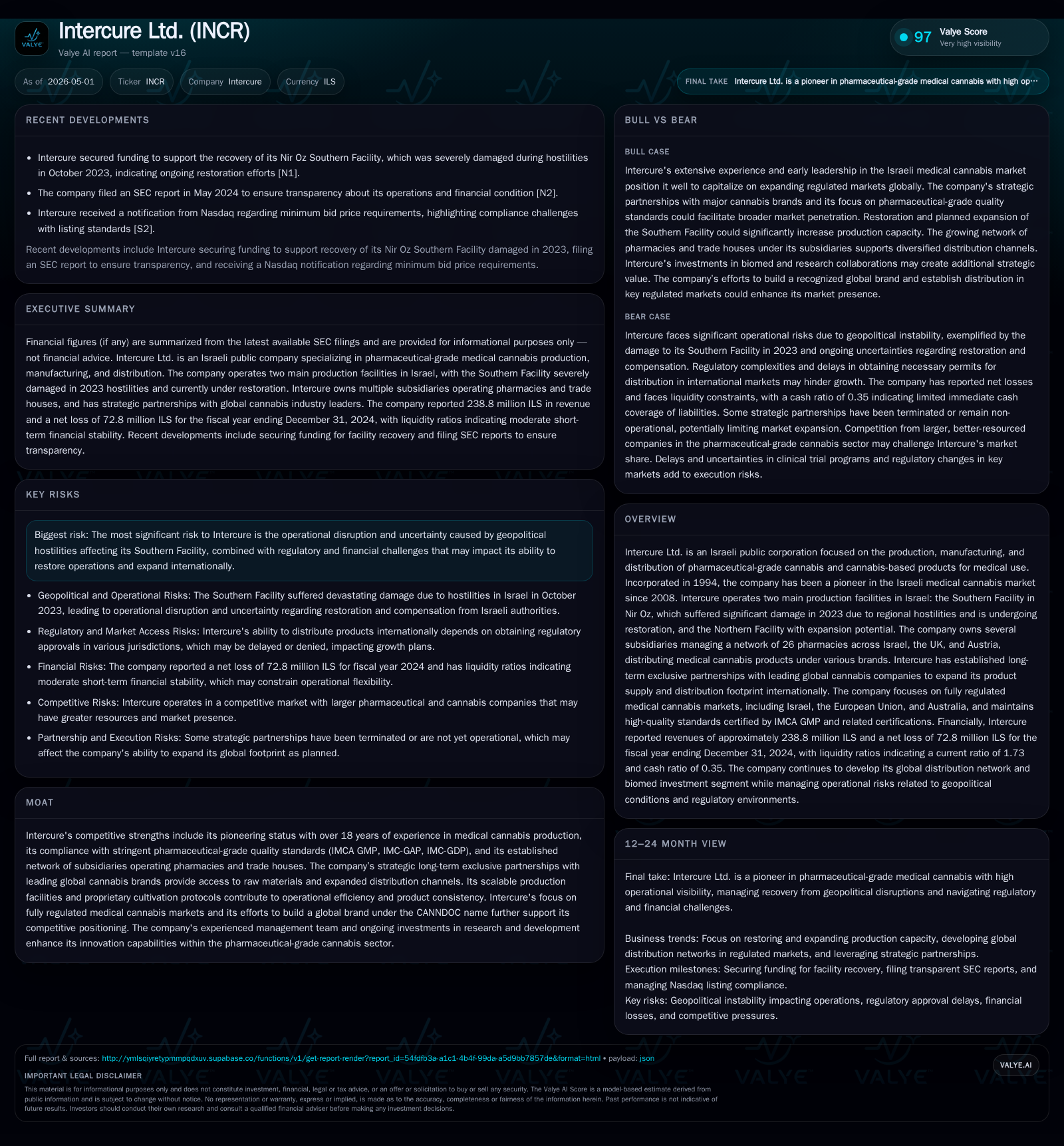
Intercure Ltd. faces a significant Nasdaq minimum bid price compliance warning threatening its listing status, jeopardizing share liquidity and investor confidence. Concurrently, the company is focused on restoring its Southern Facility damaged in 2023 hostilities, critical for scaling pharmaceutical-grade cannabis production capacity. Its vertically integrated business model, combining cultivation with distribution through a network of pharmacies across Israel and Europe, is supported by exclusive global partnerships and ongoing R&D investments. Growth hinges on regulatory approvals, successful facility restoration, and progressing strategic acquisitions. However, geopolitical uncertainties, evolving regulation, and market pressures present material risks to execution.
Nasdaq Compliance Warning: Immediate Market Implications
Intercure Ltd. disclosed on March 3, 2026 that Nasdaq issued a written notice regarding its failure to meet the minimum bid price requirement of $1.00 per share for continued listing under Rule 5550(a)(2) [S2]. The company has been granted a grace period until August 24, 2026 to regain compliance. Failure to do so could result in delisting from Nasdaq.
This poses immediate risks related to the liquidity of Intercure’s ordinary shares as brokers may limit trading activity and shareholders may find it more difficult to transact shares at prevailing prices. Delisting would likely materially impair market perception and institutional investor interest, constraining the company's ability to raise capital in public markets. The timing compounds pressure as Intercure simultaneously navigates operational recovery following its Southern Facility damage and pursues strategic growth initiatives.
Effectively navigating this deadline is critical not only for preserving shareholder value but also for maintaining financial flexibility to fund facility repairs and expansion activities.
Operational Update: Facility Damage Recovery and Capacity Constraints
The Southern Facility in Nir Oz — one of the world's largest medical cannabis production sites encompassing some 1.7 million square feet — suffered significant damage during the regional hostilities in 2023 which disrupted production capacity dramatically [S1]. Prior to these events, the facility was operating at partial capacity producing approximately seven to ten tons annually.
Full restoration when completed is expected to enable output scaling up to approximately 88 tons per year of pharmaceutical-grade cannabis [S1]. However, this remains contingent on physical rebuilding progress as well as securing regulatory approvals governing export regulations from Israel plus EU import requirements.
Until then, Intercure's product supply continuity faces constraints limiting volume availability during a critical growth phase. The Northern Facility offers potential expansion upside but the Southern site remains foundational.
Business Model: Pharmaceutical-Grade Cannabis Production and Distribution
Intercure operates a vertically integrated business model emphasizing pharmaceutical-grade production certified under IMCA GMP, GAP, and GDP standards closely aligned with EU-GMP requirements [S1]. This rigorous certification ensures product quality trusted by physicians and patients.
The company manages the entire value chain: breeding proprietary strains, cultivating high-quality cannabis plants using optimized agrotech protocols developed via collaborations with Israeli research institutes like Technion and Volcani Center [S19]; processing into standardized dosages; manufacturing final dosage forms; and distributing through a network of owned subsidiaries operating pharmacies in Israel plus select European countries including Germany and Austria [S1].
Revenue generation stems primarily from sales to patients via licensed pharmacies filled against prescriptions—patients pay market-determined prices without fixed caps under current Israeli regulation [S25]. Margins are influenced by compliance costs related to pharmaceutical-grade protocols but offset by premium pricing power in fully regulated medical markets.
Competitive Positioning in the Global Medical Cannabis Space
As an early pioneer licensing medical cannabis since 2008 in Israel—a leading regulated market—Intercure enjoys accumulated expertise that underpins scale operational efficiency and product consistency absent in many newer entrants [S12].
Exclusivity agreements with established global brands such as Tilray (operating production facilities in Portugal), Organigram, Charlotte’s Web, Cookies (notably strategic collaborations launched in Germany), Tyson's Carma brand, Binske (award-winning US brand), among others provide access to quality raw materials, intellectual property, advanced genetics, formulation know-how, and expanded product portfolios internationally under CANNDOC branding [S12][S20].[N.b., Binske products bring premium positioning leveraged exclusively within international markets.] These partnerships create tangible entry barriers for competitors lacking similar calibrated access or supply chains.
Domestic competition includes other licensed Israeli producers such as Bazelet (currently in restructuring), compounded by expanding EU regulatory complexity that favors operators able to navigate multifaceted requirements for cultivation/export/import licensing.
Key Growth Drivers: Strategic Partnerships, Facility Expansion, and Brand Development
Several initiatives underline Intercure’s growth agenda:
- Acquisition of ISHI (a cannabis technology & brand company) planned in two phases with initial closing targeted Q2 2026 subject to customary approvals strengthens technological footprint and brand portfolio [S4].
- Minority equity investment into Cannasoul R&D with option for majority stakes integrates cutting-edge research capabilities focusing on evidence-based therapeutics development aligned with global pharma standards [S4][S19].
- Planned ramp-up of Southern Facility capacity after full restoration aims at meeting increasing demand while leveraging IMCA/ EU-GMP compliance to enter or expand presence in EU medical markets especially Germany where Cookies Corners branded pharmacies have been initiated [S1][S24].
- Ongoing efforts target growing revenues through proprietary CANNDOC-branded products globally supported by exclusive international partnerships granting supply chain reliability plus market access advantages relative to non-integrated competitors.
- Focus remains strictly on fully regulated medical-use jurisdictions avoiding exposure to recreational or unregulated markets which entail legal uncertainty.
These combined efforts link directly to KPIs around facility utilization rates post-repair, acquisition closures/timelines (e.g., ISHI mid-2026), registrations/releases of new branded SKUs across territories along with product launches informed by R&D collaborations.
Risks and Constraints: Geopolitical Disruptions, Regulatory Hurdles, and Market Listing Pressures
Intercure faces intertwined risks that weigh heavily on near-term operational stability and financial flexibility:
- The geopolitical environment affecting Israel continues disrupting critical assets including prolonged downtime at Southern Facility after physical hostilities which limits production scale-up timing with attendant revenue delays.
- Export regulations out of Israel coupled with unpredictable EU import policies introduce external dependencies before full scale international expansion can be realized amid emerging legal frameworks controlling cannabis movements across borders [S1].
- Bazelet's restructuring has complicated supply-side relationships since it provided bulk production services historically underpinning parts of Intercure’s finished goods supply chain requiring contingency plans for alternative manufacturing or packaging partners [S11].
- Nasdaq delisting risk heightens financing cost uncertainties by reducing equity liquidity restricting institutional participation which further impacts strategic agility for M&A or capital investments needed for turning around disrupted operations [S2].
- Regulatory clarity around CBD classification remains uncertain in Israel impeding related product expansions despite strategic partnerships signaling potential entry into hemp extract segments once addressed.
Any delay or failure across these vectors may delay breakeven targets extending financial strain while eroding competitive momentum within fast-evolving global medical cannabis market segments.
Near-Term Catalysts: Upcoming Approvals, Facility Milestones, and Guidance Outlook
Significant upcoming events bear watching:
- Completion milestones on Southern Facility restoration will directly impact volume availability unlocking step changes in production capacity enabling improved sales trajectories [S4].
- Regulatory approvals expected midyear for ISHI acquisition’s initial phase alongside associated branding/IP integration signal expanded capability sets physically adding technology-driven differentiation soon after close [S4].
- Progress on obtaining required import/export clearances facilitating expanded presence especially targeting Germany’s recently established medical-use regimes combined with active campaign launch of Cookies Corners pharmacies underscore revenue growth prospects beyond Israel alone.
- Quarterly earnings announcements before August deadline will serve as key performance barometers indicating whether positive adjusted EBITDA trends persist while preserving cash liquidity enlightening capital markets on sustainability ahead of possible Nasdaq actions,,.
Management’s communication emphasizes achieving adjusted EBITDA positivity with sustained cash balances targeting resilience despite current headwinds offering measured optimism contingent upon execution discipline.
Concise Financial Snapshot: Cash Position and Revenue Momentum
Although detailed historic financial tables are outside this analysis scope due to policy constraints, recent disclosures provide useful snapshot context:
Preliminary estimates report revenues approaching NIS 265 million for full year 2025 accompanied by positive adjusted EBITDA margins reinforcing profitability progress amidst operating pressures [S3]. The company held approximately NIS 43 million in cash equivalents by early 2026 providing a moderate liquidity buffer supporting ongoing operational needs including facility restoration initiatives. Year-end balance sheet metrics at December 31, 2024 indicate current assets roughly NIS 392 million against current liabilities nearing NIS 227 million yielding a current ratio about 1.73 consistent with prudent short-term solvency maintenance[F1]. This positions Intercure reasonably well near-term financially though capital discipline remains essential given external risks outlined above.
Disclaimer: This analysis strictly summarizes available SEC disclosures and validated company data without speculative forecasts or investment recommendations. It aims solely to assess recent operating developments alongside structural competitive implications within regulated pharmaceutical-grade medical cannabis markets relevant as of mid-2026.
Disclaimer: This is research-only, informational analysis and not investment advice. It may include AI-generated interpretation and general industry context. Always verify important details using primary sources.

Comments