
Pinnacle Food Group’s Shift to Commercial Smart Farming and Bio-Engineering Spurs Revenue Growth Amid Profitability Challenges
Recent quarterly updates reveal Pinnacle Food Group’s strategic pivot deepening focus on commercial clients and bio-engineering expansion, underscoring growth potential and financial risks.
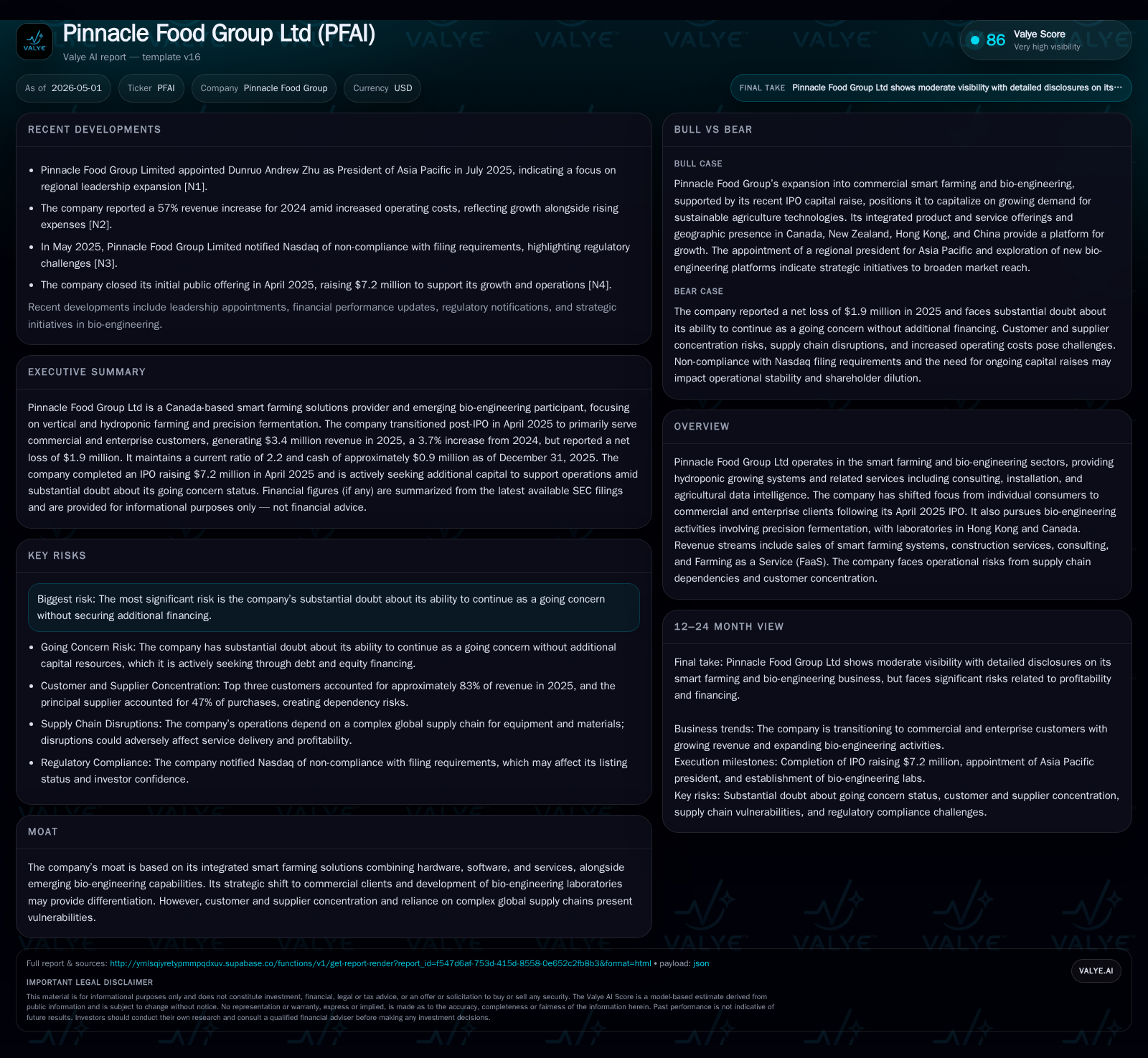
Pinnacle Food Group Ltd has accelerated its transformation from a consumer-based hydroponics supplier to a commercial smart farming solutions provider with emerging bio-engineering capabilities. The company’s latest quarterly disclosures highlight a non-binding MOU to develop an Open Yeast Platform hub, reinforcing its investment in precision fermentation research. While revenue from commercial contracts is expanding, the firm continues to face operating losses and working capital constraints, driven by supply chain complexities and customer concentration. Effective execution of lab construction and financing initiatives will be critical for Pinnacle’s path to sustainable growth.
Recent Operating Update
Pinnacle Food Group Ltd (Ticker: PFAI) disclosed in its April 20, 2026 Form 6-K [S2] that its Hong Kong subsidiary signed a non-binding memorandum of understanding to explore establishing an Open Yeast Platform hub for bio-engineering collaboration. This initiative follows earlier moves including opening a bio-engineering laboratory in Hong Kong in December 2025 with ongoing construction of a second lab in Canada as of April 30, according to the latest annual report [S1].
This development marks a tangible step towards integrating precision fermentation into Pinnacle’s offering beyond its original smart farming products. The company is thus advancing its dual strategy—commercializing hydroponic smart farming systems while building emerging bio-engineering capabilities.
Business Model
Pinnacle Food Group operates primarily in the smart farming sector, supplying hydroponic vertical farming systems complemented by consulting, installation services, agricultural data intelligence software, environmental design expertise, and ongoing technical support [S1]. These solutions package hardware elements such as sensors, growing trays and racks, light panels, water tanks, consumables like seeds and nutrient solutions into community-scale setups under their Farming as a Service (FaaS) framework.
Historically focused on individual households and community groups prior to the company’s April 2025 IPO, management has strategically pivoted towards commercial clients—enterprise businesses needing larger scale installations with integrated maintenance services. This transition has driven rapid revenue growth from commercial accounts while maintaining some consumer presence [S1].
In parallel, Pinnacle is developing biotechnology applications centered on precision fermentation to produce biological proteins by utilizing agricultural feedstocks harvested through its smart farming systems. This requires significant investment in research facilities evidenced by the construction of two bio-engineering labs (Hong Kong operational since late 2025; Canadian facility still in progress as of Q1 2026) [S1]. The recent MOU to develop an Open Yeast Platform supports collaborative innovation in this nascent segment.
Industry Structure and Competitive Position
Smart farming is an evolving industry blending agriculture technology hardware with software solutions enabling controlled-environment crop production. The sector demands integration expertise across sensor tech, data analytics platforms, modular equipment manufacture, consumables logistics, and specialized agronomy services. Pinnacle competes with both established agriculture equipment providers expanding into smart systems as well as emerging AgTech startups.
Within this context, Pinnacle’s moat stems from integrating hardware-software-service vertically combined with entry into bio-engineering innovations which could open new high-margin revenue streams if successfully commercialized. However, there remain vulnerabilities: approximately half of Pinnacle’s materials procurement is sourced from one supplier (Seonwo), forming nearly half of purchase costs [S1], which exposes the firm to supply disruptions or cost pressures.
Customer concentration also presents risks; the top three clients accounted for about 83% of revenue in 2025 [S1], representing dependency on few commercial contracts. Nonetheless, shifting client mix toward enterprises signals potentially stickier relationships supported by longer contracts and higher switching costs compared with prior household-focused sales.
Growth Drivers
Commercial Client Expansion: The strategic reorientation post-IPO toward selling community-scale equipment combined with planting & maintenance services has fueled revenue growth (2025 smart farming revenue: $3.4 million vs $3.3 million in 2024) [S1]. Capturing market share from commercial farms and urban agriculture projects remains critical.
Bio-Engineering Development: Ongoing investment into precision fermentation labs and platform partnerships aims to diversify revenue bases by producing biologically synthesized food proteins using agriculture-derived feedstocks [S1], with high upside potential if scaled.
Product & Service Ecosystem: Enhancements in agricultural data intelligence applications allow clients to optimize growing conditions remotely, creating value-add differentiation versus competitors relying solely on hardware sales.
Operational Scale & Efficiency: Increasing headcount—leading to higher payroll—and ramping construction activities foreshadow scaling benefits if matched by rising volumes; however margin compression due to cost overruns is a near-term challenge [S8].
Risks / Watchpoints / Growth Constraints
Going Concern Uncertainty: The company reported operational losses ($1.9 million net loss for 2025) and negative operating cash flows [$3.6 million used] [S1,S9]. With cash balances around $0.9 million against current liabilities exceeding $2.4 million at year-end [F1], Pinnacle must secure additional financing imminently to sustain operations without impairing shareholder value.
Supply Chain Dependence: Reliance on a limited set of suppliers controlling major portions of manufacturing inputs risks disruption or cost inflation affecting delivery performance or necessitating more expensive alternatives [S1].
Customer Concentration: High percentage of revenue tied to top three customers elevates vulnerability should contracts be terminated or renegotiated unfavorably [S1]. Greater client diversification is needed.
Margin Pressure: Gross margin fell markedly from 47% in 2024 to around 38% in 2025 due mainly to increased payroll costs and disproportionate rise in construction expenses relative to revenues [S8], compressing profitability during growth investment phase.
Execution Risk: Building the Canadian bioengineering lab remains incomplete months after starting construction; delays could push back commercialization timelines.
Financing Terms: Attempts at raising capital—equity or debt—may result in dilution or onerous financing costs impacting future earnings potential [S1,S7].
What To Watch Next
Completion of Canadian Bio-engineering Facility: Key milestone for validation of bio-protein synthesis initiatives with direct impact on R&D trajectory.
Progress on Open Yeast Platform Development: Outcomes from the recent MOU may indicate collaboration depth and potential ecosystem partnerships accelerating innovation.
Commercial Customer Base Growth & Contract Expansion: Metrics tracking customer count beyond top-three dependence and contract renewal rates will inform stability.
Margin Improvement Initiatives: Evidence of operational leverage via margin expansion through scale economies or cost optimization would signal maturation.
Capital Raise Activity Updates: Timely announcements regarding new funding rounds or credit facilities will clarify liquidity runway.
Financial Profile Snapshot as of December 31, 2025 [F1]
Latest financial snapshot
| Metric | Value | Period |
|---|---|---|
| Cash & equivalents | $942820 | |
| 2025-12-31 | ||
| Total debt | $1021337 | |
| 2025-12-31 | ||
| Net debt | $78517 | |
| 2025-12-31 | ||
| Current assets | $5mm | |
| 2025-12-31 | ||
| Current liabilities | $2mm | |
| 2025-12-31 | ||
| Current ratio | 2.2x | |
| 2025-12-31 |
Source: SEC companyfacts cache [F1].
| Metric | Value (USD) | Period End |
|---|---|---|
| Revenue | $3,413,062 | |
| 2025-12-31 | ||
| Operating Income | -$1,921,945 | |
| 2025-12-31 | ||
| Net Income | -$1,903,908 | |
| 2025-12-31 | ||
| Cash & Equivalents | $942,820 | |
| 2025-12-31 | ||
| Total Debt | $1,021,337 | |
| 2025-12-31 | ||
| Current Assets | $5,321,554 | |
| 2025-12-31 | ||
| Current Liabilities | $2,415,329 | |
| 2025-12-31 | ||
| Current Ratio | ~2.2 | Derived |
| Net Debt (Debt - Cash) | ~$78K | Derived |
The financials reflect early-stage growth pressure characterized by trailing losses despite expanding top-line revenues post-transition from consumer-focused sales models toward enterprise clients. Significant capital expenditures totalling approximately $2.8 million were invested during the year into property plant equipment and intangible assets related mainly to lab development [S14,S20].
Conclusion
Pinnacle Food Group Ltd presents a dynamic yet challenging profile typical of technology-driven agritech innovators transitioning from early-stage product-market fit toward scalable commercialization across commercial customer segments while simultaneously investing heavily in pioneering bio-engineering fronts. Recent quarterly disclosures reinforce the company’s commitment to integrated smart farming plus biotech platform strategies but also shine light on ongoing financial strain underscoring high execution risk during this pivotal growth phase.
Investors assessing Pinnacle should keenly monitor operational execution milestones particularly expansion of bio-labs alongside customer diversification efforts that can provide steadier recurring revenues balanced against financing adequacy ensuring survival beyond developmental expenditures.
This analysis is based exclusively on regulatory filings and public disclosures as cited without extrapolation or predictive forecasts. It does not constitute investment advice or recommendations.
Disclaimer: This is research-only, informational analysis and not investment advice. It may include AI-generated interpretation and general industry context. Always verify important details using primary sources.

Comments