
Hilton Grand Vacations: Surpassing Q1 with Integrated Sales and Financing Momentum
HGV's Q1 2026 performance highlights strength in its combined VOI sales, financing execution, and resort operations amid sustained liquidity.
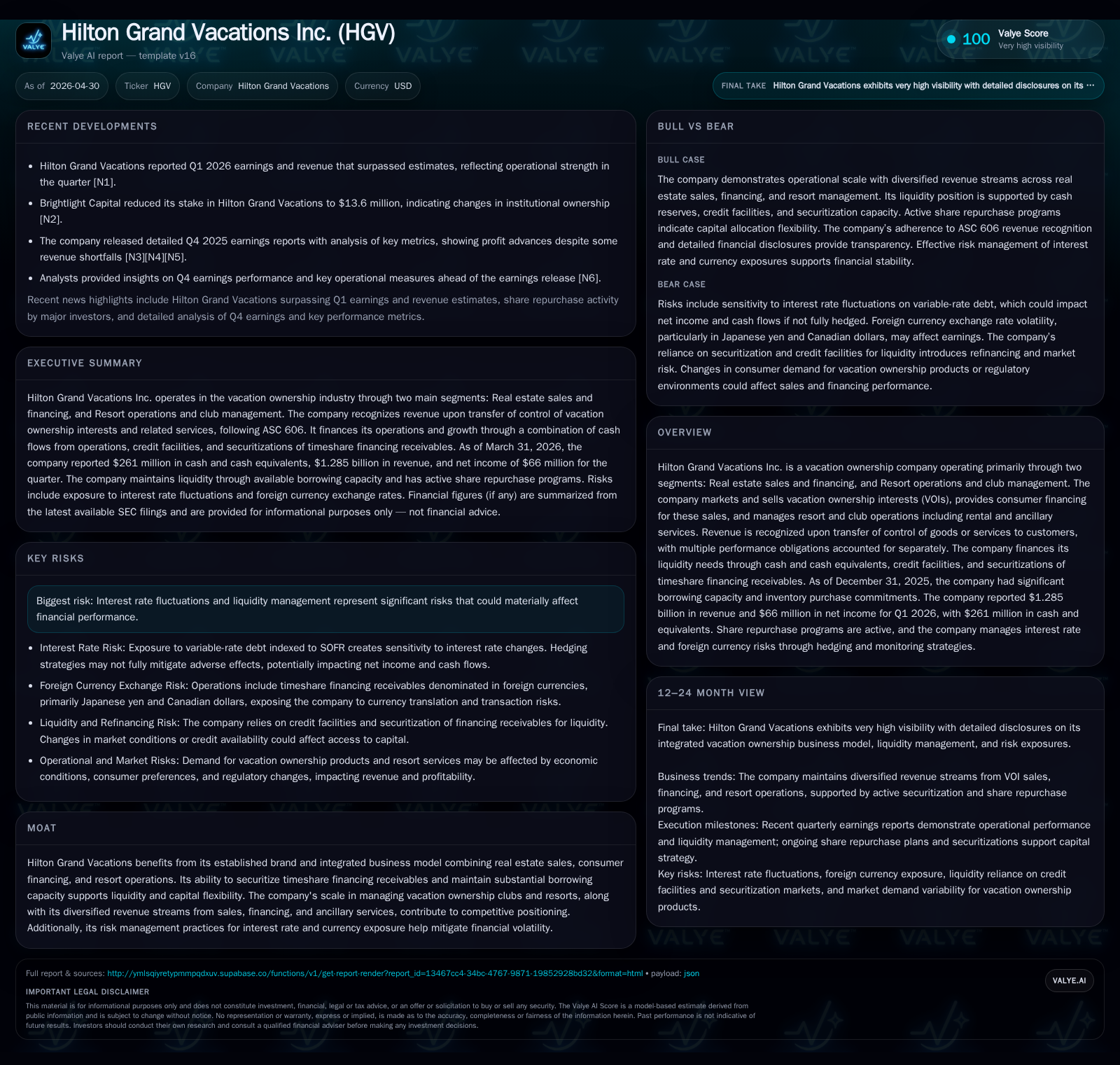
Hilton Grand Vacations (HGV) reported robust Q1 2026 results with $1.285 billion in revenue and $66 million in net income, supported by its integrated business model combining vacation ownership sales, consumer financing, and resort management. The company’s ability to securitize timeshare financing receivables and maintain substantial borrowing capacity underpins liquidity and growth prospects. HGV benefits from strong brand recognition and recurring fee streams from club memberships and ancillary services, positioning it well amidst a market sensitive to interest rate fluctuations and credit availability. Key near-term indicators include VOI sales volume, financing trends, and inventory pipeline execution.
Reported revenue reached $1.285 billion with net income of $66 million, notably surpassing market estimates as captured by recent news coverage [N1], signaling robust operating execution. Cash and cash equivalents stood at approximately $261 million at quarter-end providing a liquidity buffer in combination with substantial undrawn revolver capacity.[F1] This performance underlines effective working capital management across its integrated segments amid macroeconomic headwinds.
The ability to generate solid top-line while controlling costs contributed to improved margins supported by a steady flow of VOI sales paired with consistent consumer loan originations. Concurrently, the company preserved access to $809 million in revolving credit facility capacity alongside a further $235 million under its Timeshare Facility illustrating prudent financial stewardship that mitigates short- to medium-term liquidity risks.[S4] These factors collectively underpin the firm’s capital structure resilience despite high gross debt levels.
Business Model Overview: Integrated Real Estate Sales, Financing, and Resort Management
Hilton Grand Vacations operates primarily through two synergistic segments—Real Estate Sales & Financing and Resort Operations & Club Management—each driving distinct yet interrelated revenue streams.[S1] The first segment revolves around marketing and selling vacation ownership interests (VOIs), which represents fractional ownership in vacation properties held under HGV’s portfolio or sourced from third-party developers via fee-for-service agreements. Critical here is the provision of consumer financing; HGV originates loans tailored for VOI purchases earning interest income plus servicing fees on both internally originated loans and those belonging to third parties.[S6]
On the resort side, HGV manages an extensive network of clubs delivering activation fees upon customer entry plus annual dues generating stable recurring revenue.[S21] The segment also generates rental income from unsold inventory units or those freed via exchange programs alongside ancillary offerings such as food & beverage outlets, spa services, retail shops—all enhancing customer engagement while further diversifying revenue sources.
Revenue recognition follows ASC Topic 606 ensuring each performance obligation (e.g., unit sale versus financing service) is accounted for separately upon transfer of control.[S10] This accounting acuity helps clearly segment revenues reflecting true economic delivery rather than bundled cash flows. The integrated nature of owning the product sale through ongoing club membership management fosters pricing power via higher switching costs; customers embedded into club networks receive tangible benefits incentivizing retention.
Competitive Landscape and Industry Structure for Vacation Ownership
Vacation ownership is a niche yet capital-intensive industry requiring control over inventory—the actual VOIs—and strong brand prestige to cultivate customer trust due to significant upfront financial commitments by buyers. Hilton’s association with its globally recognized hotel brand provides meaningful differentiation relative to independent or regional competitors who lack such an established hospitality ecosystem.[S1]
The business depends heavily on regulatory compliance across states where VOI sales occur; surety bonds amounting to hundreds of millions provide mandatory escrow coverage assuring authorities of project completion or buyer protections.[S16] Access to these bonding capacities depends on insurer financial strength alongside HGV’s corporate credit profile.
Pricing dynamics face pressure from consumer credit conditions influenced by fluctuating interest rates that determine affordability of financed purchases. Inventory control enables selectivity in marketing premium units but also requires substantial capital outlay either owned or purchased via developer commitments totaling nearly $226 million through extended horizons.[S4] Seasonality affects resort occupancy patterns though not scope for contractually enforced annual dues yielding stable cash inflows.
Competitors typically vie on product location desirability, flexibility of vacation options within affiliated club systems, and ancillary amenities enriching the user experience. In this regard, Hilton leverages operational scale managing multiple resorts worldwide incorporating Bluegreen acquisition assets coherent within its footprint.[S12]
Growth Drivers: Expansion of VOI Sales, Financing Capabilities, and Club Memberships
Near-term growth vectors center on scaling VOI unit sales through refined marketing programs alongside deepening penetration in existing markets with expansion potential targeted through new resort developments.[S2][N2] The company’s demonstrated ability to originate consumer loans internally backed by timeshare financing receivables securitized periodically infuses liquidity that funds further real estate inventory procurement without excessive equity dilution.[S4]
The securitization program’s sophistication is evidenced by multiple deals completed throughout 2025 totaling over $1 billion enabling repayment of legacy debt portions while preserving capital flexibility supporting organic pipeline development.[S4][S26] Expanding assets under management within their club system drives steady activation fees plus annual dues income creating recurring margin-rich revenue streams relatively insulated from transaction cyclicality.
Ancillary services like rentals during non-peak usage periods or owner exchanges allow better asset utilization optimizing fixed cost absorption enhancing profitability while contributing positively to guest satisfaction metrics aiding long-term retention.[S20]
Management commentary affirms confidence in continued growth fueled by leveraging borrowing facilities prudently while executing marketing initiatives effectively translating into accelerated bookings especially post-pandemic travel normalization scenarios documented throughout early 2026 quarter disclosures.[N2]
Risks and Constraints: Interest Rate Sensitivity and Liquidity Management Challenges
Interest rate volatility emerges as a principal risk factor affecting demand elasticity for financed VOI purchases as rising rates increase customer borrowing costs potentially dampening volume or elevating credit losses on outstanding loan portfolios.[S2][S5] The company employs interest rate swaps fixing portions of SOFR-based floating debt reducing volatility but residual exposure remains tied to macroeconomic movements impacting installment loan performance.[S14]
Liquidity constraints warrant close scrutiny given gross indebtedness exceeding $4.5 billion inclusive of senior notes versus cash balances approximating $261 million,[F1] translating into estimated net debt north of $2.7 billion after recent repayments but precluding inclusion of newer refinancings absent current filings.[F1] Maintaining covenant compliance on credit facilities while preserving adequate revolver access remains critical particularly as management balances share repurchase programs with development spending priorities.[S18]
Regulatory risks involving surety bond provider stability may influence future bonding costs or availability required for new VOI project launches which could defer rollout timelines or increase capital requirements posing temporary headwinds.[S16] Economic downturns threatening discretionary travel budgets could disproportionately affect timeshare unit conversions limiting pricing power temporarily.
Upcoming Catalysts: Monitoring Sales Volume, Financing Trends, and New Development Pipeline
Key metrics warranting attention include sequential quarter VOI unit sales figures against backlog levels indicative of market appetite modulation.[S2] Financing origination volumes tied closely to consumer credit environment shifts provide leading signals regarding future revenue visibility particularly relevant given evolving Fed policy stances on interest rates affecting fixed-income consumers.[N2]
Introduction or acquisition of new resort properties incrementally increases inventory base diversifying geographic footprint providing incremental cross-sell opportunities within existing member base critical for durable growth trajectories.[S6] Progression against committed developer purchase obligations illuminates pipeline execution capabilities essential for sustaining medium-term unit supply.
Management will likely update guidance around these operational KPIs during forthcoming earnings releases; the market will assess ability to convert backlog efficiently into closed unit sales balancing cost inflation pressures within marketing or administrative expense lines meanwhile sustaining Adjusted EBITDA generation patterns fundamental for valuation multiples maintained historically.
Financial Snapshot: Supporting Strong Cash Flows and Balanced Capital Structure
HGV’s liquidity profile is bolstered by approximately $261 million in cash equivalents at March 31, 2026 combined with a revolving credit facility possessing $809 million unused capacity—a substantial cushion facilitating empowerment towards opportunistic financing or capital deployment for growth initiatives beyond operating needs.[F1][S4]
Periodic securitizations completed throughout the prior year have allowed deleveraging certain legacy non-recourse debt pieces demonstrating active liability management maintaining compliance across multiple financial covenants embedded within senior note indentures highlighting strategic calibration between leverage optimization versus balance sheet robustness.[S5]
While gross total debt remains elevated at roughly $4.6 billion,[F1] focused repayment strategies coupled with asset-backed financing insulated from corporate bankruptcy risk underpin investor confidence regarding sustainable debt servicing capacity even amid episodic credit market tightening.
Disclaimer: This analysis is provided solely for informational purposes based on publicly filed SEC data and recent news reports. It does not constitute investment advice nor endorsement of any securities or trading strategies.
Disclaimer: This is research-only, informational analysis and not investment advice. It may include AI-generated interpretation and general industry context. Always verify important details using primary sources.

Comments