
MONROE CAPITAL’s Merger Reshapes Strategy and Market Position
The completion of MONROE CAPITAL’s merger with Horizon Technology Finance and asset sale marked a fundamental shift in its operating model and market role.
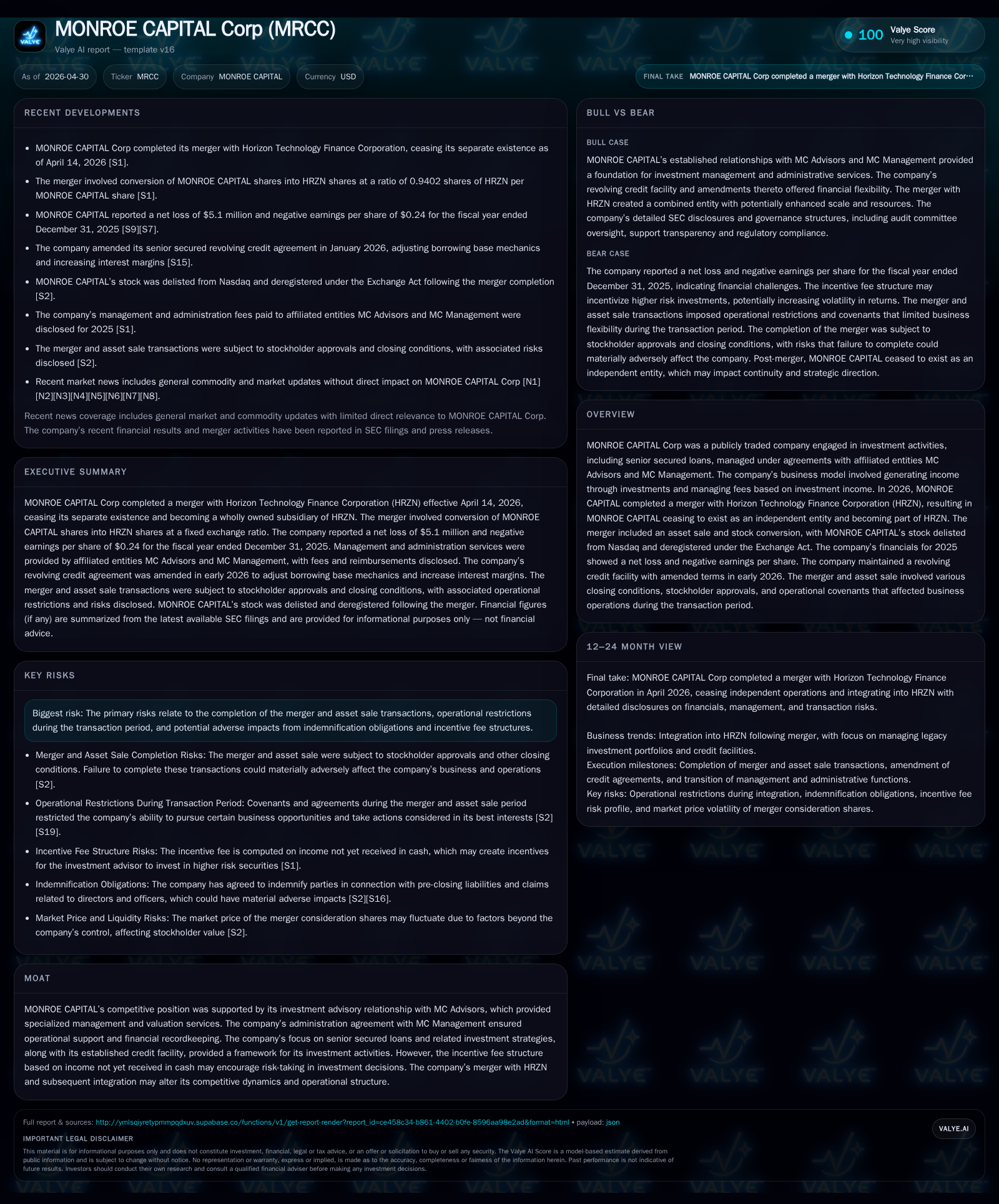
On April 14, 2026, MONROE CAPITAL Corporation completed the sale of its investment assets to Monroe Capital Income Plus Corporation (MCIP) followed by a merger into Horizon Technology Finance Corporation (HRZN), ending its independent existence. This transaction involved stock conversion for existing MRCC shareholders and the termination of key advisory and administrative agreements, effectively folding MONROE CAPITAL’s operations into HRZN. The transition reshapes MONROE CAPITAL’s business from a standalone investment company focused on senior secured loans to part of a larger entity with combined management and portfolio strategies.
Latest Operating Update: Merger Completion and Asset Sale
MONROE CAPITAL Corporation effectuated a major corporate restructuring on April 14, 2026, completing an asset sale followed immediately by a statutory merger into Horizon Technology Finance Corporation (HRZN). The asset sale transferred essentially all investment assets to Monroe Capital Income Plus Corporation (MCIP) for roughly $335.3 million fair value consideration, which was used partly to repay MONROE CAPITAL’s senior secured revolving credit facility in full [S3][S5][S26].
Following asset disposition, MRCC merged first with Merger Sub (a wholly owned HRZN subsidiary) and then immediately consolidated into HRZN itself, terminating its separate legal existence. Nasdaq delisted MRCC common stock concurrently with filings effecting deregistration under Securities Exchange Act provisions. MRCC shareholders received approximately 0.9402 shares of HRZN common stock per MRCC share held prior to the merger plus cash for fractional shares [S6][S7].
The consummation terminated critical operating contracts: the March 31, 2025 investment advisory agreement with Monroe Capital BDC Advisors LLC ("MC Advisors") and the administration agreement with Monroe Capital Management Advisors LLC ("MC Management") ceased concurrently [S5]. This marks a full operational handover to HRZN’s management structure.
Business Model Overview: Investment Strategies and Advisory Structure
Before the transaction, MONROE CAPITAL operated as an externally managed business development company specializing primarily in senior secured loans—a sub-sector defined by lending to middle-market companies often secured by tangible assets. Revenue was largely generated through interest income on loan portfolios complemented by fees paid to MC Advisors for investment advisory services. These included base management fees plus incentive fees calculated on income measures that may not have been realized in cash yet, a structure that potentially encouraged riskier lending practices aligned with valuing unrealized gains [S1].
MC Management provided essential back-office functions such as bookkeeping, recordkeeping, financial reporting, and facilities support under an administration agreement reimbursed by MONROE CAPITAL. This symbiotic trio—MONROE CAPITAL as the capital vehicle, MC Advisors managing investments, and MC Management administering day-to-day operations—created interdependent relationships with embedded switching costs.
Additionally, valuation processes were controlled through MC Advisors acting as valuation designees under SEC Rule 2a-5 since September 2022, which could pose conflicts of interest given their role both advising investments and conducting portfolio valuations [S1].
Industry Context and Competitive Positioning
MONROE CAPITAL competed within the specialized niche of business development companies regulated under the Investment Company Act of 1940. Its focus on senior secured loans is part of a broader middle-market lending ecosystem where BDCs provide alternative financing often underserved by traditional banks.
Regulatory compliance—including maintenance under rule 17a-8 safe harbors—and adherence to credit facility covenants played significant roles in limiting excessive leverage or concentrations that might jeopardize liquidity or net asset value stability. The facility backed by substantial portfolio assets constrained capital structure flexibility but provided steady capacity for debt origination until repayment at merger closing [S4].
Affiliations with MC Advisors/MC Management offered operational continuity but also complicated independence narratives relevant to investor perception amid heightened scrutiny around potential incentive misalignments.
Post-merger integration implies competitive recalibration as combined assets may increase scale advantages but dilute MONROE CAPITAL’s distinct brand identity given relinquishment of its name rights beyond licensing restrictions tied to the advisory relationship [S1],[S7].
Growth Drivers: Integration Benefits and Investment Opportunities
From a growth perspective, merging with HRZN offers potential benefits primarily centered on scale economies—in particular reducing overlapping administrative expenses while leveraging a broadened investment portfolio across complementary middle-market sectors. Combined advisory teams may enhance deal sourcing efficiency and credit selection prudence through shared market intelligence.
Prior losses reported by MONROE CAPITAL suggest improvement opportunities leveraging synergy effects post-merger as standalone operational costs are eliminated or reduced significantly. The issuance ratio of HRZN shares received may serve as an intermediate gauge for expansion potential assuming underlying asset quality stabilizes or improves after consolidation [S3][S7].
This strategic reorientation could align better with evolving market demands for diversified credit exposure among institutional investors who favor scale and liquidity over fragmented smaller vehicles.
Risks and Growth Constraints Post-Merger
Key risks persist despite expected integration gains. Market price fluctuations in HRZN common stock directly impact the realized value of merger consideration for former MRCC shareholders—a source of uncertainty mitigated only upon final settlement. This volatility could influence investor sentiment after completion affecting liquidity conditions [S2].
Indemnification clauses embedded within transaction documents impose continuing obligations potentially restricting cash deployment flexibility or burdening balance sheet metrics if contingent liabilities arise post-close. Additionally, conflict-inducing incentive fee arrangements pre-close may have motivated risk-taking behavior in portfolio selections that bear watching during integration [S1][S7].
Governance shifts replacing all prior directors/officers could affect corporate culture or strategic continuity during early merging phases.[S5][S6]
Upcoming Milestones and Market Watchpoints
Investors should monitor regulatory filings related to formal deregistration under Form 15 and ongoing communication from HRZN regarding merged portfolio performance metrics. Key governance milestones including final board appointments under new bylaws implemented at merger effective time may indicate stability or emerging risks.
Market reaction to HRZN’s quarterly earnings reports will be especially informative given their cascading effect on legacy MRCC shareholder realizations via exchanged stocks. Clarity around integration execution plans remains crucial over coming quarters.[N1][S6]
Financial Snapshot: Leverage, Liquidity, and Profitability
Latest financial snapshot
| Metric | Value | Period |
|---|---|---|
| Cash & equivalents | $1925000 | |
| 2025-12-31 | ||
| Total debt | $192mm | |
| 2025-12-31 | ||
| Net debt | $190mm | |
| 2025-12-31 |
Source: SEC companyfacts cache [F1].
| Metric | Value |
|---|---|
| Net Income | -$5.12 million |
| Cash & Equivalents | $1.93 million |
| Total Debt | $192 million |
As of December 31, 2025—the last available reporting date before the asset sale—MONROE CAPITAL reported net losses nearing $5.12 million reflecting pressures from market conditions or operational inefficiencies predating consolidation [F1]. Cash reserves were comparatively light at approximately $1.93 million against total debt near $192 million indicating high leverage levels typical for BDCs reliant on external financing for loan origination capacity [F1].
Credit facility amendments introduced early in 2026 established tighter borrowing base mechanics applicable during a designated "Borrowing Base Flex Period," enhancing lender protections but increasing pressure on capital management prior to payoff at closing [S4][S18].
The full repayment of this facility at merger close signals a reset point paving way for HRZN's consolidated balance sheet management but underscores the tight liquidity scenario faced independently by MONROE CAPITAL pre-merger.
Disclaimer: This analysis is based solely on publicly available SEC filings and does not constitute investment advice or recommendations regarding securities mentioned herein.
Disclaimer: This is research-only, informational analysis and not investment advice. It may include AI-generated interpretation and general industry context. Always verify important details using primary sources.

Comments