
Medicus Pharma Expands Equity Offering to Accelerate Clinical Development
The company upsizes its ATM equity program to $50 million, strengthening financial resources for advancing its clinical-stage pipeline.
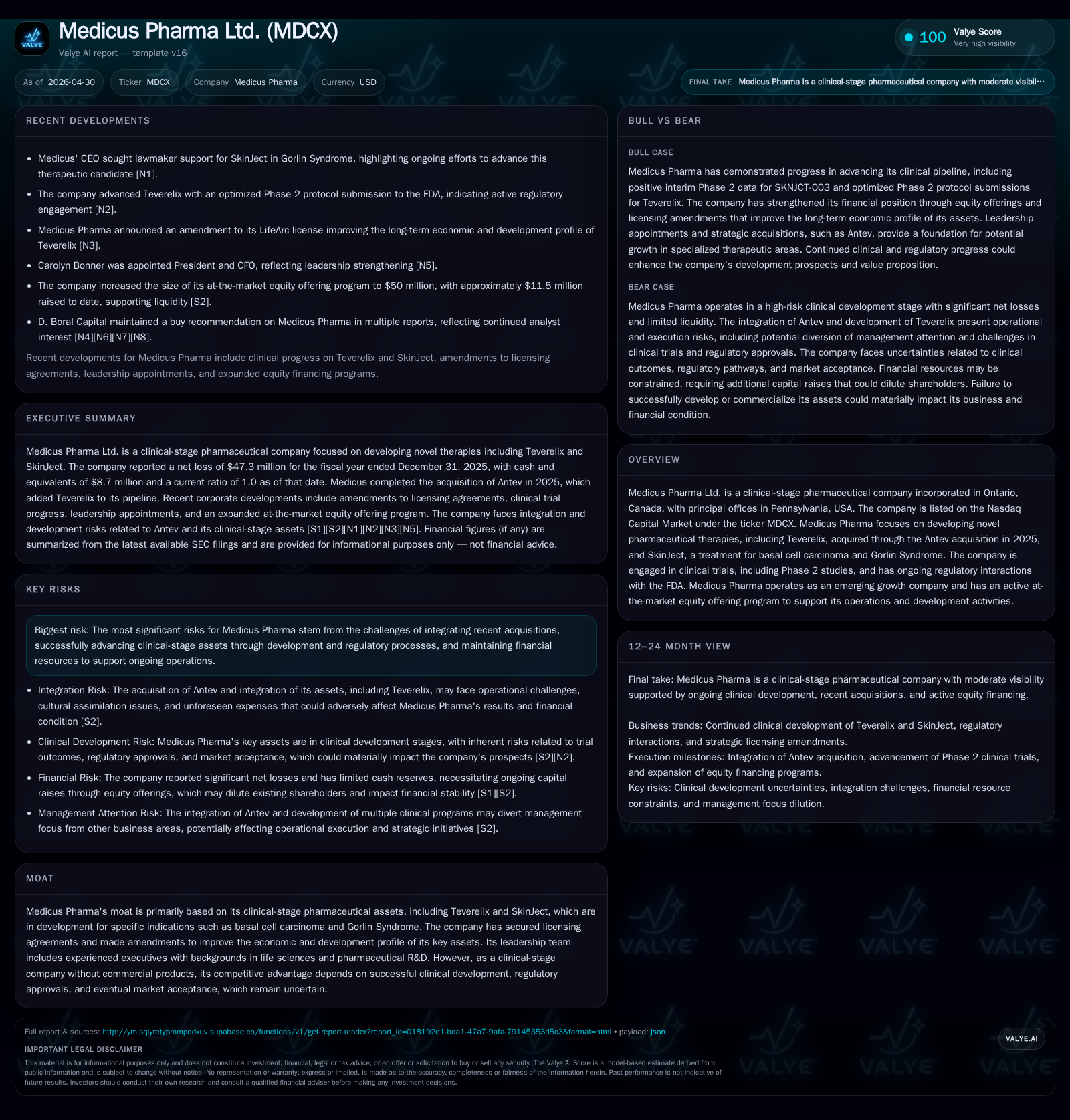
Medicus Pharma recently amended its at-the-market equity offering agreement to increase the aggregate offering amount from approximately $15.3 million to $50 million, providing enhanced capital flexibility for ongoing clinical development. This expansion comes amid continued regulatory progress in its pipeline assets Teverelix and SkinJect, as well as challenges integrating the recent Antev acquisition. The company’s business model remains focused on progressing these clinical-stage assets through FDA interactions toward commercial viability in niche therapeutic areas. Key risks include integration complexity and sustaining operational funding. Investors should monitor upcoming regulatory feedback and trial milestones alongside equity raise deployment.
Recent Capital Raise Amendment Signals Increased Funding Capacity
On April 23, 2026, Medicus Pharma Ltd. executed Amendment No. 1 to its existing Equity Distribution Agreement with Maxim Group LLC and Yorkville Securities LLC, increasing the aggregate capacity of its at-the-market (ATM) equity offering program from roughly $15.3 million to $50 million [S3]. This significant upsizing concretely enhances the company's ability to raise capital over time by enabling sales of common shares at prevailing market prices through authorized agents without needing separate public offerings.
This move is critical as Medicus operates as a clinical-stage pharmaceutical entity with no commercial product revenues to fund costly ongoing research and development activities. The increased ATM size directly addresses anticipated funding needs associated with accelerating clinical trials and regulatory submissions for its lead candidates including Teverelix and SkinJect. By raising this threshold early in Q2 2026, management signals an intent to preempt liquidity constraints that commonly challenge emerging biotech firms operating in capital-intensive development phases.
As of this filing date, the company had already generated approximately $11.5 million through ATM sales under the previous facility [S3], indicating investor receptivity but also substantial capital demand beyond initial plans. This expanded funding framework reduces refinancing uncertainty near term while retaining flexible dilution management since share issuance volume aligns with ongoing operational cash flow requirements.
Business Model and Product Pipeline Overview
Medicus Pharma Ltd. functions as a clinical-stage biotechnology company focused on developing novel pharmaceutical therapies targeting niche rare diseases and oncological dermatology indications [S1],[N2]. Its core revenue-generating mechanisms remain prospective; medicinal products have not yet reached commercialization nor generated sales revenue.
The firm's principal assets consist of:
- Teverelix: inherited through the acquisition of Antev Incorporated completed in August 2025 [S2], this drug candidate is currently under optimized Phase 2 trial evaluation targeting specific indications with increased protocol efficiency aimed at FDA licensure pathways [N2].
- SkinJect: an investigational therapy aimed at basal cell carcinoma and Gorlin Syndrome—both underserved conditions characterized by complex dermatological oncology profiles—currently undergoing clinical development supported by active advocacy efforts [N1].
Medicus’ business model revolves around advancing these candidates through clinical validation toward regulatory approvals that could enable licensing agreements or eventual direct commercialization. Future revenues would predominantly derive from milestone payments under out-licensing deals or sales if Medicus establishes a go-to-market infrastructure post-approval.
This structure presents inherent strengths in focusing on orphan indications which benefit from regulatory exclusivities and pricing power due to limited competition. However, it combines with traditional biotech developmental risks including probability of success hurdles during Phase 2/3 stages and dependency on sustained R&D investment.
Competitive Environment and Industry Positioning
Within the broader biopharma landscape targeting rare dermatology oncology conditions, Medicus occupies a specialized vertical intersecting orphan drug spaces [S1],[N1]. Basal cell carcinoma treatments are available but often lack innovation tailored for severe forms or syndromic manifestations like Gorlin Syndrome where unmet needs persist.
Competitors range from small specialty firms developing combination therapies or next-generation topical agents to larger companies pursuing broader oncology portfolios overlapping skin cancer treatments. Given the small patient populations characteristic of orphan segments (<200k US patients generally), Medicus can leverage FDA orphan drug designations potentially conferring expedited development timelines, enhanced reimbursement frameworks, and longer market exclusivity periods.
However, constraints exist including recruitment challenges for trials due to low prevalence patient pools which may elongate study durations; supply chain complexities inherent in biopharma manufacturing scale-up; evolving payer landscapes demanding robust health economics justification; and potential technological disruptions if emerging gene-editing or immunotherapy approaches gain traction within these niches.
Pricing power appears durable structurally yet depends critically on demonstrated efficacy/safety differentiation versus incumbent standards of care. Regulatory pathways involve intricate FDA interactions that mandate meticulous protocol submission strategies - an area the company actively refines as evidenced by recent Teverelix Phase 2 optimization efforts [N2].
Growth Catalysts Driving Upstream Value Creation
The principal catalysts underpinning Medicus’ growth trajectory include:
- Clinical Trial Advancements: Progression through Phase 2 trials for Teverelix incorporating FDA feedback has potential to de-risk regulatory pathways substantially if interim endpoints are met favorably [N2].
- SkinJect Advocacy & Market Access: Engagements spearheaded by executive leadership aim at raising awareness among legislators regarding Gorlin Syndrome treatment imperatives potentially facilitating accelerated approval scenarios [N1].
- Capital Raising Flexibility: The substantial increase in ATM equity capacity enables sustained funding enabling uninterrupted R&D spending crucial in retaining development momentum [S3].
- Potential Deals & Partnerships: Continued licensing or alliance negotiations could provide validating capital infusions or enhance commercialization prospects depending on progress milestones.
- Regulatory Milestones & Data Readouts: Key events such as protocol amendment acceptance by FDA or positive efficacy/safety signals expected over the coming quarters offer tangible catalysts for valuation recalibration.
These levers feed into actionable KPIs such as enrollment rates in clinical studies, timing of regulatory meetings/submissions, volume of ATM capital deployed versus planned budgets, and partner engagement intensity.
Risks and Operational Challenges Ahead
Despite outlined upside avenues, several risk vectors merit close attention:
- Integration Risks: The Antev acquisition’s operational consolidation remains a significant undertaking involving potential distractions impacting collective focus on both Teverelix advancement and parallel SkinJect development programs [S2],[S27].
- Clinical Development Risks: As typical within biotech R&D pipelines, trial failures or delayed outcomes could severely impair expected timelines or necessitate costly protocol redesigns.
- Financial Sustainability: Persistent operating losses exceeding $34 million annually require resolute capital management; capital raises dilute shareholders yet underpin essential runway [F1].
- Competitive Pressures: Emergence of novel therapeutic modalities or aggressive competitor launches may erode anticipated market share or pricing dynamics.
- Regulatory Uncertainties: Navigating evolving FDA guidance combined with stringent approval conditions may impose unanticipated hurdles delaying commercialization prospects.
These risks impact immediate strategic priorities; failure mitigation will depend on adept execution across scientific validation steps and operational integration pathways.
Key Upcoming Milestones and Investor Watchpoints
Several definable events warrant tracking by interested stakeholders:
- FDA’s response timelines concerning Phase 2 protocol amendments for Teverelix expected imminently post-submission confirmatory stages [N2],[S3].
- Interim data releases delineating efficacy/safety metrics from ongoing trials particularly involving SkinJect within basal cell carcinoma cohorts.
- Updates concerning subscription progress under the expanded ATM facility which influence liquidity projections [S3].
- Regulatory filings reflecting New Warrant inducement agreements showcasing financing instruments shaping shareholder structure [S29].
- Legislative advocacy outcomes pertaining to orphan disease support policies that may indirectly enhance reimbursement frameworks for SkinJect usage [N1].
- Periodic reporting including quarterly filings reflecting operating expense trends relative to capital inflows illuminating burn rate sustainability.[S2,S3]
Attentive monitoring aligned with these milestones affords granularity into both developmental progression and financial resource deployment effectiveness.
Current Financial Position and Liquidity Summary
Latest financial snapshot
| Metric | Value | Period |
|---|---|---|
| Cash & equivalents | $9mm | |
| 2025-12-31 | ||
| Current assets | $10mm | |
| 2025-12-31 | ||
| Current liabilities | $10mm | |
| 2025-12-31 | ||
| Current ratio | 1x | |
| 2025-12-31 |
Source: SEC companyfacts cache [F1].
As per audited results ending December 31, 2025 data compiled in latest annual filing [F1]:
| Metric | Value |
|---|---|
| Cash & Equivalents | $8.7 million |
| Current Assets | $9.9 million |
| Current Liabilities | $10.0 million |
| Current Ratio | 1.0 |
Despite facing a net operating loss exceeding $34 million annually consistent with clinical-stage biotech dynamics [F1], Medicus sustains near-term liquidity balanced against liabilities—a status buttressed by recent capital activities including drawdown under standby purchase agreements detailed through late Q1/early Q2 2026 event disclosures [S3,S26]. The enlarged $50 million ATM program further extends financial flexibility essential for continuous pipeline investment while managing capitalization dilution judiciously.
This analysis incorporates publicly available filings as current through April 30, 2026. It emphasizes forward-looking operational developments anchored primarily in SEC filings supplemented with verifiable news sources focused exclusively on factual description without investment recommendations.
Disclaimer: This is research-only, informational analysis and not investment advice. It may include AI-generated interpretation and general industry context. Always verify important details using primary sources.

Comments