
Central Pacific Financial Advances Capital Return Amid Hawaii Tourism Stability and Loan Portfolio Optimization
CPF's Q1 2026 results highlight steady income growth, strategic share repurchases, and cautious exposure to Hawaii's economic dynamics.
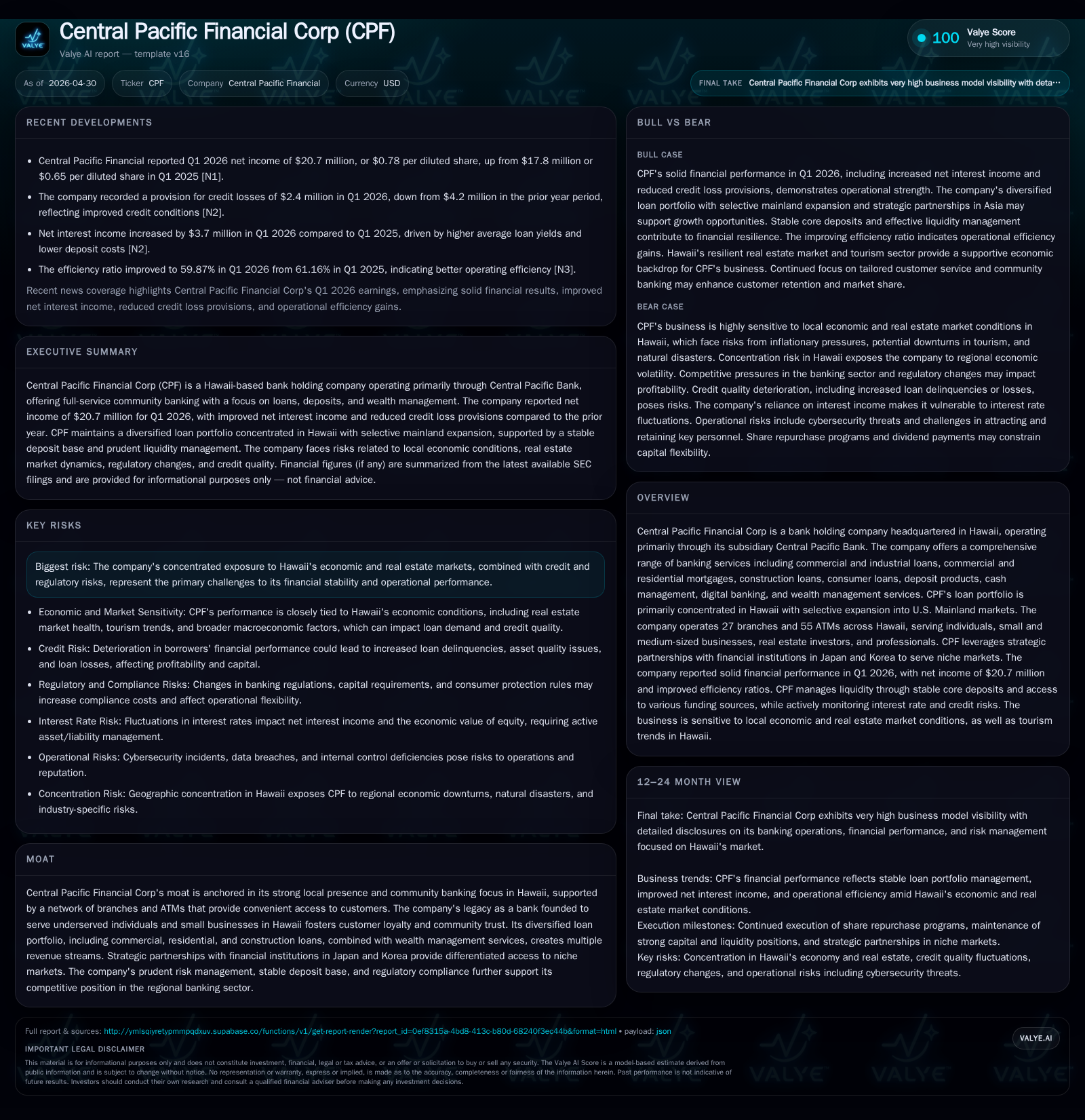
Central Pacific Financial Corp reported solid Q1 2026 financial performance with net income rising to $20.7 million, supported by Hawaii’s stabilizing tourism sector despite minor volume declines. The company’s core business model remains anchored in Hawaii-focused commercial and residential lending complemented by wealth management and deposit services. CPF sustained prudent capital deployment through a refreshed $55 million share repurchase plan. Key challenges include concentrated geographic risk in Hawaii’s real estate markets and sensitivity to macroeconomic and regulatory shifts, while growth catalysts involve selective loan portfolio expansion and digital capability enhancements.
Recent Operating Update
Central Pacific Financial Corp (CPF) reported a compelling start to 2026 with Q1 net income reaching $20.7 million or $0.78 per diluted share, outperforming the prior year period's $17.8 million [S2][S3]. This uptick is underpinned by improving operational efficiency alongside disciplined credit loss provisioning — the provision for credit losses dropped from $4.2 million in Q1 2025 to $2.4 million in Q1 2026, attributable to reductions in loan balances and a more favorable economic outlook.
Key regional economic insights reveal that Hawaii’s tourism industry, critical to CPF's market given its local concentrations, is stabilizing. The University of Hawaii Economic Research Organization forecasts that although visitor arrivals by air will slightly decline by 0.6% to about 9.58 million in 2026 versus prior year levels, visitor spending is expected to grow moderately at approximately 0.7%, reaching $21.3 billion [S2]. This nuanced environment maintains a supportive context for CPF’s commercial loan demand while highlighting ongoing headwinds from international markets such as Japan due to yen depreciation.
CPF continues to exercise proactive capital management through share repurchases; following the Board's authorization of a new $55 million buyback program in January 2026 replacing the prior plan [S4][S14], the company repurchased shares valued at $10.5 million during Q1 alone, with substantial authorization remaining.
Liquidity positioning remains solid with approximately $406.6 million in cash augmented by nearly $2.58 billion in other readily available funding sources at quarter-end March 31, 2026 [S2], ensuring ample capacity for ongoing operations and loan growth initiatives.
Business Model
CPF operates as a bank holding company predominantly focused on serving Hawaii via its wholly-owned subsidiary Central Pacific Bank [S1]. Its core revenue streams derive from interest income on its diversified loan portfolio encompassing commercial & industrial loans, commercial real estate mortgages, residential mortgages including home equity lines, construction loans frequented by real estate investors and developers, consumer loans, plus fee income from deposit services and wealth management offerings.
Customer segments span individuals, small-to-medium enterprises (SMEs), professionals across sectors such as real estate development, and niche international clients especially connected through CPF’s alliances with Japanese and Korean financial institutions — these partnerships foster differentiated access to cross-border capital flows and clientele [N1].
Deposits function as both a funding source and non-interest revenue lever through fees; CPF maintains a network of 27 branches and 55 ATMs statewide facilitating accessibility [S1]. Non-interest income is complemented by wealth management services including investment advisory, trust custody services, annuities sales, and estate planning solutions that broaden CPF’s relationship scope beyond traditional banking products.
Strategically, CPF leverages deep community ties as a legacy lender in Hawaii focusing on underserved segments combined with rigorous credit underwriting measures aligned with regulatory standards overseen by the Federal Reserve Board since early 2025 [S1]. These efforts support asset quality stability evidenced by low nonperforming asset ratios (~0.19% of total assets end-2025).
Industry Structure and Competitive Position
CPF occupies a regional banking niche in Hawaii marked by limited large-scale competition but facing rivalry from both community banks and national players targeting local commercial real estate financing and consumer deposits. The island economy's dependency on tourism creates unique demand patterns distinct from mainland peers.
The company benefits from a moat rooted in its established local presence enhanced through branch footprint density providing customer convenience—this overcomes growing digital banking trends which are gaining prominence but do not fully substitute personalized relationship banking essential in its primary SME segment [S1][N2].
Its bilateral partnerships with Asian financial entities also differentiate CPF within its regional ecosystem by facilitating cross-border customer flows sensitive to foreign exchange rhythms — a factor absent for many mainland banks serving similar-sized markets.
Regulatory scrutiny reflects typical community bank oversight magnified by state chartering nuances plus Federal Reserve membership imposing capital adequacy frameworks under Basel III risk-based requirements [S1][S14]. CPF’s compliance infrastructure aligns with evolving supervisory expectations covering internal controls, credit risk administration, liquidity readiness via multiple funding channels (including FHLB borrowing capacity) [S2][S12].
Growth Drivers
- Tourism-Linked Economic Stability: Visitor spending growth supports demand for commercial lending especially in hospitality-related sectors which feed into CPF’s commercial loan pipelines.
- Selective Geographic Diversification: While maintaining Hawaiian concentration, measured U.S. mainland market expansion cushions localized economic shocks.
- Deposit Base Expansion & Fee Income: Cross-selling digital banking solutions alongside traditional deposit accounts broadens fee revenue channels amid competitive pressures.
- Wealth Management Initiatives: Growing affluence in Hawaii fuels uptake of investment advisory and trust services enhancing non-interest income diversification.
- Capital Return Strategy: An aggressive share repurchase plan preserves shareholder value signaling strong free cash flow generation capacity.
- Risk Management Excellence: Maintained sound asset quality supports sustainable earnings even if macroeconomic challenges arise.
These drivers converge toward KPIs such as loan originations volume, deposit growth rates (especially core deposits), net interest margin resilience amid rate variability assessed through EVE analyses mentioned in filings [S2], share repurchase volume/costs executed [S14], non-performing asset ratios trending upward or downward based on borrower performance [S1], plus regulatory capital ratios compliance ensuring strategic flexibility.
Risks / Watchpoints / Growth Constraints
CPF faces intrinsic risks stemming from:
- Concentration Risk: Heavy exposure to Hawaii's economic cycles particularly real estate markets amplifies vulnerability during downturns or natural disaster events uncommon elsewhere but consequential locally (e.g., volcanic activity).
- Credit Quality Pressures: Potential deterioration in borrower repayment capacity could raise loan loss provisions impacting profitability despite current low NPL figures.
- Foreign Exchange Sensitivities: Yen weakness imposes challenges on niche Japanese client flows despite improving tourism volumes from that market segment [S2].
- Regulatory Environment: Compliance costs rising from evolving Basel III amendments or Consumer Financial Protection Bureau directives affect operating expense structures.
- Uninsured Deposit Concentration: Approximately 42% of total deposits lack FDIC insurance coverage as of Q1 2026 posing liquidity run-off risks if confidence weakens abruptly [S2].
- Competitive Advances: Rising digital-only banks or fintech entrants might erode brick-and-mortar revenue streams without commensurate technology investments.
- Macro-Economic Shocks: U.S./global inflation persistence or geopolitical tensions potentially constrict local economic activity curtailing demand for credit products.
Monitoring these factors relies heavily on forward-looking credit indicators embedded within ACL estimates management reports quarterly [S16], deposit retention metrics including uninsured portion volatility [S2], regulatory guidance developments affecting dividend/share repurchase policies [S4], and capital adequacy ratio thresholds compliance status periodically disclosed [S14].
What To Watch Next
Investors and analysts should track:
- Loan portfolio composition updates including mainland market penetration details.
- Evolution of Hawaii tourism-related economic indicators notably visitor arrival volume vs spending shifts impacting client repayment capacity.
- Quarterly capital return progress under the new repurchase plan regarding utilization pace relative to authorized limits.
- Regulatory announcements especially from FRB or State of Hawaii banking authorities addressing capital rules or dividend restrictions.
- Key credit metrics changes including allowance for credit losses movement reflecting macroeconomic assumptions orientation [S16].
- Adoption rate gains for digital banking platforms revealing customer channel migration trends impacting operating cost efficiency.
- Deposits mix changes with emphasis on insured/uninsured proportions signaling liquidity risk dynamics.
- Changes to partnership activities linking CPF clients with Japanese/Korean financial institutions indicating cross-border business growth potential.
Financial Profile Summary
CPF’s first quarter maintained robust liquidity featuring $406.6 million cash reserves supplemented by an aggregate of approximately $2.58 billion available funding facilities ensuring broad operational flexibility amidst market uncertainties [S2]. Total shareholders’ equity stood near $594 million as of March 31, 2026 lightly increased due to net income generation offset partially by share repurchases totaling $10.5 million alongside dividends disbursed totaling $7.6 million during the same quarter; book value per share slightly appreciated reflecting retained earnings accumulation net of distributions [S4].
Total debt monitored at approximately $76.5 million does not represent significant leverage given negative net debt positioning achieved through high cash buffers emphasizing conservative financial stewardship [F1][S2]. Capital ratios comfortably meet regulatory minimums under Basel III frameworks endorsing prompt corrective action preparedness if needed [S14].
Overall efficiency gains were noted consistent with management commentary focusing on cost containment alongside quality loan growth underpinning net interest margin sustainability against rate scenario fluctuations measured through EVE analyses described within latest quarterly disclosures [S2].
This analysis integrates information derived strictly from recent SEC filings dated through April 29, 2026 ([S1]-[S21]), supported by complementary news transcripts ([N1]-[N3]) and updated Companyfacts financial data ([F1]). All forward-looking statements within are grounded explicitly upon disclosed facts without speculative forecasts beyond documented guidance or commentary provided by Central Pacific Financial Corp representatives or official regulatory sources.
Disclaimer: This is research-only, informational analysis and not investment advice. It may include AI-generated interpretation and general industry context. Always verify important details using primary sources.

Comments