
MGIC Investment Corp Updates Risk and Growth Strategy in Q1 2026 Filing
MGIC’s Q1 2026 results highlight declining new insurance volumes offset by enhanced reinsurance coverage and capital management amid evolving housing finance dynamics.
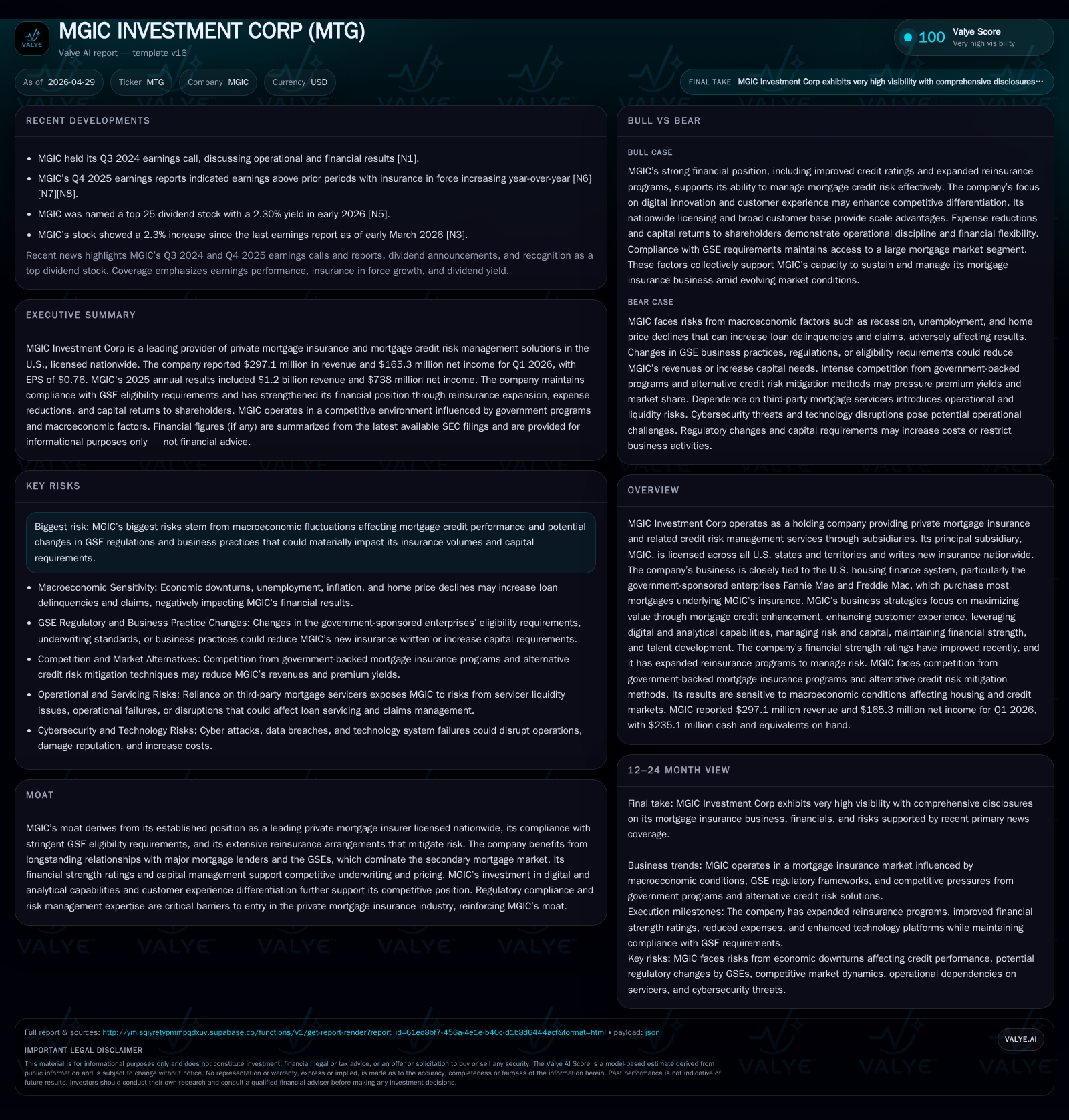
In its latest quarterly filing for Q1 2026, MGIC Investment Corp reported a notable decline in new insurance written, reflecting softness in the U.S. housing market and mortgage originations. The company responded by expanding its reinsurance arrangements to improve risk mitigation and capital efficiency, underpinning its financial strength ratings upgrades achieved in prior periods. MGIC’s business model remains tightly linked to government-sponsored enterprises’ mortgage purchasing practices, with growth drivers resting on regulatory compliance, digital capabilities enhancement, and market recovery. Key risks persist from macroeconomic volatility and potential regulatory shifts affecting mortgage credit availability and insurer eligibility requirements.
Q1 2026 Operational Highlights and Implications
MGIC Investment Corp’s 10-Q filing dated April 29, 2026 outlines a tangible slowdown in new insurance written (NIW) during the first quarter. This trend signals decelerating originations in the low-down-payment mortgage segment—a reflection of broader housing finance headwinds including elevated interest rates and affordability constraints [S2], [S3]. While top-line premiums growth has tapered, MGIC has strategically expanded its reinsurance programs to fortify its risk profile against potential credit losses tied to both existing Risk In Force (RIF) and future insurance issuance. This approach enhances capital efficiency by transferring portions of risk off-balance-sheet while supporting underwriting discipline [S1].
Loss reserves and claims have not exhibited material deviations thus far this year, with seasoned portfolio credit performance stabilizing following historical cycles seen in delinquency trends. Management highlights continued focus on workflow optimization and technology platform upgrades completed in prior years to reduce underwriting expenses even as sales volumes soften [S2]. The overall operating environment remains influenced by government-sponsored enterprise (GSE) purchasing policies which dominate mortgage secondary markets.
Overview of MGIC’s Business Model and Product Offering
MGIC operates as a holding company primarily engaged through subsidiaries that provide private mortgage insurance (PMI) across all U.S. states, D.C., Puerto Rico, and Guam. Its operating subsidiary MGIC holds licenses nationwide enabling it to write new insurance for residential mortgages mainly purchased or securitized by the GSEs—Fannie Mae and Freddie Mac [S1]. This PMI business insures lenders against borrower defaults on low down payment loans that the GSEs require credit enhancement for acquiring.
Revenue streams arise from insurance premiums tied to the volume of underlying insured mortgages (New Insurance Written), which drive Insurance In Force (IIF) balances earning ongoing premium payments under contract terms. Profitability is influenced by claim payments (losses), expense efficiency, premium pricing relative to risk segmentation, investment income on deposited reserves, and reinsurance cost-sharing structures.
Central to MGIC’s model is rigorous adherence to PMIERs — the GSE-mandated eligibility framework demanding minimum capitalization based on asset quality metrics. Compliance ensures MGIC’s continued eligibility to insure mortgages delivered to or purchased by GSEs—a critical revenue channel. Reinsurance contracts extend financial protection by ceding layers of potential losses to counterparties while freeing up regulatory capital that can be redeployed or conserved. Digital tools applied to underwriting improve risk selection precision boosting margin stability amid competitive pressures [S1].
Private Mortgage Insurance Industry Structure and MGIC’s Competitive Position
The private mortgage insurance sector is dominated by a small group of licensed insurers including MGIC that must maintain compliance with strict regulatory standards designed around financial solvency and claims-paying capacity. The industry revolves around facilitating liquidity in the secondary mortgage market through PMI securing loans underwritten with down payments below traditional thresholds.
Market dynamics are governed largely by GSE policies which dictate PMI eligibility requirements influencing volume flows materially. These include capitalization mandates under PMIERs that act as significant entry barriers due to the need for substantial capital reserves. Pricing power is constrained given PMI commoditization; lenders often choose providers insulated from GSE approval risk ensuring seamless loan sales.
MGIC’s competitive moat stems from longstanding relationships with major lenders coupled with upgraded financial strength ratings — Moody’s A2 from A3 previously — lending confidence in claims-paying ability while enabling access to capital at favorable costs [S1]. Its comprehensive national licensing footprint allows broad addressable market reach. Reinsurance diversification further secures downside exposure helping sustain competitive underwriting margins despite cyclical earnings variability.
Switching costs for lenders arise from integration of MGIC’s analytics platforms as well as entrenched operational workflows customized over years of partnership—enhancing retention prospects even as rival offerings compete on price. Regulatory scrutiny also dissuades new entrants given compliance complexity.
Key Drivers of MGIC’s Growth Trajectory
Structural demand drivers remain anchored in the U.S. housing market where a steady supply of low down payment mortgages incentivizes lender use of PMI credit enhancement amid ongoing home affordability challenges [S1],. Even as interest rates temper refinancing activity reducing volumes temporarily, home purchase demand from first-time buyers sustains pipeline opportunities.
MGIC’s digital transformation efforts — including retirement of legacy data systems and creation of advanced underwriting environments — position it for expense leverage gains boosting unit economics when volume normalizes [S1]. Expanded reinsurance transactions extend balance sheet capacity enabling higher risk assumption without commensurate incremental capital deployment [S1].
Additionally, Moody’s rating upgrade combined with S&P's positive outlook creates incremental funding cost advantages allowing more aggressive yet prudent underwriting stances [S1], reinforcing pricing power consistency within regulated limits.
Recovery in New Insurance Written volumes will materially drive premium growth; however management continues favoring risk-adjusted margins over rapid market share expansion in this cyclical context. Execution milestones include scaling analytic capabilities offered directly to lenders enhancing customer experience differentiation [S1].
Risks and Constraints on Future Expansion
The core risks confronting MGIC are predominantly macroeconomic: any downturn manifesting as sustained unemployment rises or real estate price declines could degrade loan performance leading to heightened claims frequency and severity [S7], [S21], [S23]. Elevated home prices relative to incomes threaten affordability constraining new origination demand structurally.
Regulatory uncertainty around GSE reform initiatives poses an additional challenge given their dominant role in the industry ecosystem; alterations to PMIERs or insurer eligibility rules could impose increased capital charges or limit accessible volumes abruptly impacting underwriting profitability [S7]. Ongoing litigation exposure under laws such as RESPA and Fair Credit Reporting Act pose intermittent reputational/legal risk albeit currently managed conservatively [S22], [S24].
Moreover, a slowing refinance market reduces NIW opportunities transiently as refinancing becomes economically unattractive at higher rate levels leading to compressed premium inflows before eventual stabilization.
Analyst Focus: Upcoming Catalysts and Execution Benchmarks
Looking forward through 2026, close monitoring of NIW quarter-over-quarter trajectories will be vital to gauge recovery timing versus housing finance cyclicality amplitudes [N2], [S2]. Progress on further reinsurance expansions announced previously will signal management’s effectiveness at leveraging third-party capital partnerships enhancing loss liquidity buffers.
Regulatory intelligence regarding modifications in FHA/GSE PMI policies or changes to federal housing finance reform legislation remain significant external catalysts potentially reshaping volume flows or reserving standards. Advancement in digital platform rollouts designed for lenders should be assessed via adoption rates directly related to renewal retention metrics.
Underwriting margin targets inclusive of combined ratios below long-run averages amidst current market softness will represent meaningful execution markers validating operational efficiency improvements documented by management [S1,S2]. Expense ratio reductions stemming from process automation also merit attention as supplementary profitability enhancers.
Financial Profile and Capital Management Insights
As of March 31, 2026, MGIC held $235 million in cash and equivalents providing ample liquidity cushion navigating uneven premium inflows stemming from NIW declines [F1]. While no recent public disclosures update debt outstanding explicitly beyond historical levels reported at approximately $837 million (2018 figure), conservative capital posture is evident given strong operating earnings generation capacity documented in prior years ($738 million net income in 2025) supporting dividend payments and selective share repurchases [F1], [S1].
Capital management benefits increasingly accrue from improved financial strength ratings upgrading borrowing cost profiles fostering structural competitiveness alongside low gearing typical of insurers mandated under state regulations. Dividend policies have shown resilience with gradual increases evidencing confidence in free cash flow stability subject to regulatory consent particularly at the holding company level where most cash accumulates before intercompany distributions occur [S28].
Overall, the company balances prudent risk retention with reinsurance sophistication maintaining efficient use of equity capital — a vital requisite given expected volatility inherent in mortgage credit cycle exposures.
Disclaimer: This analysis is based exclusively on publicly available filings and reported data without inclusion of non-public information or forward-looking investment advice. It reflects an objective assessment grounded in current disclosures as of April 29, 2026 but does not constitute a recommendation concerning purchase or sale of securities.
Disclaimer: This is research-only, informational analysis and not investment advice. It may include AI-generated interpretation and general industry context. Always verify important details using primary sources.

Comments