
Brixmor Property Group Inc. Strengthens Leasing and Portfolio Value Amid Stable Operating Trends
Brixmor's Q1 2026 results reflect resilient leasing activity and strategic reinvestments driving growth in its grocery-anchored retail portfolio.
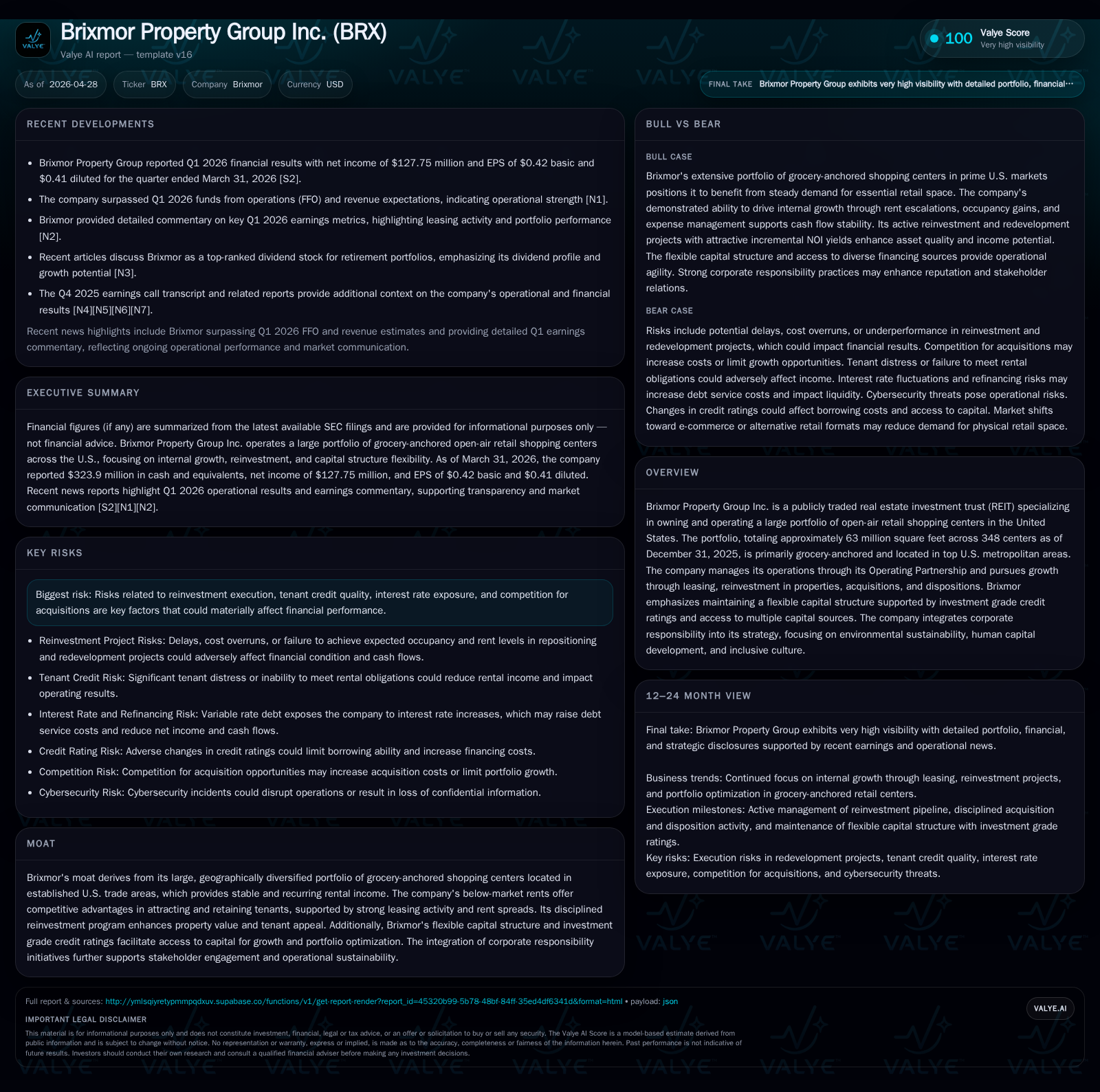
In its latest quarterly filing, Brixmor Property Group Inc. reported strong leasing momentum and sustained occupancy in its U.S. grocery-anchored shopping centers, underscoring the durability of its business model. The company focuses on value-enhancing reinvestment projects and selective acquisitions to optimize its portfolio, with a capital structure designed for flexibility and growth. While macroeconomic risks related to inflation, interest rates, and tenant credit remain, Brixmor’s scale and diversified tenant base provide a competitive moat in the open-air retail segment.
Recent Operating Update
Brixmor Property Group Inc. released its quarterly results for Q1 2026 on April 27 [S2], reaffirming its steady operational execution. The company reported leasing performance that exceeded internal forecasts with significant positive rent spreads on new leases—a key indicator of income growth potential for its shopping centers [N1], [N2]. Occupancy levels remain strong with total portfolio leased occupancy at 95.1% as of year-end 2025, sustained into the new quarter by consistent tenant retention and new lease signings [S1], [S15]. These results underscore resilience in Brixmor's grocery-anchored open-air retail properties despite mixed macroeconomic signals such as inflationary pressures and elevated interest rates.
Furthermore, Brixmor continues to actively pursue value-enhancing reinvestments by repositioning underperforming assets and expanding tenant mix with best-in-class retailers [S1], extending positive net operating income yields of approximately 10% on recently completed projects. The company reported a healthy pipeline of redevelopment initiatives slated to support future cash flow growth.
The broader operating environment remains cautiously favorable, though risks related to refinancing costs due to variable interest exposure are noted [S13]. However, Brixmor’s flexible capital structure—including a $1.25 billion revolving credit facility and staggered debt maturities—provides ample liquidity to manage near-term obligations and fund ongoing strategic priorities [F1], [S9], [S11].
Business Model
Brixmor operates as a publicly traded REIT specializing in owning and managing an extensive portfolio of open-air retail properties strongly anchored by grocery tenants. The firm's revenue primarily stems from rental income based on long-term leases with national and regional tenants such as The Kroger Co., TJX Companies, Inc., and Burlington Stores [S1], [S16]. This grocery anchoring is crucial given the non-discretionary nature of grocery shopping, which drives stable foot traffic and supports demand from complementary retailers.
A notable feature of Brixmor’s model is its focus on below-market rents across many leases relative to local market rates. This gap provides substantial rent reset opportunities during lease renewals or new leasing activities, contributing to internal growth drivers beyond mere occupancy gains [S25]. The company emphasizes prudent expense management alongside contractual rent escalations embedded in existing leases, reinforcing margin stability.
Brixmor further enhances property attractiveness through selective capital reinvestment programs targeting remerchandising, outparcel development, and anchor space repositioning projects. These initiatives are tenant-driven and aim to upgrade asset quality while fostering long-term NOI expansion [S26]. Acquisitions target complementary assets within existing markets to leverage operational expertise without diluting focus.
The Operating Partnership structure consolidates operations under Brixmor's control ensuring unified management aligned with shareholder interests.[S1]
Industry Structure and Competitive Position
Within the broader real estate sector focusing on retail properties, Brixmor occupies an advantageous niche specialized in grocery-anchored community centers—a segment less prone to e-commerce disruptions due to essential consumer needs associated with groceries. Its portfolio size (348 centers totaling approximately 63 million square feet) provides geographic diversification across top U.S. metropolitan areas enhancing market coverage and risk mitigation against localized downturns or sector idiosyncrasies [S1].
Competition arises from other REITs specializing in shopping centers as well as from alternative retail formats including regional malls, outlet centers, lifestyle centers, and online channels. Brixmor competes favorably through its value proposition of well-located assets with high occupancy supported by grocer anchors attracting diverse tenant categories including service providers who benefit from stable foot traffic flows.
Strong leasing velocity driven by rigorous underwriting standards helps maintain credit quality among tenants mitigating default risks common in retail real estate [S24]. Additionally, the company's sustainable business practices reflected in integrated Corporate Responsibility strategies bolster stakeholder relationships supporting reputation and long-term viability [S20].
Growth Drivers and Constraints
Growth for Brixmor hinges substantially on several identifiable levers:
- Lease Renewals With Positive Repricing: The portfolio’s leased occupancy coupled with below-market rents creates a structural tailwind where expiring leases routinely translate into rent increases aligning closer to prevailing market rates.
- Reinvestment Pipeline: Capital allocated toward redevelopment projects generates incremental NOI at attractive yields (circa 10%), directly feeding through earnings growth when stabilized.
- Selective Acquisitions: Opportunistic purchases within core markets intended to amplify scale complement organic growth while optimizing portfolio risk-return dynamics.
- Expense Efficiency: Continuous cost management efforts enhance net operating margins.
Constraints surround cyclical economic pressures influencing discretionary spending patterns impacting some tenants outside essential goods sectors. Inflationary cost increases for redevelopment inputs or elevated interest rates present headwinds that may compress returns or inflate financing costs going forward [S12], [S13]. Moreover, competition for high-quality acquisitions remains intense which could limit accretive deployment opportunities or raise capital costs.
Tenant credit quality monitoring remains pivotal given shifting retail dynamics; retailer insolvencies or bankruptcies—while limited—could impose revenue losses requiring tenant replacement or concessions dampening near-term cash flow.[S24]
What To Watch Next
Important upcoming indicators for monitoring include:
- Lease Expiration Roll-Off & Renewal Rates: Tracking the volume of expiring leases alongside signed but uncommenced lease backlog (~2.7 million sq ft representing $62 million ABR) will indicate visibility on near-term cash flow.
- Execution of Reinvestment Projects: Timely stabilizations of ongoing redevelopment efforts will reveal ability to sustain NOI yield targets amid construction cost fluctuations.
- Debt Maturity Management: Monitoring capital markets conditions surrounding $607 million debt maturities scheduled in 2026 for signs of refinancing cost impact or liquidity constraints.
- Occupancy Trends Post-COVID: Observing any shifts in physical store foot traffic or vacancy levels given evolving consumer preferences toward omni-channel models.
- Macro-Economic Developments: Inflation trajectory, Federal Reserve rate policy changes, and broader consumer confidence will feed into both operational costs and tenant health.
Financial Profile (Brief)
As of March 31, 2026, Brixmor held cash reserves near $324 million against total debt approximating $5.52 billion resulting in net debt exceeding $5.19 billion [F1]. This leverage level reflects the capital intensity typical of large-scale REIT operators but is cushioned by favorable liquidity access including a $1.25 billion revolving credit facility extended through April 2029 [S9], [S11]. Interest expenses might rise due to variable rate loans amounting to $500 million under the Term Loan Facility exposing the company somewhat to rising rates risk absent hedges.[S13]
Operating leverage is moderated by steady rental income enhanced through contractually embedded escalations plus active management of voids via aggressive leasing campaigns documented by recent positive rent spreads reaching nearly 39% on new leases signed during 2025.[S25]
Disclaimer
This analysis is based solely on publicly available information including SEC filings up to April 27, 2026, company disclosures, and selected news sources without any investment advice or recommendation. It aims to provide an informed perspective grounded in domain expertise rather than trading guidance or valuation assessments.
Disclaimer: This is research-only, informational analysis and not investment advice. It may include AI-generated interpretation and general industry context. Always verify important details using primary sources.

Comments